Introduction
A hot chamber die casting mold is often misunderstood because the term combines two different things: the mold (die) and the hot chamber injection system. The mold is the precision steel tool that forms the part; the hot chamber system is the machine’s melting and injection assembly, with a gooseneck and plunger submerged in molten metal. The mold is designed to work with that system. This article explains what the mold is, how the cycle works, what design features matter, and where the process is best applied. It also corrects common misconceptions, such as the idea that the mold itself contains the furnace or that hot chamber tooling can cast aluminum.
What Is a Hot Chamber Die Casting Mold?
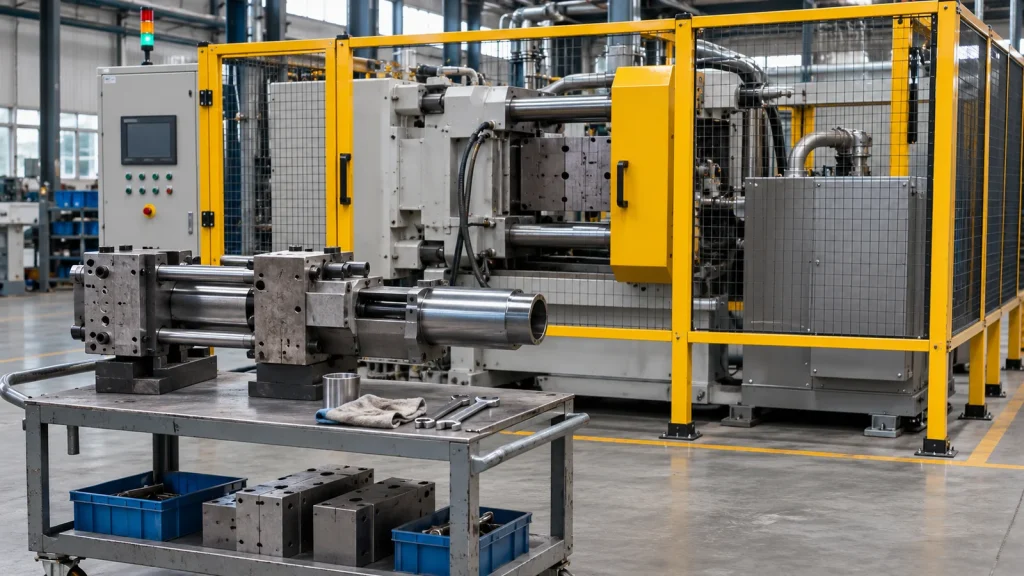
A hot chamber die casting mold, also called a hot chamber die or hot chamber tool, is a reusable, precision-machined steel tool used on a hot chamber die casting machine. It consists of two main halves: the cover die (stationary half) and the ejector die (moving half). When clamped together, they form a closed cavity into which molten metal is injected under high pressure. The mold includes the cavity and core inserts, sprue bushing, runners, gates, overflow wells, vents, cooling channels, ejector pins, slides, and other features. The mold’s job is to shape, cool, and eject the casting repeatedly with high dimensional accuracy.
The ‘hot chamber’ part refers to the machine’s injection system, not to the mold cavity. In a hot chamber machine, the melting furnace (crucible) is integrated with the machine, and the injection mechanism—the gooseneck, plunger, and nozzle—is immersed in or directly connected to the molten metal. The mold is clamped to the machine and receives metal through the nozzle and sprue. So a hot chamber die casting mold is a mold designed for this direct, submerged injection system. It is typically used for low-melting-point alloys such as zinc, magnesium, lead, and tin.
Terminology: ‘die’ and ‘mold’ are often used interchangeably in die casting. Some shops say ‘tool’ or ‘tooling.’ The two halves are also called the fixed half and moving half. The cover die is usually the stationary half; the ejector die is the moving half and carries the ejection system. The mold may include multiple cavities, family tools, inserts, and slides for undercuts.
The Hot Chamber System and the Mold’s Role
To understand the mold, you need to see the whole system. The hot chamber machine has a holding furnace that keeps metal molten. A gooseneck (a curved refractory steel tube) is submerged in the melt. Inside the gooseneck is a plunger driven by a hydraulic or pneumatic cylinder. The gooseneck connects to a nozzle that presses against the sprue bushing of the mold. When the plunger retracts, molten metal enters the gooseneck through a feed port. When the plunger advances, it seals the port and pushes metal through the nozzle into the mold.
The mold’s role is to receive that metal, distribute it through the sprue, runners, and gates, fill the cavity, absorb heat, and eject a solid part. The mold must withstand high pressure and thermal cycling. It must also align precisely with the nozzle and clamping unit. In that sense, the mold is the shaping half of the system; the gooseneck and plunger are the delivery half. The term ‘hot chamber die casting mold’ therefore describes a mold that is compatible with the hot chamber delivery system, not a mold that contains the furnace.
Mold Assembly Components
- Cover die: stationary half, often contains the sprue bushing and aligns with the nozzle.
- Ejector die: moving half, contains ejector pins, return pins, and sometimes the ejection plate.
- Cavity and core inserts: precision-machined shapes that define the part; inserts are replaceable and can be made of premium steels.
- Gating system: sprue, runner, and gate that guide metal from the nozzle to the cavity.
- Overflow and venting: overflow wells capture cold metal and oxides; vents release air and gas.
- Cooling channels: water or oil lines that remove heat and control solidification.
- Ejection system: pins, sleeves, blades, or lifters that push the part out without distortion.
- Slides and lifters: movable components for undercuts, side holes, and complex features.
- Alignment and clamping features: guide pins, bushings, and clamping pockets that keep the halves aligned.
The Injection Unit
- Furnace/crucible: holds molten alloy at casting temperature.
- Gooseneck: curved injection chamber submerged in the melt.
- Plunger: reciprocating piston that draws and injects metal.
- Nozzle: heated outlet that contacts the mold’s sprue bushing.
- Feed port: inlet that opens when the plunger retracts.
The separation is important: the mold does not usually include the gooseneck or plunger. Those are machine components. However, the mold’s sprue bushing, gate design, and thermal layout must be matched to the hot chamber machine’s nozzle, shot capacity, and cycle.
Basic Working Principle: Step by Step
The hot chamber cycle is fast, repetitive, and highly automated. The exact sequence varies by machine, but the core steps are consistent.
1. Clamping and Port Opening
The cover die and ejector die close and are locked by the clamping unit. The clamping force must be high enough to resist the injection pressure and prevent flash. At the same time, the plunger retracts. This uncovers the feed port in the gooseneck, allowing molten metal from the furnace to flow into the injection chamber. The nozzle is pressed against the sprue bushing, and the mold is closed and ready.
2. High-Pressure Injection
The plunger advances. It first seals the feed port, then drives the molten metal through the gooseneck, nozzle, sprue, runners, and gates into the closed cavity. The metal fills the cavity under high pressure and at high speed. The gate design and venting must allow air to escape while the metal fills thin walls and fine details. Injection pressure and plunger velocity are key parameters. Too slow, and the metal may freeze before filling; too fast, and turbulence, gas entrapment, and flash can occur.
3. Solidification Under Pressure
After the cavity fills, the plunger holds pressure (intensification) while the metal solidifies. The mold is water-cooled or oil-cooled, so heat is removed through the die steel. Holding pressure compensates for shrinkage and helps produce dense parts with good surface finish. The goal is to keep the metal pressurized until the gate freezes. The die temperature must be balanced: hot enough to prevent cold shuts and premature freezing, cool enough to solidify the part quickly and maintain cycle time.
4. Mold Opening and Ejection
Once the casting is solid enough, the plunger retracts. The clamping unit opens the ejector die away from the cover die. Ejector pins or sleeves push the casting, including the sprue and runner, out of the mold. The part may be trimmed later to remove the biscuit, runners, and overflows. A light release agent or lubricant may be sprayed onto the cavity surfaces before the next cycle, although many modern hot chamber operations use minimal lubrication and rely on good die design and temperature control.
5. Reset and Repeat
The mold closes again, the plunger retracts to refill the gooseneck, and the cycle repeats. Cycle times can be very short—often a few seconds to tens of seconds, depending on part size, wall thickness, alloy, and cooling. This speed is one of the main economic advantages of hot chamber casting.
Why the Hot Chamber Design Works
The hot chamber principle is elegant: the metal is always molten and ready. There is no ladling step, no open transfer of metal from a separate furnace to a shot chamber, and no waiting for a cold chamber to be filled. The gooseneck is submerged, so the metal is drawn directly into the injection chamber. This reduces oxidation, heat loss, and cycle time. It also allows high shot speeds and thin-wall filling.
The plunger acts as a piston and a valve. When it retracts, the feed port opens; when it advances, the port closes and pressure builds. The gooseneck must be made from a heat-resistant steel that can survive continuous immersion in molten zinc or magnesium. The nozzle must stay hot enough to prevent freezing but not so hot that it damages the sprue bushing. The mold must handle the thermal shock of repeated shots. The whole system is a balance of hot delivery and cold solidification.
A common misconception is that the mold itself is hot. In reality, the mold is cooled. The ‘hot chamber’ refers to the injection system. The mold’s temperature is controlled to optimize solidification. The contrast is between the hot gooseneck and the relatively cooler die.
Thermal Management and Die Design
Thermal management is the heart of hot chamber mold design. The gooseneck and nozzle are continuously hot, while the mold must remove heat from each shot. If the die is too cold, the metal may freeze before the cavity fills, causing cold shuts, flow marks, or short shots. If the die is too hot, the cycle slows, the metal may stick (soldering), and thermal fatigue accelerates. The goal is a balanced die temperature, often maintained with internal water lines, baffles, bubblers, or thermal pins.
Cooling channels should be placed near hot spots, thick sections, and gate areas, but not so close that they cause steep thermal gradients and cracking. The sprue bushing and gate area often need separate cooling. The ejector die and cover die may need different cooling rates. For thin walls, the cavity may need to run hotter to fill; for thick sections, more cooling may be needed to avoid shrinkage porosity. Thermal simulation is often used to predict fill, solidification, and die temperature.
Die steel selection matters. H13 and similar hot-work tool steels are common. Premium grades with higher cleanliness and toughness resist heat checking. Surface treatments such as nitriding, PVD coatings, and polishing can improve wear resistance and release. For magnesium, special steels and protective atmospheres may be needed because magnesium is more reactive. For lead and tin, lower temperatures reduce thermal load, but the alloy can still be aggressive.
Heat checking is a common failure mode: cyclic heating and cooling creates a network of fine cracks on the die surface. It is accelerated by steep thermal gradients, high injection temperatures, and poor cooling. Good design, preheating, and temperature control extend die life. Die maintenance includes polishing, stress relief, and repair of worn gates and cores.
Suitable Alloys and Limitations
Hot chamber die casting is limited to alloys with relatively low melting points and low reactivity with the submerged steel components. The most common alloy is zinc, especially Zamak alloys (Zamak 2, 3, 5, and 7) and ZA alloys. Zinc alloys cast at around 380–420°C, have good fluidity, and produce accurate, smooth parts. Magnesium alloys, such as AZ91, are also cast in hot chamber machines, but they require careful melt protection because molten magnesium can oxidize and burn. Lead and tin alloys are used for specialty parts, but their lower strength and toxicity concerns limit applications.
Aluminum is generally not cast in hot chamber machines. Molten aluminum attacks the steel gooseneck and plunger, causing rapid erosion and contamination. The higher melting point also increases thermal load. For aluminum, brass, and copper alloys, cold chamber die casting is used instead. In cold chamber casting, the metal is melted in a separate furnace and ladled into a shot chamber for each cycle. The mold itself is similar in function, but the injection system is different. This is why the term ‘hot chamber die casting mold’ implies a mold designed for low-melting-point alloys.
Alloy selection affects mold design. Zinc alloys have low shrinkage and good castability, so they can fill thin walls and fine details. Magnesium has higher reactivity and requires different gating and temperature control. Lead and tin are soft and low-melting, but their toxicity requires ventilation and personal protective equipment. The mold’s gating, cooling, and materials must be matched to the alloy.
Advantages and Trade-offs
Hot chamber die casting offers several advantages:
- Fast cycle times: no ladling step; the metal is ready in the gooseneck.
- High productivity: automated, repeatable cycles; suitable for high-volume production.
- Good dimensional accuracy: tight tolerances and smooth surfaces are achievable.
- Thin walls and complex shapes: high fluidity and fast filling allow detailed parts.
- Less oxidation: the metal is enclosed and submerged, reducing exposure to air.
- Lower metal loss: less dross and scrap compared with open ladling.
- Energy efficiency: the integrated furnace and direct injection reduce heat loss.
Trade-offs:
- Limited alloys: only low-melting-point alloys that do not rapidly attack the gooseneck.
- Gooseneck and plunger wear: continuous immersion and high pressure cause erosion and corrosion.
- Maintenance complexity: the injection system is inside the furnace, so maintenance can be more involved.
- Magnesium safety: molten magnesium requires protective gas or flux and careful handling.
- Part size limits: hot chamber machines are generally suited to small and medium parts, not very large castings.
- Die life: thermal fatigue and soldering can limit die life if cooling and coatings are not optimized.
These trade-offs explain why hot chamber and cold chamber processes coexist. Each is suited to different alloys and production requirements.
Hot Chamber vs Cold Chamber Die Casting
| Feature | Hot Chamber | Cold Chamber |
|---|---|---|
| Alloy melting point | Low (zinc, magnesium, lead, tin) | Higher (aluminum, brass, copper) |
| Injection system | Gooseneck and plunger submerged in furnace | Separate shot chamber; metal ladled each cycle |
| Cycle speed | Very fast | Slower due to ladling |
| Oxidation | Lower | Higher |
| Part size | Small to medium | Medium to large |
| Mold wear | Thermal fatigue, soldering | Higher thermal shock, erosion |
| Typical applications | Zinc hardware, electronics, automotive | Aluminum automotive, aerospace, industrial |
The mold itself has similar functions in both processes: it forms the cavity, distributes metal, cools the part, and ejects it. The difference is in how the metal is delivered. A hot chamber mold must be designed for the direct nozzle contact, the sprue bushing, and the thermal profile of the hot chamber machine. A cold chamber mold must handle a ladle shot and often a larger shot chamber. The two are not interchangeable.
Mold Design and Manufacturing Essentials
Designing a hot chamber die casting mold requires a systematic approach:
- Part design review: wall thickness, draft angles, radii, undercuts, and tolerances. Hot chamber zinc parts can have thin walls, but sharp corners and uneven sections should be avoided.
- Cavity layout: number of cavities, family tooling, runner balance, and shot weight. The shot weight must fit the machine’s capacity.
- Gating: sprue, runner, and gate design. The gate should fill the cavity smoothly, avoid jetting, and freeze at the right time. Hot chamber gating often uses a sprue bushing that matches the nozzle.
- Cooling: channel layout, baffles, and thermal simulation. Hot spots and thick sections need more cooling.
- Venting and overflow: air must escape; overflow wells capture cold metal and oxides. Vacuum assist may be used for difficult parts.
- Ejection: ejector pin placement, ejection area, and part ejection. Pins should not leave marks on critical surfaces.
- Materials and heat treatment: H13 or premium hot-work steel; hardening and tempering; surface treatment.
- Alignment and clamping: guide pins, bushings, and clamping pockets. The mold must align with the machine’s platens and nozzle.
- Tryout and optimization: shot parameters, die temperature, gate adjustment, and defect analysis.
Manufacturing includes CNC machining, EDM, wire EDM, grinding, polishing, heat treatment, and assembly. Precision is critical: cavity dimensions, parting line flatness, and alignment affect part quality and flash. Inspection may include CMM, surface roughness, and leak testing for cooling channels. A well-built mold can last hundreds of thousands of shots; with good maintenance, some zinc molds last millions of shots.
Applications and Industry Examples
Hot chamber die casting is used for high-volume, small-to-medium parts with complex shapes and fine details. Common examples include:
- Zinc alloy hardware: door handles, locks, hinges, zipper pulls, buckles, and decorative fittings.
- Electronics: connectors, housings, heat sinks, shielding, and small brackets.
- Automotive: carburetor parts, sensors, small brackets, and interior components.
- Toys and consumer products: model parts, figurines, and mechanical components.
- Industrial: gears, pulleys, pneumatic fittings, and instrument parts.
- Magnesium: power tool housings, laptop cases, camera frames, and automotive components.
- Lead and tin: specialty bearings, weights, and low-melting components.
The process is especially valuable for parts that need thin walls, smooth surfaces, and tight tolerances without extensive machining. Zinc alloys are popular because they cast easily, plate well, and have good mechanical properties. Magnesium is used where weight reduction is important, but its reactivity requires special handling.
Quality Control, Defects, and Troubleshooting
Quality control in hot chamber die casting focuses on dimensional accuracy, surface finish, porosity, and mechanical properties. Common defects include:
- Cold shuts: incomplete fusion where two metal fronts meet. Causes: low melt temperature, low die temperature, slow injection, poor gating. Remedies: increase temperature, adjust gate, increase shot speed.
- Porosity: gas or shrinkage voids. Causes: trapped air, turbulence, inadequate venting, insufficient intensification. Remedies: improve venting, reduce turbulence, increase holding pressure, optimize cooling.
- Flash: excess metal at the parting line. Causes: insufficient clamping force, worn dies, high injection pressure. Remedies: increase clamp force, repair dies, reduce pressure.
- Soldering: metal sticking to the die. Causes: high die temperature, poor release, die surface damage. Remedies: reduce die temperature, improve lubrication, polish or coat the die.
- Heat checking: thermal fatigue cracks. Causes: cyclic thermal stress, steep gradients. Remedies: preheat, improve cooling, use better steel, stress relief.
- Short shots: incomplete filling. Causes: insufficient metal, low pressure, low temperature, blocked gate. Remedies: adjust shot size, pressure, temperature, and venting.
- Warpage: uneven cooling or ejection. Remedies: balance cooling, adjust ejection, review part design.
Process parameters must be monitored: melt temperature, die temperature, injection pressure, plunger velocity, shot size, cycle time, and cooling flow. Statistical process control and automated monitoring help maintain consistency. Die maintenance and lubrication also affect quality. For critical parts, X-ray or CT inspection may be used to detect internal porosity.
Safety, Environmental, and Operational Considerations
Hot chamber die casting involves molten metal, high pressure, and moving machinery. Safety measures include:
- Molten metal PPE: face shields, heat-resistant clothing, gloves, and spats.
- Ventilation: remove fumes and metal oxides, especially for lead and magnesium.
- Magnesium protection: use protective gas (such as SF6/CO2 mixtures) or flux, and control moisture. Magnesium fires require special extinguishing agents.
- Machine guarding: prevent access to the clamping and injection areas.
- Lockout/tagout: during maintenance of the furnace, gooseneck, and mold.
- Housekeeping: keep the floor dry to prevent molten metal explosions.
Environmental considerations include energy use, metal recycling, and emissions. Die casting generates scrap that can be recycled. Lubricants and release agents should be selected to minimize emissions. Water cooling systems should be maintained to prevent leaks. Modern hot chamber machines are highly automated and can reduce operator exposure.
Conclusion
A hot chamber die casting mold is a precision steel tool used on a hot chamber die casting machine to shape low-melting-point alloys into complex, repeatable parts. The mold itself is the cavity tool—cover die, ejector die, gating, cooling, and ejection—while the ‘hot chamber’ refers to the integrated furnace and submerged gooseneck/plunger injection system. The working principle is a fast cycle: clamp the mold, retract the plunger to fill the gooseneck, drive the plunger to inject metal into the closed cavity, hold pressure during solidification, then open and eject the part. The process is fast, accurate, and efficient, but it is limited to alloys such as zinc, magnesium, lead, and tin. Successful hot chamber casting depends on balanced thermal design, proper gating and venting, alloy compatibility, and disciplined maintenance. When applied correctly, it delivers high-volume, high-quality parts with excellent surface finish and dimensional consistency.
FAQ
Is a hot chamber die casting mold the same as the injection unit?
No. The mold is the tool that forms the part; the injection unit—gooseneck, plunger, nozzle, and furnace—is part of the machine. The mold is clamped to the machine and receives metal through the nozzle. The term ‘hot chamber’ describes the machine’s delivery system, not the mold cavity. A hot chamber mold is designed to work with that system, but it does not contain the furnace or gooseneck.
Why can’t aluminum be cast in a hot chamber die casting machine?
Molten aluminum is highly reactive with steel at casting temperatures. It attacks the submerged gooseneck, plunger, and nozzle, causing rapid erosion, contamination, and maintenance problems. The higher melting point also increases thermal load. For aluminum, cold chamber die casting is used, where the metal is melted separately and ladled into a shot chamber for each cycle. This avoids continuous contact between molten aluminum and the injection components.
What cycle times are typical in hot chamber die casting?
Cycle times depend on part size, wall thickness, alloy, and cooling. Small zinc parts can run in a few seconds; larger or thicker parts may take 20–60 seconds. Hot chamber casting is generally faster than cold chamber because there is no ladling step and the metal is always ready. The mold’s cooling design and die temperature control are major factors in cycle time.
What alloys are commonly used with hot chamber die casting molds?
The most common are zinc alloys, especially Zamak 2, 3, 5, and 7, and ZA alloys. Magnesium alloys such as AZ91 are also used, but they require special melt protection. Lead and tin alloys are used for specialty low-melting parts. Aluminum, brass, and copper alloys are generally not suitable because of their higher melting points and reactivity with the injection system.
How long does a hot chamber die casting mold last?
Die life varies widely with alloy, part geometry, die steel, heat treatment, cooling, and maintenance. A well-maintained zinc die can last hundreds of thousands to millions of shots. Magnesium dies may have shorter life due to reactivity and thermal load. Heat checking, soldering, and wear at the gate and cores are common limits. Regular polishing, stress relief, and repair can extend life.
Can hot chamber die casting produce large parts?
Hot chamber machines are generally best for small to medium parts. The shot capacity, clamping force, and gooseneck size limit the maximum shot weight. Very large parts are usually produced by cold chamber die casting, gravity casting, or other processes. Hot chamber casting excels at high-volume, detailed parts with thin walls and tight tolerances.