Introduction: A Small Alloy Family With a Large Industrial Footprint
Zamak is one of the most important families of zinc-based die-casting alloys, yet it is often discussed in vague terms as pot metal or simply as zinc. That description misses the point. Modern Zamak is a tightly controlled engineering material whose chemistry, melting behaviour, and casting characteristics are deliberately balanced for high-volume precision production. It is found in door locks, handles, hinges, gears, brackets, electrical connectors, automotive interior hardware, decorative trim, toy components, model parts, and many small mechanical assemblies that require shape complexity, dimensional accuracy, and a good as-cast surface.
The question of why Zamak is used so heavily in hot-chamber die casting is therefore not a minor process detail. It is the key to understanding the alloy family. Hot-chamber die casting is a fast, automated process in which the injection mechanism is immersed directly in molten metal. That arrangement is only practical when the metal melts at a relatively low temperature, flows easily, solidifies quickly, and does not aggressively dissolve the steel gooseneck, plunger, nozzle, and die components. Zamak meets those conditions unusually well. Aluminium and magnesium do not, at least not in the same economical way, which is why their die casting is normally performed in cold-chamber machines.
This article explains what Zamak is, how its main alloying elements work, which grades are common, and why the material fits hot-chamber die casting so naturally. It also covers design and quality considerations, applications, limitations, and common misconceptions so that the answer is useful not only as a definition but as a practical selection guide.
What Is Zamak? Composition and Metallurgical Logic
The name and the base metal
Zamak is a German-derived acronym from the names of its main alloying elements: Zink, Aluminium, Magnesium, and Kupfer, or zinc, aluminium, magnesium, and copper in English. The family is based on high-purity zinc, typically about 94-96% of the alloy. The word high-purity matters. Zinc die-casting alloys are not simply melted scrap zinc. Impurities such as lead, tin, cadmium, and iron must be kept within strict limits because small amounts of the wrong element can damage castability, surface quality, and long-term durability.
The most familiar compositional pattern is approximately 4% aluminium, a few hundredths of a percent magnesium, and copper ranging from almost zero to about 3% depending on the grade. This is not an arbitrary recipe. It places the alloy near a useful zinc-rich eutectic region, giving a relatively low and narrow melting range, good fluidity, and a microstructure that can solidify quickly in a steel die. The result is a material that can be cast into intricate shapes at high speed and still retain useful strength, stiffness, and dimensional stability.
The role of aluminium
Aluminium is the most important alloying addition after zinc. At roughly 3.5-4.3%, it improves fluidity, strength, and castability. It also helps control the freezing behaviour so that the alloy fills thin sections before it stiffens. Without sufficient aluminium, the alloy would not have the same combination of castability and mechanical properties. Too much aluminium, on the other hand, moves the alloy away from the classic Zamak range and toward the higher-aluminium ZA alloys, which have different processing requirements and are not simply interchangeable with Zamak.
In the solid state, the zinc-rich alloy consists largely of a zinc solid solution with a small amount of eutectic or secondary phases depending on composition and cooling. The exact microstructure is less important to the designer than the consequence: the material can be cast with good detail, reasonable toughness, and predictable behaviour when the chemistry and process are controlled.
The role of magnesium
Magnesium is present only in small amounts, commonly around 0.02-0.06%, but it is metallurgically significant. It helps refine the grain structure and reduces susceptibility to intergranular corrosion. Intergranular corrosion is the insidious failure mode in which corrosion proceeds along grain boundaries, causing a casting to weaken, swell, or crack. In zinc alloys, this problem is closely associated with harmful impurities, especially lead and tin, but magnesium helps the alloy tolerate normal processing and service conditions. The magnesium addition is therefore a small amount with a large quality function.
The role of copper
Copper is the main grade-setting element. It increases strength, hardness, and creep resistance, which is why higher-copper grades are selected for gears, levers, wear parts, and small load-bearing components. The trade-off is that copper reduces ductility and can make the alloy less dimensionally stable over long periods or at elevated temperature. This is why Zamak 3, with very little copper, remains the general-purpose grade, while Zamak 5 and Zamak 2 are chosen when strength or wear resistance matters more than maximum ductility and stability.
Impurity control is part of the definition
A modern Zamak specification is as much about what is excluded as what is included. Lead, tin, and cadmium must be kept very low. If they are not, the alloy can suffer intergranular corrosion, dimensional growth, cracking, and poor surface quality. Iron is also controlled because it can form hard intermetallic particles that affect fluidity, machining, and surface finish. Good foundries therefore use certified ingot, careful melt handling, and regular spectrographic analysis rather than relying on visual appearance or generic scrap identification.
This is one reason the old term pot metal can be misleading. Historical pot metal was often an uncontrolled mixture of scrap with unpredictable impurities. Zamak is a specified engineering alloy with controlled chemistry, mechanical properties, and casting behaviour.
Common Zamak Grades and How to Choose Them
Zamak is a family rather than a single material. The most common grades are Zamak 3, Zamak 5, Zamak 2, and Zamak 7. Different standards use different designations, such as ZnAl4, ZnAl4Cu1, ZnAl4Cu3, and ZnAl4Ni, but the broad logic is consistent.
| Grade | Common designation | Approximate alloying pattern | Key characteristics | Typical applications |
|---|---|---|---|---|
| Zamak 3 | ZnAl4 | About 4% Al, about 0.04% Mg, very low Cu | Best general balance of castability, ductility, dimensional stability, and finishing quality; tensile strength often around 280-300 MPa with elongation near 10% | Hardware, housings, fittings, locks, decorative trim, toys, general die-cast components |
| Zamak 5 | ZnAl4Cu1 | About 4% Al, about 1% Cu, about 0.04% Mg | Higher strength and hardness than Zamak 3, with lower ductility; tensile strength often around 320-340 MPa | Gears, levers, brackets, functional mechanisms, small load-bearing parts |
| Zamak 2 | ZnAl4Cu3 | About 4% Al, about 3% Cu, about 0.04% Mg | Highest strength and hardness in the common family, but lower ductility and less dimensional stability; used where wear and load matter | Bearings, wear parts, heavy-duty hardware, special mechanical components |
| Zamak 7 | ZnAl4Ni | About 4% Al, small Mg, nickel addition, very low impurities | Improved ductility and thin-wall performance, good dimensional stability, excellent for plating and complex details | Thin-wall castings, plated parts, delicate components, parts requiring more deformation before fracture |
These property figures are approximate because actual values depend on casting process, section thickness, porosity, and the governing standard. The selection logic is more reliable than a single number. Zamak 3 is the default when the part needs a good all-round balance. Zamak 5 is selected when the part needs more strength or hardness and can accept somewhat lower ductility. Zamak 2 is reserved for demanding wear or strength applications where its reduced ductility and greater dimensional sensitivity are acceptable. Zamak 7 is useful when thin walls, complex detail, or plating quality are central and the higher strength of Zamak 5 is not necessary.
It is also important not to confuse Zamak with the ZA alloy family. ZA-8, ZA-12, and ZA-27 contain much more aluminium and have different casting behaviour, mechanical properties, and process requirements. Some ZA alloys are associated with cold-chamber processing or specialised handling, while Zamak is the classic hot-chamber zinc die-casting family. A design that works in Zamak 3 cannot simply be switched to ZA-27 without rechecking shrinkage, tooling, casting simulation, and mechanical behaviour.
Why Zamak Fits Hot-Chamber Die Casting So Well
How hot-chamber die casting works
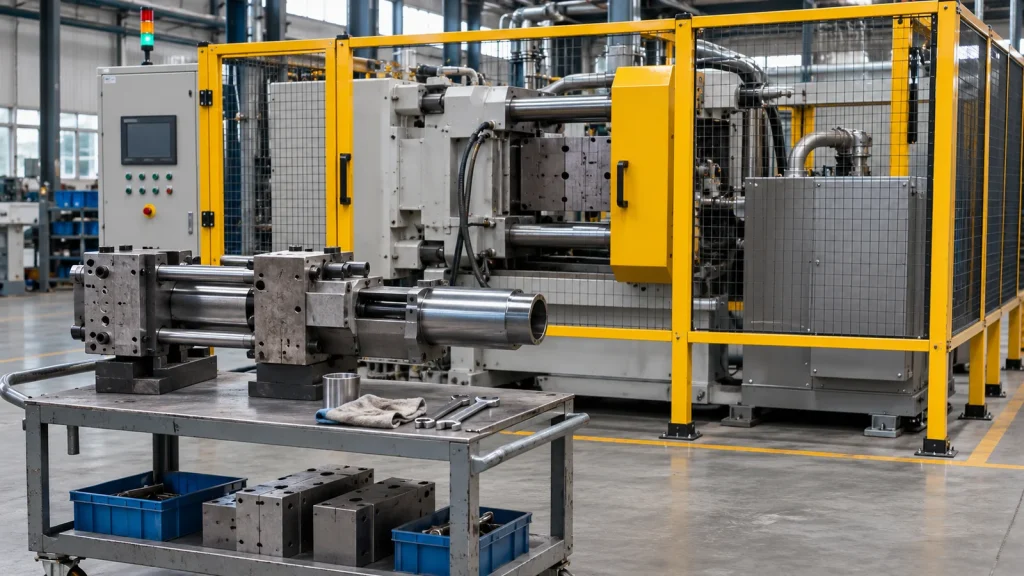
In hot-chamber die casting, a heated holding pot contains molten alloy. The gooseneck, injection cylinder, and plunger are immersed in that bath. On each cycle, the plunger forces molten metal through a nozzle into a closed steel die. Because the injection system is already full of melt and does not need ladling from a separate furnace, the process can be highly automated and very fast. It is well suited to high-volume production of small and medium-sized parts.
The process has a hard requirement: the molten metal must be compatible with the immersed steel hardware. It must not dissolve or erode the gooseneck and plunger rapidly, and it must not require such a high temperature that the hardware degrades. This is where Zamak stands out. Its melting range is low, its chemistry is relatively gentle on steel at normal casting temperatures, and its fluidity is high. The process and the material evolved together.
Low melting range and lower thermal burden
Zamak melts in the region of about 380-390 °C, with typical casting temperatures somewhat above that. This is far below aluminium, which melts around 660 °C, and magnesium, which also requires high-temperature handling and special protection. The lower temperature means less energy is needed to melt and hold the metal. It also means less thermal shock to the die and less thermal stress on the immersed injection components.
A lower thermal burden has several practical effects. Die life can be long because the steel is not being cycled through extreme temperature swings. Machine components last longer because they are not exposed to aggressively high temperatures. Temperature control is easier, which helps maintain consistent filling and solidification. The alloy also has a relatively narrow freezing range, so it can solidify quickly and predictably rather than remaining mushy for a long time.
Chemical compatibility with steel
One of the most important reasons Zamak dominates hot-chamber processing is that molten zinc at normal die-casting temperatures does not attack steel in the same way as molten aluminium. Aluminium has a strong affinity for iron. At aluminium casting temperatures, it can react with steel goosenecks, shot sleeves, plungers, and die surfaces, forming iron-aluminium intermetallic compounds and causing erosion or soldering. That is a major reason aluminium is normally die cast in cold-chamber machines, where the molten metal contacts the shot sleeve only briefly and the injection mechanism is not submerged in a bath.
Zinc is less aggressive toward steel under Zamak conditions. It still requires good process control, appropriate materials, and attention to temperature and impurity levels, but it allows the gooseneck and plunger to remain immersed in the melt for production. This single materials fact underpins the economics of hot-chamber zinc die casting. Without it, the process would not be practical at high volume.
Excellent fluidity and detail reproduction
Zamak has excellent fluidity. It fills thin walls, sharp corners, fine ribs, small bosses, and complex cavity details more easily than many higher-temperature alloys. This allows designers to combine features into one casting that might otherwise require machining or assembly. It also supports thin-wall sections and good surface reproduction, so textures, lettering, and cosmetic details can be cast directly into the part.
The fluidity advantage is not only about filling the mould. It also helps reduce cold shuts and incomplete filling when the process window is properly set. It allows relatively tight dimensional tolerances and reduces the need for secondary machining. For small, intricate parts such as lock components, connectors, and decorative hardware, that combination is extremely valuable.
Fast solidification and high productivity
Hot-chamber machines are fast, and Zamak supports that speed. Because the alloy has a low melting temperature and solidifies quickly in the die, parts can be ejected after a relatively short cycle. The injection system is always ready with molten metal, so there is no ladling step. High-volume production can therefore run at low cost per part when the tooling and process are well designed.
Fast solidification also helps dimensional consistency. The casting retains the shape of the cavity, and the die can be designed with appropriate shrinkage allowance. With good thermal control, producers can hold tight tolerances and repeatable dimensions across large production runs. This is one reason zinc die casting is often chosen for precision hardware and small mechanical components that must fit together reliably.
Good as-cast strength, finish, and finishing behaviour
Zamak 3 and related grades provide useful as-cast strength and impact resistance for many non-structural and light-load applications. The surface finish is smooth enough that parts can often be used with little or no cosmetic preparation. Zamak also accepts electroplating, chromate conversion coatings, powder coating, and liquid paint well. Chrome, nickel, and other decorative finishes are common because the alloy provides a good substrate and the casting can be made with the smoothness needed for a class-A appearance.
This finishability is part of the hot-chamber value proposition. A single process can produce a complex shape with a surface that is ready for plating or painting. The limitation is that porosity or surface defects can cause blistering or visible imperfections after finishing, so casting quality and process control remain important.
Tooling life and economic balance
The lower casting temperature and relatively benign interaction with steel help extend die life. Hot-chamber tooling can be expensive, but it is amortised over large production volumes. Zamak is dense, so material cost per part can be higher than with aluminium or plastics for the same volume. However, the ability to cast thin, complex, near-net-shape parts at high speed often offsets that disadvantage. The economics are especially favourable for small parts produced in large quantities, where cycle time, machining elimination, and finishing quality matter more than raw material weight.
In short, the fit between Zamak and hot-chamber die casting can be summarised as low melting point plus high fluidity plus limited steel attack plus fast solidification. Those four characteristics together create a fast, precise, and cost-effective production route.
Design and Processing Considerations for Zamak Castings
Select the grade by function, not habit
Zamak 3 is the default for many parts because it offers the best balance of castability, ductility, dimensional stability, and finishing quality. If the part is a decorative cover, a housing, a handle, or a general fitting, Zamak 3 is often the sensible starting point. If the part must carry a load, resist wear, or maintain threads under repeated use, Zamak 5 may be better. If the application involves bearings, cams, or wear surfaces, Zamak 2 may be considered, but its lower ductility and greater dimensional sensitivity must be evaluated. If the part has very thin walls or needs more ductility for assembly, Zamak 7 can be attractive.
Grade selection should also consider finishing. High-copper grades can be more challenging for some finishing processes and may show greater dimensional change over time. Zamak 3 and Zamak 7 are often preferred for dimensionally critical or decorative plated parts.
Control melt quality and impurities
Impurity control is not optional. Lead, tin, and cadmium can cause intergranular corrosion and dimensional growth. Iron can create hard particles and affect fluidity and machining. The foundry should use certified ingot, maintain clean melting practice, avoid cross-contamination with other alloys, and verify chemistry regularly. Recycled material can be used only within a controlled system that maintains the specification. A beautiful sample casting made from unknown scrap is not evidence of a reliable production process.
Design for filling and solidification
Zamak is fluid, but good casting design still matters. Wall thickness transitions should be gradual. Thick sections should be avoided or fed properly because they can create shrinkage porosity. Thin sections should not be so thin that the metal freezes before the cavity fills. Gates should be positioned to fill the cavity smoothly and avoid jetting or trapped air. Overflows and vents should allow air to escape. Sharp internal corners should be radiused to reduce stress concentration and improve metal flow.
The die thermal balance is also important. Hot spots can cause shrinkage porosity, while cold areas can cause cold shuts or poor surface finish. A well-designed die uses cooling channels, inserts, and gate placement to promote directional solidification and consistent cycle times.
Manage porosity and pressure tightness
Porosity is a common concern in all die casting. It can come from trapped gas, shrinkage, or both. For cosmetic parts, porosity near the surface can cause blisters after plating or painting. For pressure-tight parts, porosity can cause leakage. Zamak’s fluidity helps filling, but it does not eliminate the need for good process control. Vacuum assistance, squeeze casting, or specialised die design may be used when pressure tightness is critical. In some cases, a different alloy or process may be more appropriate.
Plan finishing and assembly early
Zamak parts can be machined, drilled, tapped, and assembled with inserts or fasteners. The alloy machines well, but thin walls and sharp threads need careful design. Self-tapping screws can be used in some zinc castings, but boss diameter, wall thickness, and thread engagement must be specified correctly. Plating and painting should be considered during design because surface defects, porosity, and sharp edges can affect finish quality. The part should be designed so that it can be held, masked, racked, and coated economically.
Applications: Where Zamak Makes Economic Sense
Zamak is used wherever a small or medium-sized part needs complex shape, good dimensional accuracy, smooth surface, and moderate mechanical performance. Common examples include locks and lock components, door handles, hinges, window hardware, furniture fittings, zippers, buckles, decorative trim, electrical connectors, junction boxes, small gears, levers, brackets, automotive interior hardware, toy parts, model components, and housings for small devices.
Many of these applications share a common profile: high production volume, complex geometry, thin walls, cosmetic requirements, and a need for low assembly cost. Zamak is often chosen over machined brass because it can be cast close to final shape. It is often chosen over plastic when stiffness, wear resistance, dimensional stability, metallic appearance, thermal conductivity, or electromagnetic shielding matter. It is often chosen over aluminium when the part is small and precision is more important than weight, because Zamak can be hot-chamber cast at high speed with excellent detail and finishing quality.
The alloy is less suitable for large structural parts, high-temperature applications, or components that must be as light as possible. Zinc is dense, with a specific gravity around 6.6-6.7, compared with roughly 2.7 for aluminium and 1.7 for magnesium. For a given volume, a Zamak part is substantially heavier. That does not matter for a lock or a connector, but it matters for a large housing or a weight-sensitive automotive component.
Practical Limitations and Common Misconceptions
Temperature limits
Zamak is not a high-temperature material. Its mechanical properties fall as temperature rises, and dimensionally critical parts are generally limited to service temperatures around 100 °C or lower, depending on grade, load, and allowable deformation. Prolonged exposure to warm environments can cause slight dimensional drift, especially in higher-copper grades. Zamak should not be used for engine components, high-temperature manifolds, or structural parts that must retain strength at elevated temperature.
Density and strength-to-weight ratio
Zinc is dense. Zamak can be strong in absolute terms, but its strength-to-weight ratio is lower than that of aluminium or magnesium. Designers should not select Zamak simply because it has a high tensile strength number. They should compare stiffness, wear behaviour, castability, finishing cost, and total part cost. For many small precision parts, the denser material is still the better economic choice.
Corrosion and environmental exposure
Zamak has useful atmospheric corrosion resistance and is often plated or painted for decorative and protective reasons. However, it is not immune to all environments. Strong acids, strong alkalis, and some aggressive industrial or marine atmospheres can attack zinc. Uncoated parts may develop white corrosion products in wet conditions. The correct finish and drainage design should be specified for outdoor or humid applications.
The pot metal misconception
Calling Zamak pot metal is technically lazy and often misleading. Pot metal historically referred to uncontrolled scrap-based alloys with inconsistent composition. Zamak is a controlled family with specified chemistry and properties. The distinction matters because a failed zinc casting is often blamed on the material family when the real cause is impurity contamination, poor process control, or bad design.
The strongest grade misconception
Zamak 2 is not automatically the best choice because it has the highest strength and hardness. It also has lower ductility and less dimensional stability than Zamak 3. Many applications are better served by Zamak 3 or Zamak 5. Grade selection is a balance, not a ranking.
Zamak Compared With Other Materials and Processes
Compared with aluminium, Zamak is heavier and has lower elevated-temperature capability, but it offers excellent castability, thin-wall filling, tight tolerances, good plating quality, and the productivity of hot-chamber processing. Aluminium is preferred for lightweight structural parts and higher-temperature service. Compared with magnesium, Zamak is much heavier but easier to handle and less chemically reactive. Magnesium requires special melt protection and careful handling, and its die casting is generally more demanding. Compared with plastics, Zamak provides stiffness, wear resistance, dimensional stability, metallic appearance, thermal conductivity, and electromagnetic shielding, but at higher weight and material cost. Compared with brass, Zamak is generally cheaper to cast into complex shapes and can be plated to a similar decorative appearance, although brass may be preferred for certain wear, corrosion, or electrical applications.
The process comparison is equally important. Hot-chamber die casting is fast and economical for low-melting alloys such as Zamak. Cold-chamber die casting is used for aluminium, magnesium, and other higher-temperature alloys because the injection mechanism cannot be submerged in the melt. The choice between hot-chamber and cold-chamber is therefore not merely a machine preference. It is determined by the alloy’s melting point and chemical compatibility with steel.
FAQ
Is Zamak the same as zinc die-casting alloy?
Zamak is the most important family of zinc die-casting alloys, but the terms are not perfectly identical. Zamak refers to a specific controlled family based on high-purity zinc with aluminium, magnesium, and copper. Other zinc alloys, such as the higher-aluminium ZA alloys, are also zinc-based but are not Zamak. In everyday industrial language, people often say zinc die casting when they mean Zamak, but a technical specification should always identify the exact grade and standard.
Why is Zamak 3 the most common grade?
Zamak 3 offers the best overall balance for general-purpose die casting. It casts easily, fills thin sections, holds dimensions well, accepts plating and painting, and has enough ductility for many hardware and housing applications. It is not the strongest grade, but it is the most forgiving and versatile. That is why it dominates general zinc die casting and is often the first grade considered for a new part.
Why can aluminium not be hot-chamber die cast in the same way?
Molten aluminium reacts with steel at normal casting temperatures. It can dissolve or erode goosenecks, plungers, nozzles, and shot sleeves by forming iron-aluminium intermetallic compounds. Because hot-chamber machines keep these components immersed in the melt, the attack would be too severe and the process would not be economical. Aluminium is therefore normally cast in cold-chamber machines, where the melt contacts the injection system only briefly.
What is the maximum service temperature for Zamak?
For dimensionally critical parts, Zamak is generally limited to service temperatures around 100 °C or lower, depending on grade, load, and acceptable deformation. Higher-copper grades can be more prone to dimensional change over time. Zamak should not be used for high-temperature engine parts or applications where strength must be retained at elevated temperature. If higher temperature capability is required, aluminium, magnesium, or another material should be evaluated.
Can Zamak be plated and painted?
Yes. Zamak is widely plated with chrome, nickel, and other finishes, and it can be painted or powder coated. Its smooth as-cast surface and metallic substrate are advantages. However, surface porosity, cold shuts, and contamination can cause blistering, poor adhesion, or visible defects after finishing. Good casting quality and proper pre-treatment are essential for decorative and corrosion-resistant finishes.
How does Zamak compare with ZA alloys?
Zamak alloys contain about 4% aluminium and are designed for the classic hot-chamber zinc die-casting process. ZA alloys contain much more aluminium, ranging from about 8% to 27%, and have different mechanical properties and processing requirements. Some ZA alloys offer higher strength or wear resistance, but they are not drop-in replacements for Zamak. A change in alloy requires a review of tooling, shrinkage, casting simulation, machining, finishing, and mechanical design.
Conclusion
Zamak is a family of high-purity zinc-based die-casting alloys built around a simple but effective alloying strategy: about 4% aluminium for fluidity and castability, a small magnesium addition for grain control and corrosion resistance, and copper in selected grades for strength, hardness, and wear resistance. Zamak 3 is the versatile workhorse, Zamak 5 adds strength, Zamak 2 adds wear resistance at the cost of ductility, and Zamak 7 supports thin-wall and high-ductility applications.
The reason Zamak is so closely associated with hot-chamber die casting is equally clear. Its low melting range of roughly 380-390 °C reduces energy demand and thermal stress. Its excellent fluidity fills thin walls and fine details. Its fast solidification supports short cycles and high productivity. Most importantly, molten Zamak is sufficiently compatible with steel at normal casting temperatures to allow the gooseneck and plunger to remain immersed in the melt, which is the defining feature of hot-chamber processing. Aluminium lacks that compatibility, which is why it generally requires cold-chamber casting.
The practical conclusion is that Zamak should be selected as an engineered material, not as generic pot metal. Designers should choose the grade by function, control impurities, design for proper filling and solidification, and respect the alloy’s limitations in temperature, density, and corrosion resistance. Used within those boundaries, Zamak remains one of the most cost-effective routes to complex, precise, decorative, and functional small metal parts.
参考资料
- https://www.gettyimages.com/detail/photo/industrial-aluminum-die-cast-and-machined-metal-royalty-free-image/2281376024
- Zinc Zamak 3
- Zinc Die Casting Alloys: Zamak 3, 5 and ZA Grades
- Zamak Foundry in Italy: Custom Die Casting | Micrometal
- Zinc Casting Alloys: Zamak 3 vs 5 vs ZA-8 | MechCodex
- Composition of casting zamak
- Common Zinc Die Casting Alloys: Zamak 3, 5, 7 and the ZA Grades
- Zinc Alloys for Die Cast Manufacturing
- What are the most common zinc alloys used in die casting? – SOMI Custom Parts
- ZZnAl4-1 Zinc Alloy (ZAMAK 3) | Yuheng Metal