Introduction
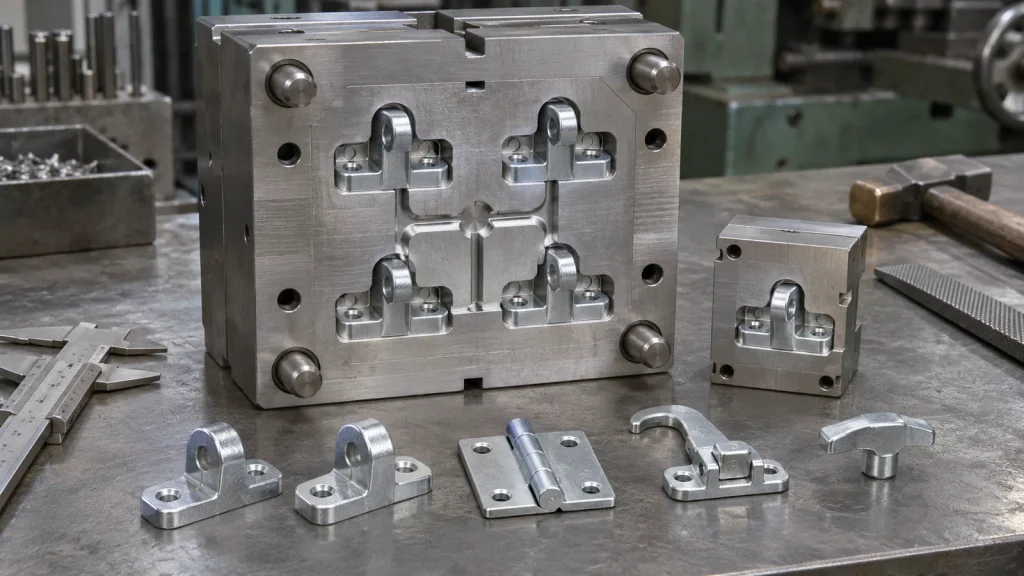
A family mold, sometimes called a family die or combination mold, is a single die-casting tool that contains several different cavities for several different parts. In one shot, molten zinc fills all cavities, and the parts are ejected together as a connected cluster. After trimming, the runner, sprue, overflow, and gates are removed, and the individual components go to finishing, inspection, and assembly. The defining feature is not the number of cavities but the fact that the cavities are not identical. A conventional multi-cavity mold makes several copies of the same part. A family mold makes one complete set, or a fixed subset of a set, in every cycle.
This distinction matters in zinc alloy hardware because hardware products are usually assemblies. A door handle set may include a lever, a rosette, a spindle cap, and a latch plate. A lock may include a body, a cover, a cam, and a faceplate. A buckle may include a frame, a pin, and a decorative insert. If these parts are always used together, a family mold can produce them in matched quantities, reduce tooling investment, and simplify production planning. At the same time, a family mold is not a universal cost-saving device. It creates a fixed production ratio, narrows the process window, and can turn one cavity problem into a whole-set problem.
The practical question is therefore not simply whether a family mold is cheaper than several separate molds. The real question is whether the parts form a stable family in terms of alloy, geometry, finish, demand, tolerance, and risk. This article explains the concept, the zinc-specific process background, the situations where family molds are appropriate, the situations where they should be avoided, and the engineering and procurement checks that make the decision defensible.
What a Family Mold Is and What It Is Not
A tool for different parts in one cycle
In high-pressure die casting, a mold is a hardened steel tool with a cavity block, a cover block, slides, cores, ejector pins, runners, gates, overflows, and vents. A family mold places cavities for different part numbers in the same die. The layout may be a simple row, a balanced circle, or an asymmetric arrangement dictated by part size and gating. The molten zinc enters through a sprue, is distributed by runners, passes through gates into each cavity, and fills the cavities while air escapes through vents and overflows. The parts solidify quickly, the die opens, and the ejector system pushes the shot out. The shot is a single connected piece until trimming.
The most common example in hardware is a matched pair. Left-hand and right-hand window cranks, left and right hinge leaves, or a handle and its escutcheon can be cast together. The cavities are different, but the parts belong to the same assembly and are consumed in a known ratio. A second example is a small kit, such as a lock body, a cover, and a cam. A third example is a set of decorative parts with the same finish, such as a handle, a rosette, and a trim ring. In each case, the family mold is a production tool, not a collection of unrelated jobs.
It is not the same as a multi-cavity mold
A multi-cavity mold can also have four, eight, or sixteen cavities, but all cavities are usually identical. The purpose is output and redundancy. If one cavity is damaged, production may continue at reduced output, and the parts are interchangeable. In a family mold, the cavities are complementary. If one cavity is damaged, the set is incomplete, and the entire shot may become unusable or require rework. This is a critical operational difference. Multi-cavity tools are optimized for volume and repeatability of one part number. Family molds are optimized for set completeness and tooling economy across several part numbers.
A family mold is also not the same as a modular mold with interchangeable inserts. A modular tool may allow different inserts to be installed for different part versions, but it normally runs one version at a time. A family mold runs the different parts simultaneously. Nor is a family mold the same as a prototype tool. A prototype tool may contain several unrelated cavities for convenience during development, but it is not intended for stable production. The term family mold should be reserved for a production or pre-production tool in which the cavity set is deliberately designed around a product family.
The fixed-ratio consequence
Every family mold has a production ratio. If the tool has one cavity for part A, one cavity for part B, and two cavities for part C, each cycle produces one A, one B, and two C. That ratio is locked into the tool unless the tool is modified. This is the single most important planning consequence. A family mold is efficient when demand follows the same ratio. It is inefficient when demand is unbalanced. If the market needs ten thousand A parts but only one thousand B parts, a one-to-one family mold will either overproduce B or force the molder to run partial shots, which is usually impractical and costly. The ratio must be validated before the steel is cut.
Why Zinc Alloys Are Well Suited to Family Molds
Fluidity and hot-chamber processing
Zinc alloys, especially Zamak 3 and Zamak 5, are common in hardware die casting because they combine good fluidity, dimensional stability, thin-wall capability, and excellent response to plating and coating. Zamak 3 is often chosen for decorative hardware and general-purpose parts because it casts easily and holds detail. Zamak 5 offers higher strength and hardness and is often used where wear or load is more demanding. Both are typically run in hot-chamber machines, where the gooseneck and nozzle are immersed in the melt and cycle times are short. The process is well suited to high-volume production of small and medium hardware components.
That same fluidity makes family molds technically feasible. Molten zinc can fill several different cavities in one shot if the runner system is designed correctly. The alloy also reproduces fine surface detail, which is important for decorative hardware that will be polished, chrome plated, or painted. However, fluidity is not a substitute for balance. Zinc solidifies quickly, and a cavity that is starved of metal will not be rescued by good alloy properties. The die designer must balance fill time, gate freeze, shot weight, and thermal distribution across all cavities.
Shared alloy and shared finish
A family mold runs one alloy per shot in normal practice. Different zinc grades are not simultaneously cast in different cavities because the melt is common to the whole shot. This is a practical constraint, not a theoretical one. If one part requires Zamak 5 for strength and another is acceptable in Zamak 3, the family mold must be run in the higher-grade alloy if that is technically acceptable for both, or the parts should be separated. The same logic applies to finish. If all parts will be chrome plated, a family mold can provide a consistent substrate and a single finishing batch. If one part will be painted and another will be left as-cast, the tooling may still be shared, but the finishing flow becomes more complex and the benefit of a single batch is reduced.
Zinc hardware often requires tight cosmetic control. Chrome plating reveals flow lines, cold shuts, porosity, and polishing defects. A family mold can help consistency when the parts have similar geometry and similar flow behavior, because they experience the same alloy, the same die temperature, and the same cycle. It can hurt consistency when one cavity is much more difficult to fill or polish than another. The plater may accept one part and reject another from the same shot. This is why family molds should be built around parts with comparable cosmetic requirements, not merely parts that happen to be sold together.
Similar wall thickness and projected area
Zinc die casting rewards uniform wall thickness. Thick sections cool slowly and can produce shrinkage porosity, sink, and dimensional variation. Thin sections freeze quickly and may fail to fill if the gate or runner is inadequate. In a family mold, the cavities compete for metal. If part A has a thick section and part B has a thin wall, the thick cavity may continue to draw metal while the thin cavity freezes prematurely. The result can be incomplete fill in the thin part, flash on the thick part, or porosity in the thick section. A good family mold pairs parts with similar wall thickness, similar projected area, and similar shot weight per cavity.
Projected area is important because it affects clamp force and cavity loading. A large part requires more clamp tonnage and more metal flow than a small part. If the size difference is extreme, the small cavity may be overpacked before the large cavity is full. Overpacking causes flash, high internal stress, and ejector damage. Underfilling the large cavity causes cold shuts and weak mechanical properties. A family mold can tolerate some variation, but it cannot ignore physics. The design should be checked with filling simulation and, where necessary, balanced with different gate sizes, runner lengths, or overflow volumes.
The Main Use Cases in Zinc Hardware Production
Matched assemblies and kits
The strongest use case is a product that is assembled or packaged as a set. Door hardware, window hardware, furniture hardware, lock sets, buckles, hinges, and decorative trim are typical. If the customer orders one handle, one rosette, and one latch plate per set, a family mold can produce that set in a stable ratio. The molder avoids the classic mismatch problem in which ten thousand handles are ready but only six thousand rosettes are available. The tool also simplifies kitting and shipment because the parts are produced together and can be kept traceable by lot.
A matched left-right pair is an especially good candidate. Left and right hinge leaves or left and right window cranks are usually consumed in equal quantities, share the same alloy and finish, and have similar geometry. The cavities can be arranged symmetrically, and the runner system can be balanced more easily than with unrelated parts. A handle and its escutcheon can also work well if the two parts have similar wall thickness and finish requirements. A lock body, cover, and cam may work, but only if the body and cover have compatible filling behavior and the cam does not require a very different tolerance or mechanical property.
Low-to-medium volume and tooling-sensitive programs
Family molds are often justified when annual volume is too low to amortize several dedicated molds. A new hardware line, a custom architectural project, a seasonal product, or a limited edition may need several parts but not enough volume to support separate tooling. One family mold can reduce tooling cost, reduce die trials, reduce machine setups, and shorten the path to first shipment. The savings are not only in steel. They also come from fewer drawings, fewer die approval loops, fewer setup events, and fewer inventory items.
This advantage fades as volume rises. At high volume, a dedicated mold with optimized cooling, optimized gating, and identical cavities can run faster and more consistently. The family mold’s flexibility becomes less valuable, while its balance and maintenance penalties become more visible. A common mistake is to use a family mold for a mature high-volume product simply because it worked during launch. The tool should be reviewed when volume grows, especially if one part in the set becomes a bottleneck.
Prototyping and market testing
The model answers correctly note that family molds can support prototyping or market testing. A company may want to prove a complete assembly before committing to high-volume tooling. A family mold can produce a small batch of all components, allowing fit checks, finish trials, customer approval, and assembly testing. This is valuable when the product family is likely to change. However, a prototype family mold should be designed with change in mind. If the parts are likely to be revised, replaceable inserts may be better than a fully hardened production die. The decision should consider the expected number of design iterations, not only the expected production volume.
Custom and seasonal hardware
Custom architectural hardware often involves a family of related parts in small quantities. A single project may require a handle, a pull, a rosette, and a matching trim piece. The volumes may be low, but the customer expects a consistent finish and a complete set. A family mold can be a good fit if the parts are similar in size and finish. Seasonal products have a similar profile. The tool can be built once and run in short campaigns, provided the demand ratio is stable and the parts can be stored without excessive inventory risk. The key is to confirm that the set is truly a family and not a temporary collection of unrelated parts.
The Economics: Tooling Cost Versus Cycle Time and Yield
The business case for a family mold is usually presented as one mold instead of three or four. That is only part of the calculation. A proper comparison should include tooling cost, die trials, machine setup, cycle time, scrap, inventory mismatch, maintenance, and risk. The family mold often wins on tooling and setup. It may lose on cycle time, yield, and flexibility. The decision should be based on total cost per accepted set, not cost per mold.
A simple illustrative model can clarify the logic. Suppose a hardware set has three parts and the expected annual volume is thirty thousand sets. Three dedicated molds might cost more in tooling but could run at a faster cycle and with independent optimization. A family mold might cost less in tooling but could run at a slower cycle because the heaviest cavity sets the cycle time. If one cavity has a higher scrap rate, the whole set is affected. If demand for one part changes, the fixed ratio becomes a liability. The family mold is most attractive when the volume is moderate, the parts are similar, the set ratio is stable, and tooling cash flow matters more than maximum output.
A useful way to compare options is to calculate total cost per good set as tooling amortization plus material plus machine time plus finishing plus scrap plus inventory carrying cost plus downtime risk. The tooling term favors the family mold at low volume. The machine time term may favor dedicated molds at high volume. The scrap term depends on balance and cosmetic difficulty. The inventory term depends on demand ratio stability. The risk term depends on how critical each part is and how easily production can recover from a damaged cavity. This framework prevents a common error: comparing only the invoice price of the mold.
Engineering Constraints: Balance, Gating, and Thermal Control
Cavity filling balance
In a family mold, the runner system must deliver the right amount of metal to each cavity at the right time. If one cavity fills first, its gate may freeze while another cavity is still filling. If one cavity is overpacked, flash and stress increase. If one cavity is starved, cold shuts and incomplete fill appear. The die designer must consider gate area, runner length, runner diameter, bend losses, overflow volume, venting, and thermal gradients. Filling simulation is strongly recommended for asymmetric family molds. Short-shot trials can confirm the simulation, but they should not replace it.
A balanced family mold does not necessarily mean equal-sized gates. It means each cavity receives the flow it needs within the same practical window. A small cavity may need a smaller gate to avoid overpacking. A large cavity may need a larger gate or a shorter runner. A thick part may need more overflow to manage shrinkage. The design is a system, not a copy-paste of one cavity. This is why family molds often cost more to design than a simple multi-cavity mold, even if the total tooling cost is lower than several separate molds.
Thermal balance
The die temperature must be managed across all cavities. A large cavity may need more cooling, while a small cavity may need more heat to avoid premature freezing. If the thermal balance is poor, one part may have a different surface finish, different dimensions, or different porosity from another part in the same shot. This is especially important for chrome-plated hardware, where flow lines and thermal marks are visible. The cooling layout should be designed with the cavity map in mind, not added after the cavity layout is fixed.
Process window and tolerances
The process window is the range of shot parameters that produces acceptable parts. A family mold usually has a narrower process window than a dedicated mold because one set of parameters must satisfy several different cavities. If one part requires a higher die temperature and another requires faster cooling, the compromise may reduce yield. If one part has a tight dimensional tolerance and another has a loose tolerance, the process may be tuned for the tight part, which can affect the others. This is a manageable issue when the parts are similar, but it becomes a serious problem when the parts have very different requirements.
Maintenance and downtime risk
A family mold concentrates risk. A damaged core pin, a cracked insert, a worn gate, or a sticking ejector can stop production of the entire set. In a dedicated mold, the same failure affects only one part number. In a family mold, it can create an assembly bottleneck because the other parts continue to be produced but cannot be shipped as a complete set. Maintenance planning should therefore include spare inserts, a clear cavity identification system, and a repair procedure that restores the family tool quickly. The tool should be designed for maintainability, not only for first-shot performance.
When a Family Mold Is the Right Choice
A family mold is likely to be the right choice when most of the following conditions are true. The parts are consumed together in a stable ratio. They use the same zinc alloy. They have similar wall thickness, projected area, and shot weight. They require the same surface finish and plating process. The annual volume is low to medium, or the tooling budget is constrained. The parts have comparable tolerances and cosmetic standards. The die designer can demonstrate a balanced filling and thermal layout. The program can tolerate the maintenance risk of a combined tool. The customer values set completeness and simplified logistics.
A simple scoring matrix can help. Score each criterion from one to five, with five being most favorable to a family mold. Criteria could include demand ratio stability, alloy compatibility, wall thickness similarity, projected area similarity, finish compatibility, tolerance similarity, volume suitability, maintenance risk, and expected design stability. A high total score supports the family mold. A low score, especially on demand ratio or size similarity, suggests separate molds or a different approach. The matrix is not a substitute for engineering judgment, but it exposes assumptions that might otherwise be hidden in a tooling quote.
When to Avoid or Reconsider a Family Mold
A family mold should be avoided or reconsidered when demand is unbalanced. If the assembly needs four brackets for every housing, a one-to-one tool is wrong. A different cavity ratio may help, but it must match the real demand and remain stable over the product life. It should also be avoided when the parts are very different in size or wall thickness. A large, thick part and a small, thin part in the same shot are difficult to fill and cool consistently. The small cavity may flash while the large cavity is still filling, or the thin cavity may freeze before the thick cavity is packed.
High-volume production is another reason to reconsider. At high volume, the cost of a dedicated mold can be recovered through faster cycles, better yield, and independent optimization. Tight cosmetic tolerances are also a warning sign. If one part requires Class A decorative plating and another is a hidden structural component, the process may be tuned for the cosmetic part and penalize the other. Unstable design is another warning sign. If one part in the family is likely to change, the whole tool may need modification. A modular insert design may be better than a fixed family cavity.
Finally, a family mold should not be used to combine unrelated parts merely to fill a tool. The cavities should belong to a real product family. If the parts have no assembly relationship and no stable demand ratio, the tool becomes an inventory trap. The initial tooling saving can be erased by excess stock, partial shots, or repeated rework.
Alternatives and Hybrid Approaches
When a family mold is not suitable, several alternatives should be considered. Dedicated single-cavity molds are simple, robust, and easy to optimize. They are appropriate for high-volume parts or parts with critical tolerances. Dedicated multi-cavity molds with identical cavities are appropriate when one part dominates demand. Modular molds with interchangeable inserts are useful when part versions are likely to change. Prototype tools, CNC machining, or temporary tooling may be better for market testing. A hybrid approach can also work: build a family mold for the stable, similar parts and a separate mold for the outlier. This captures most of the tooling saving without forcing a bad match.
Another hybrid option is a family layout with a replaceable cavity insert. If one part in the set is likely to evolve, its cavity can be designed as an insert that can be changed without scrapping the whole tool. This adds cost and complexity, but it can be worthwhile for a new product line. The decision should be based on the expected number of engineering changes and the cost of downtime, not only the initial mold price.
Design and Procurement Checklist
Before approving a family mold, the buyer and the die caster should agree on a part family matrix. The matrix should list each part, its alloy, wall thickness range, projected area, shot weight, tolerance class, cosmetic requirement, finishing process, annual volume, and assembly ratio. The matrix should also identify the critical dimensions and the failure modes that matter most. This document becomes the basis for the die layout, the process plan, and the quality plan.
The die design review should cover cavity layout, runner balance, gate design, overflow and venting, cooling, ejection, slides and cores, maintenance access, and cavity identification. Filling and solidification simulation should be used for asymmetric layouts. The review should confirm that the process window is wide enough for production, not only for a perfect first shot. The quality plan should include first article inspection, dimensional capability studies, porosity checks where relevant, plating adhesion tests, and a cavity traceability method. The commercial review should confirm the demand ratio, the volume forecast, the tooling ownership, the spare parts list, and the maintenance responsibility.
A useful set of questions for the die caster includes the following. Which cavity sets the cycle time? What is the expected shot weight and scrap rate? How will the runner be balanced? What happens if one cavity is damaged? Can the damaged cavity be isolated or repaired without stopping the whole set? What is the expected die life and maintenance interval? How will parts be identified by cavity? What is the process capability for the tightest dimension? These questions turn a tooling quote into an engineering decision.
Quality Control and Common Defects
Family molds can produce excellent hardware, but they require disciplined quality control. Common defects include incomplete fill, cold shuts, flash, porosity, sink, warpage, flow lines, and dimensional variation. In a family mold, these defects may appear in only one cavity, which can be missed if inspection samples are not cavity-specific. The quality plan should sample by cavity and record the cavity number. If a defect is found, the molder can determine whether it is a tool issue, a process issue, or a part-design issue.
Porosity is a special concern for zinc hardware that will be plated or machined. Gas porosity, shrinkage porosity, and flow-related porosity can originate from poor gating, trapped air, or unbalanced cooling. X-ray inspection or sectioning may be required for critical parts. Plating adhesion and cosmetic appearance should be checked on finished parts, not only on as-cast samples. Dimensional checks should include the critical fit dimensions for the assembly, because a family mold can produce parts that are individually acceptable but do not assemble well together.
Worked Examples
A left-right window crank pair is a strong family mold candidate. The two parts are mirror images, consumed in equal quantities, and usually share the same alloy and finish. The cavities can be arranged symmetrically, and the runner can be balanced with relative ease. The cycle time is similar for both parts, and the maintenance risk is manageable. If one cavity is damaged, the pair is incomplete, but the symmetry makes repair and replacement relatively straightforward.
A lock body, cover, and cam is a more mixed case. The body and cover may be similar in alloy and finish, but the cam may have a different wall thickness, a different tolerance, or a different mechanical requirement. If the cam is small and the body is large, the filling balance may be difficult. A family mold could still work if the parts are designed as a set, the volumes are moderate, and the simulation shows a stable process window. If the cam requires a different alloy or a much tighter tolerance, a separate mold may be better.
A buckle frame, pin, and decorative trim is another mixed case. The frame and trim may share a finish, but the pin is often small and may be consumed in a different ratio. If the pin is cast in the same family mold, the tool may overproduce pins or underproduce frames. A separate mold for the pin, or a different cavity ratio, may be more economical. The example shows why the demand ratio must be checked before the cavity layout is finalized.
Hinge leaves are usually a good fit when the left and right leaves are similar in size and finish. The pair is consumed together, and the family mold reduces tooling and inventory mismatch. A pin cap, however, may be a poor addition if it is much smaller than the leaves. The cap may overpack or freeze differently. In that case, a two-part family mold for the leaves and a separate mold for the cap may be the better compromise.
Frequently Asked Questions
Is a family mold the same as a multi-cavity mold?
No. A multi-cavity mold usually has identical cavities for the same part number. A family mold has different cavities for different parts that belong to a product family. The multi-cavity mold is optimized for output and redundancy. The family mold is optimized for set completeness and tooling economy. The operational consequences are different, especially when one cavity is damaged or when demand for one part changes.
Can a family mold cast different zinc alloys in different cavities?
In normal production, no. The shot uses one melt, so all cavities receive the same alloy. If one part needs Zamak 5 and another can use Zamak 3, the family mold must be run in an alloy that is acceptable for both, or the parts should be separated. Special insert or overmolding techniques exist, but they are not the normal family mold concept and should be evaluated as a different process.
How many different parts can a family mold contain?
There is no fixed number. Practical family molds often contain two to six different parts, but the limit is set by balance, tool size, maintenance, and demand ratio. More cavities increase the complexity of the runner system and the risk of one cavity limiting the whole shot. A small, well-balanced family of similar parts is usually better than a large collection of unrelated parts.
How should unequal demand be handled?
The cavity ratio should match the assembly ratio. If the product needs two brackets for every housing, the tool can be designed with two bracket cavities and one housing cavity, provided the filling and thermal balance are acceptable. If demand is unstable or the ratio is extreme, separate molds may be better. Inventory, alternate tooling, and partial shots are possible in some cases, but they should not be used to rescue a fundamentally wrong cavity ratio.
Does a family mold always reduce part cost?
No. It usually reduces tooling cost and setup cost, but it may increase cycle time, scrap, or maintenance risk. The total cost per accepted set depends on volume, balance, yield, and demand stability. A family mold is most cost-effective when the parts are similar, the volume is moderate, and the set ratio is stable. At high volume, dedicated molds often win.
What information should be provided to a die caster for quoting?
Provide 3D models, 2D drawings with critical dimensions and tolerances, alloy specification, surface finish and plating requirements, annual and monthly volumes, assembly ratios, expected product life, design change plans, and any special quality or regulatory requirements. Also provide samples or reference parts if available. The more clearly the part family is defined, the more accurately the die caster can judge whether a family mold is technically and commercially suitable.
Conclusion
A family mold is a single die-casting tool with different cavities that produce a matched set of parts in one shot. In zinc alloy hardware, it is most appropriate when the parts are consumed together in a stable ratio, share the same alloy and finish, have similar wall thickness and projected area, and are produced at low to medium volume where tooling cost and set completeness matter more than maximum cycle speed. It can reduce tooling investment, simplify kitting, and improve inventory matching for door hardware, window hardware, locks, hinges, buckles, and decorative trim.
It is not a universal solution. A family mold locks production into a fixed ratio and narrows the process window. It becomes a poor choice when demand is unbalanced, when the parts differ greatly in size or tolerance, when cosmetic requirements are unequal, or when high volume justifies dedicated tooling. The right decision comes from a part family matrix, a filling and thermal balance review, a total-cost comparison, and a clear maintenance plan. Used with discipline, a family mold is an efficient tool for the right zinc hardware family. Used as a shortcut for unrelated parts, it becomes an inventory and quality problem.
参考资料
- Zinc Alloy Die Casting Mold Guide | Precision Zamak Die Casting Solutions
- What Is Zinc Die Casting? | Process, Materials and Applications Guide
- Die Casting Parts
- What Is a Die Casting Part and How Is It Made?
- Zinc Alloy Die Casting for Luggage Hardware: Zipper Pulls, Locks and Buckles Manufacturing Guide
- How Can Zinc Die Casting Deliver Greater Precision, Durability, and Cost Efficiency for Your Manufacturing Projects
- Zinc Die Casting Components: Design & Materials Guide
- Module 04 :: Die Casting
- SAIMM – Versatile zinc is an ideal metal for die casting
- Zinc Die Casting for Building Industry