Introduction: The Die-Casting Mould Base Is a Supply Chain Product
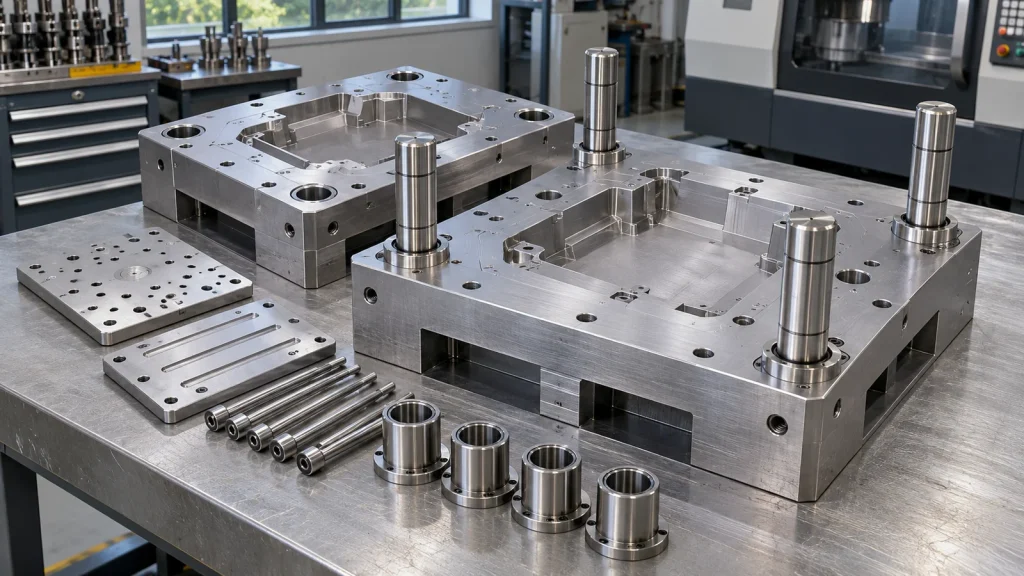
A die-casting mould base is often described as a simple steel frame, but in practice it is a precision subassembly that sits at the centre of a complex tooling supply chain. The base usually includes an A-plate and a B-plate, support pillars or spacer blocks, guide pins and guide bushings, return pins, ejector plates, clamp slots, mounting features and sometimes pre-machined pockets for inserts, slides or cooling lines. It is supplied as a near-finished frame that a toolmaker later fits with cavity inserts, cores, slides, cooling circuits, gating and the shot-sleeve interface required by a cold-chamber or hot-chamber die-casting machine.
The important point is that die-casting mould bases are not made by one kind of company. The market is divided into catalogue-standard manufacturers, custom build-to-print factories, full-service die-casting toolmakers, general CNC and precision machining shops, distributors and traders, OEM/ODM agents, and upstream steel and component suppliers. Each tier solves a different problem. A standard frame buys speed and interchangeability. A custom frame buys freedom of design. A turnkey toolmaker buys single-source responsibility. A local distributor buys availability. A steel service centre buys material traceability. A trader or marketplace seller buys export convenience, but not necessarily engineering depth.
The distinction between a mould base and a complete die is also important. A mould base is the frame and mechanical platform. A complete die-casting die includes the cavity and core inserts, runners and gates, overflow and venting, cooling channels, slides, ejector system, thermal control and the interface to the machine. Some suppliers sell only the base. Some sell the base plus machining. Some sell the whole die and offer tryout and production support. Buyers who use the term mould base loosely may receive quotations for very different scopes of work. The best sourcing decision therefore starts with a clear definition of what is being purchased: a bare frame, a machined frame, a frame with inserts, or a turnkey die.
The choice also depends on the casting alloy, machine size, part geometry, expected die life, number of cavities, slide layout, cooling requirements and quality documentation. A standard catalogue base can be ideal for a repeat job on a standard machine platen. A custom base is more suitable for a large automotive casting, a multi-cavity die, a complex slide arrangement or a non-standard machine interface. A full toolmaker is preferable when the buyer wants one vendor responsible for design, manufacturing, tryout and production launch. A CNC shop may be the right answer for a repair, a prototype or a modification to an existing base. The rest of this article maps these supplier types and explains how to choose among them.
1. Standard Catalogue Mould-Base Manufacturers
Standard mould-base manufacturers are the brand-name catalogue suppliers. They produce fixed sizes, plate thicknesses, guide-pin arrangements and standards, and they keep inventory or maintain repeatable production programmes so that lead times are short and spare parts are interchangeable. Common standards in the market include DME, HASCO, LKM, Meusburger, Futaba and Misumi. PCS Company is another well-known supplier with a broad catalogue of standard and special bases. These names appear repeatedly in supplier listings because toolmakers, machine shops and buyers use them as a common technical language.
DME, for example, offers pre-engineered assemblies, plates and components in several series, including A-Series, B-Series, T-Series, AX-Series, X-Series and Master Unit Die formats. PCS Company lists a wide range of standard sizes, from small frames to large frames, in P20 and stainless steel, and also offers special or custom bases. HASCO and Meusburger are strongly associated with European standard systems and modular components. LKM, based in Asia, is widely used in China and export markets and is often named as a standard alongside DME and HASCO. Futaba and Misumi serve buyers who need Japanese-standard components and catalogue availability. The exact product range varies by supplier, but the logic is the same: the buyer selects a standard frame and then machines or fits the die-specific features.
The main advantage of a standard base is speed and cost control. Catalogue frames are usually available faster than custom frames because the supplier does not need to create a new design from scratch. Plates, guide pins, bushings and ejector components are interchangeable, so replacement and repair are simpler. A toolmaker can order a standard frame with known dimensions, known steel grades and known tolerances, then focus engineering effort on the cavity, core, slides and cooling. For repeat jobs, spare tools and standard machine platens, this is often the most economical route.
The limitation is design constraint. A standard base is designed around a catalogue grid, not around a specific part. If the casting requires an unusual plate thickness, a non-standard ejector pattern, deep pockets, large slides, non-standard water lines or a special machine interface, the standard frame may require extensive modification. In some cases the modification cost and lead time erase the apparent savings. A standard base is therefore not automatically cheaper on a total-project basis. It is cheapest when the die design can fit the standard envelope without compromise.
Standard manufacturers also differ in how much value they add. Some sell only plates and components. Some sell semi-finished frames with basic machining. Some offer pocketing, drilling, tapping, water-line drilling and insert-pocket machining as catalogue services. Buyers should confirm whether the quoted standard base is a bare frame, a machined frame or a ready-to-fit assembly, because the scope affects price, lead time and the amount of work left for the toolmaker.
Typical buyers of standard bases include toolrooms that build repeat plastic or die-casting tools, maintenance departments that need replacement frames, and companies that want a known standard for spare parts across multiple dies. The best use case is a project where the machine interface, die size and cooling layout are already close to a catalogue standard and the buyer values fast delivery and interchangeability more than full design freedom.
2. Custom and Non-Standard Mould-Base Factories
Custom mould-base factories build frames to a specific part, machine, alloy and slide or cooling layout. They work from drawings, 3D models or technical specifications and machine the base to the required dimensions, pocket positions, ejector pattern, water-line layout and machine interface. The trade-off is well known in the industry: a standard base is fast and economical but constrains part and die design, while a custom base costs more and takes longer but can deliver a tailored solution.
Many custom mould-base factories are concentrated in China, particularly in tooling clusters such as Ningbo, Dongguan, Kunshan, Shenzhen, Taizhou and surrounding manufacturing regions. These factories often advertise non-standard size ranges, from small frames around 15 by 15 cm to large frames around 80 by 130 cm or beyond. They machine steels such as P20, S50C, 718, 2738, NAK80, S136 and S136H, and they can work to HASCO, LKM or DME dimensions while adding custom pocketing, cooling, ejector work and clamping features. Some also offer heat treatment, stress relief, surface treatment, deep-hole drilling and precision grinding.
Examples from supplier directories include Ningbo Fuxin Mould Base Co., Kunshan PNS Mold Co., Kunshan XK Mold Co. and Zhejiang Tongte Mold Technology Co., among many others. These names are illustrative rather than exhaustive. The custom segment is broad, and capability varies widely. Some factories are highly specialized in large die-casting frames and have heavy boring, gantry milling and deep-hole drilling equipment. Others are general mould-base shops that serve plastic injection, die casting, stamping and die-cast tooling with a mixed workload. Buyers should verify equipment, inspection capability and experience with the relevant alloy and die size rather than relying only on a product listing.
Custom bases are especially important for large automotive castings, multi-cavity dies, complex slide systems, non-standard machine platens and dies with asymmetric cooling or ejector layouts. A large die-casting base must handle high clamping forces, repeated thermal cycling and the mechanical loads of slides and ejector systems. The frame must be robust, flat, accurately aligned and dimensionally stable. Custom factories that understand die-casting loads can design support pillars, ribbing and plate thickness accordingly. Factories that only machine plates to a drawing may produce a frame that fits but does not perform well under thermal and mechanical stress.
The custom route requires more engineering input from the buyer or the toolmaker. The buyer should provide a complete drawing or model, steel grade requirements, hardness and stress-relief requirements, dimensional tolerances, flatness and parallelism tolerances, pocket and water-line details, guide-pin and bushing specifications, ejector pattern, clamp-slot dimensions, lifting points, surface protection and inspection documentation. If the buyer provides only a rough sketch, the factory may fill the gaps with assumptions that later cause fitting problems. Good custom suppliers will ask questions, propose manufacturable details and provide a pre-manufacturing drawing for approval.
Custom factories are also well placed to make modifications to existing bases, such as adding slides, changing ejector patterns, repairing damaged pockets or adapting a frame to a different machine. However, the buyer should distinguish between a factory that designs and machines new custom frames and a general machine shop that only modifies existing parts. Both can be useful, but the quality systems and engineering support are different.
The best use of a custom mould-base factory is when the die design is fixed and the frame must match it exactly. In that case, the factory becomes a manufacturing partner for a defined component. If the buyer does not yet have a die design, a full-service toolmaker may be a better first stop, because the toolmaker can design the base and the die together.
3. Full-Service Die-Casting Toolmakers and Turnkey Die Builders
Full-service die-casting toolmakers do not just sell the base. They design and build the complete die around it, including cavity inserts, cores, water-cooled cores, slides, ejector pins, gating, overflow, venting and the shot-sleeve interface for a specific part geometry and machine. They often offer the base as part of a turnkey tooling package and may also provide die-casting production support, sampling, process optimization and maintenance.
These companies are the right choice when the buyer wants one vendor responsible for base, die, tryout and production launch. The toolmaker can design the die and the base together, which is especially valuable for complex castings. If the base is purchased separately from the die design, there is a risk of interface mismatch: guide-pin positions may conflict with slides, ejector plates may not clear core pins, cooling lines may intersect pockets, or the clamp slots may not match the machine platen. A full toolmaker manages these interfaces as part of the design process.
Supplier lists in this segment include companies such as Raidy Mold, which is known for aluminium die-casting moulds, Tooling Tech Group, which offers die design and manufacturing, and Sunrise Metal, which provides die-casting tooling and machining. These examples illustrate the type of company rather than the entire market. Many regional toolmakers serve local automotive, appliance, electronics, industrial equipment and consumer product customers. Some specialize in cold-chamber dies for aluminium and magnesium, while others focus on hot-chamber dies for zinc and magnesium. The machine type and alloy experience matter, because the thermal loads, gating, shot-sleeve interface and die materials differ.
A turnkey toolmaker typically starts with a part drawing or CAD model and a set of production requirements: alloy, machine tonnage, cavitation, cycle time, quality targets and expected die life. The toolmaker then develops a die layout, selects the base and insert materials, designs cooling and ejection, and manufactures the complete tool. The buyer receives a die that is ready for tryout and production, often with documentation, spare parts and maintenance recommendations. This single-source approach reduces coordination risk, but it usually costs more than buying a base and inserts separately. The value comes from engineering integration, accountability and faster problem-solving during launch.
Full-service toolmakers are also useful when the buyer lacks in-house die design capability or when the project is large enough to justify a turnkey contract. For a simple die on a standard machine, a catalogue base plus a local toolroom may be more economical. For a complex die with multiple slides, thermal control and tight dimensional requirements, the integrated approach is often safer.
Buyers should check whether the toolmaker manufactures the base in-house, sources it from a partner factory or purchases a standard catalogue frame. Each model can work, but the buyer should understand where responsibility lies. If the toolmaker outsources the base, the contract should specify inspection, dimensional reports, steel certificates and delivery milestones for the base as well as the finished die. The toolmaker should also confirm that the base design accounts for die-casting loads, cooling and maintenance access, not just the cavity geometry.
4. CNC Machining, Precision Engineering and Repair Shops
General CNC machining and precision engineering shops machine plates, frames and components to build-to-print drawings. They may not carry a catalogue of standard mould bases, but they can rough and finish plates, drill deep cooling holes, mill pockets, grind surfaces, bore guide-pin holes and modify existing frames. Many mould-base factories describe themselves in similar terms, listing CNC machining alongside die-casting moulds, stamping dies, mould components and plastic injection moulds. The difference is usually one of specialization and scale.
CNC shops are particularly useful for one-offs, prototypes, repairs and modifications. If an existing base is damaged, a precision shop can re-machine a pocket, install a bushing, repair a guide-pin hole or add a new mounting feature. If a prototype die is needed quickly, a CNC shop can machine a frame or modify a standard frame without waiting for a full custom factory production slot. If a standard base is close but not exact, a CNC shop can add the missing features.
However, a general CNC shop may not have the application knowledge to design a die-casting base from scratch. Die-casting frames must resist high clamping forces and thermal cycling, and they must maintain alignment over many cycles. A shop that is excellent at general machining may not know how to specify plate thickness, support pillars, stress relief, guide-pin fits or cooling-line placement for a die-casting tool. Buyers should therefore provide a complete drawing or work with an experienced toolmaker when using a general CNC shop for a new base.
Precision engineering shops can also provide valuable services such as jig boring, surface grinding, wire EDM, deep-hole drilling and coordinate measuring. These services are often used by mould-base factories themselves. For a buyer, the practical question is whether the shop can provide a complete, inspected base or only individual machining operations. If the shop only machines to print, the buyer or toolmaker remains responsible for design, material selection, heat treatment and final assembly.
The best use of CNC and precision shops is therefore not usually the purchase of a new standard base. It is the correction, modification, repair or one-off fabrication of a frame when speed and flexibility matter more than catalogue standardization. For repeat production, a dedicated mould-base factory or standard manufacturer is usually more efficient.
5. Distributors, Traders, OEM/ODM Agents and B2B Marketplaces
Distributors and traders sit between the factory and the buyer. Distributors stock standard bases and components locally, offer faster delivery, local currency, technical support and replacement parts. They often resell DME, HASCO, LKM or other standard products and may provide basic services such as plate grinding, cutting or assembly. For a toolroom that needs a standard frame quickly, a local distributor can be more practical than ordering directly from a distant manufacturer.
Trading companies source from factories and handle export, quality control, documentation and logistics. Some focus on standard mould bases of LKM, HASCO or DME standards and also source raw materials from steel suppliers. Others specialize in custom frames and act as the export arm for one or more factories. Trading companies can be useful when the buyer does not want to deal directly with a factory, needs export documentation, or wants a single point of contact for multiple components. The risk is that the trader may not have deep engineering capability. The buyer should confirm who actually manufactures the base, which factory is used, what inspection is performed and who is responsible for warranty.
OEM and ODM manufacturers are factories that build to a buyer’s drawing or private label. B2B marketplaces such as Made-in-China, Global Sources and ECPlaza list many suppliers that describe themselves as OEM/ODM mould-base manufacturers. One portal alone may list thousands of die-casting base factories and companies. This abundance is useful for discovery but not sufficient for qualification. Listings can be outdated, capability claims can be broad, and the same factory may appear under multiple trading names.
Marketplaces are best used as a starting point for supplier discovery, not as a substitute for technical evaluation. Buyers should verify business licence, factory address, production equipment, inspection equipment, main products, export experience, customer references and quality certifications. They should ask for a detailed quotation that separates material, machining, heat treatment, inspection, packing and shipping. They should also request a pre-production sample or a first-article inspection report for a critical base.
The best use of distributors, traders and OEM/ODM agents is volume sourcing, export convenience or local availability. A distributor is ideal when the buyer needs a standard base quickly. A trader can be useful for a custom project when the trader has a reliable factory partner and transparent quality control. An OEM/ODM factory is appropriate when the buyer wants private-label production or a long-term supply relationship. None of these intermediaries removes the need for clear specifications and incoming inspection.
6. Upstream Steel Mills, Service Centers and Component Suppliers
Upstream suppliers do not usually make the mould base themselves, but they supply the materials and components that base makers machine. Tool steel mills and service centres provide die steel plates in grades such as P20, 4140, H13, S136, NAK80, 718, 2738, 1.2343, 1.2344, 8407, S50C and others. They may supply plates that are pre-ground, stress-relieved, rough-machined or cut to size. Companies such as Uddeholm, Böhler and Thyssenkrupp are associated with specialty tool steels, while many regional service centres cut, grind and heat-treat material for local mould-base factories.
The steel grade matters because die-casting mould bases must withstand clamping forces, thermal cycling and mechanical wear. The base itself may not contact molten metal, but it supports the die and must maintain alignment. For large dies, plate thickness, flatness and dimensional stability are critical. Good steel with proper stress relief reduces the risk of distortion during machining and use. Cheap or unverified steel can lead to machining problems, premature wear, cracking or inconsistent hardness. Buyers should request steel certificates and heat-treatment records for critical bases.
Component suppliers provide guide pins, guide bushings, ejector pins, ejector sleeves, return pins, springs, interlocks, cooling fittings, clamps, lifting eyes and other standard hardware. Many catalogue manufacturers sell these components alongside mould bases. If a buyer purchases a bare base, the guide pins, bushings and ejector components may be sourced separately. This can be economical, but it adds coordination work. The buyer must ensure that the components match the base standard and that the fits and tolerances are correct.
Upstream suppliers are also important for special requirements. If a die-casting base needs a high-hardness insert pocket, a wear-resistant guide system, special cooling fittings or a corrosion-resistant surface, the base maker may need to source material or components from a specialist. The buyer should understand which supplier is responsible for the final assembly and inspection. A steel service centre can provide a certified plate, but it will not guarantee that the finished base meets the die design. The base maker or toolmaker must take that responsibility.
For buyers who purchase a complete base, the upstream supply chain is usually invisible. For buyers who purchase plates or components separately, it becomes part of the project. In either case, material traceability and component quality affect the life and reliability of the finished die.
7. How to Choose the Right Supplier Type
The fastest way to choose is to start with the buyer’s need, not with the supplier’s product list. The following matrix provides a practical guide.
| Need | Best supplier type | Why |
|---|---|---|
| Fast, standard, interchangeable frame | Standard base manufacturer or distributor | Catalogue sizes, short lead time, known tolerances and spare parts |
| Specific size, cooling, slides or machine interface | Custom mould-base factory | Build-to-print capability and design freedom |
| Complete die plus base plus tryout | Full-service die-casting toolmaker | Single-source responsibility and integrated design |
| One-off, repair, prototype or modification | CNC or precision machining shop | Flexible machining without catalogue constraints |
| Volume sourcing, export or private label | Trader, OEM/ODM agent or marketplace supplier | Commercial convenience and export support |
| Certified steel plate or standard components | Steel service centre or component supplier | Material traceability and standard hardware |
A buyer should also ask whether the supplier is a manufacturer, a trader or a hybrid. Many factories present themselves as manufacturers but source certain operations externally. That is not necessarily a problem, but the buyer should know who controls quality. A useful question is simple: which operations are performed in your own workshop, and which are subcontracted? The answer reveals the supplier’s real capability.
The next step is to define the technical inputs. For a die-casting mould base, the buyer should provide the machine size and platen pattern, the alloy, the expected die life, the number of cavities, the part size, the slide layout, the cooling requirements, the ejector pattern, the insert-pocket details, the preferred standard, the steel grade, the hardness requirement, the surface treatment and the inspection documentation. If the buyer does not have all of this information, the supplier should be able to help develop it. A supplier that only asks for a size and a price is unlikely to deliver a well-engineered base.
Commercial factors also matter. Lead time, price, payment terms, packing, shipping, warranty and after-sales support should be compared on the same scope. A low quotation for a bare frame cannot be compared with a high quotation for a machined, stress-relieved, inspected frame. Buyers should request a itemized quotation that separates material, machining, heat treatment, inspection, packing and freight.
Finally, the buyer should consider the total cost of ownership. A cheap base that arrives out of tolerance can cost far more in rework, delay and lost production than a properly specified base from a reliable supplier. A standard base that requires extensive modification may cost more than a custom base designed for the job. A turnkey toolmaker may have a higher initial price but reduce coordination risk. The right choice is the one that minimizes total project risk, not the one with the lowest line-item price.
8. Specification and Quality Checklist for Die-Casting Mould Bases
A die-casting mould base is a precision component, so the purchase specification should be explicit. The following checklist helps buyers compare suppliers and avoid disputes.
Material and heat treatment
Specify the steel grade for each plate, the required hardness, the heat-treatment condition and the stress-relief requirement. For die-casting bases, common grades include P20, 718, 2738, S50C, H13, 1.2343, 1.2344, 8407, S136 and NAK80, depending on the application and budget. Request mill certificates and heat-treatment records. For large or thick plates, confirm that stress relief is performed after rough machining and before finish machining.
Dimensions and tolerances
Specify overall length, width and height, plate thickness, pocket dimensions, guide-pin and bushing positions, ejector-plate dimensions, clamp-slot size and position, and machine interface dimensions. Critical tolerances should include flatness, parallelism, squareness, hole position and pocket depth. The buyer should state whether the tolerances apply to the finished base or to the pre-machined frame.
Machining features
List all pockets, slots, holes, tapped holes, water lines, lifting points and clearance areas. Confirm whether water lines are drilled, plugged and pressure-tested. Confirm whether ejector holes are drilled to the required pattern and whether guide-pin holes are bored or jig-ground. For slides and cores, confirm the pocket tolerances and the surface finish requirement.
Alignment and fit
Guide pins and bushings must align with the die design and the machine. Ejector plates must move freely without binding. Return pins must contact the ejector plate correctly. The base should be checked for guide-pin fit, bushing fit, ejector-plate parallelism and clearance. A dimensional report should include the actual measurements, not only a pass or fail statement.
Inspection and documentation
Request a first-article inspection report, material certificates, heat-treatment certificates, water-line pressure-test records and surface-treatment records. For critical projects, request a coordinate measuring machine report and photographs of the finished base. The documentation should identify the serial number, drawing revision and inspection date.
Protection and packing
Die-casting mould bases are heavy and prone to rust and damage during shipping. Specify surface protection, rust preventive, lifting points, packing method and shipping marks. For export, confirm that the packing is suitable for sea freight or air freight and that the base is protected from moisture and impact.
Commercial terms
Confirm lead time, delivery date, warranty, spare parts availability, payment terms and after-sales support. If the base is part of a larger tooling package, confirm how the base delivery fits into the die-build schedule. A late base can delay the entire tool, even if the cavity and core work are on time.
9. Market Geography, Lead Times and Commercial Considerations
Supplier geography affects lead time, cost and communication. China is a major source of custom mould bases, with clusters in Ningbo, Dongguan, Kunshan, Shenzhen, Taizhou and other manufacturing cities. These clusters offer a deep supply of steel, machining, heat treatment and component suppliers. They can be cost-effective for custom and volume orders, but buyers should allow time for communication, sample approval and shipping. Quality varies, so factory qualification is essential.
Europe and North America have strong standard-base manufacturers, distributors and high-end toolmakers. They are often preferred when the buyer needs local technical support, fast delivery, European or North American standards, or close collaboration during die design. The cost may be higher than in low-cost regions, but the total project risk can be lower for complex or urgent projects. Japan also has a strong base of standard component and mould-base suppliers, particularly for buyers who use Japanese machine tools and standards.
Lead time depends on the supplier type. A standard catalogue base from stock may ship in days or a few weeks. A machined standard base may take several weeks. A custom base may take several weeks to a few months, depending on size, complexity, material availability and heat-treatment requirements. A complete die-casting tool may take several months or more. Buyers should build these lead times into the project schedule and avoid treating the mould base as a last-minute purchase.
Commercial considerations include freight, duties, taxes, currency and payment terms. Large steel bases are heavy, so freight can be significant. Buyers should compare delivered cost, not only ex-works price. They should also confirm Incoterms, insurance, packing and documentation. For international purchases, a pre-shipment inspection can reduce the risk of receiving a base that does not match the drawing.
10. Common Mistakes and Misconceptions
One common mistake is to assume that all mould bases are the same. A plastic injection mould base and a die-casting mould base may look similar, but die casting involves higher thermal loads, different machine interfaces and more robust cooling and ejection requirements. A base designed for plastic injection may not be suitable for die casting without modification.
Another mistake is to buy only on price. The cheapest quotation may exclude machining, heat treatment, inspection, packing or freight. It may also use unverified steel or skip stress relief. The resulting base may fit badly, distort during machining or fail in service. Buyers should compare scope and quality, not just the headline price.
A third mistake is to treat a trader as a factory. Traders can be useful, but the buyer should know who manufactures the base and who is responsible for quality. A trader that cannot provide a factory audit, inspection report or technical contact may add risk rather than reduce it.
A fourth mistake is to provide incomplete specifications. If the buyer does not specify the machine interface, water-line layout, ejector pattern or slide pockets, the supplier may make assumptions. Those assumptions may be reasonable, but they are not a substitute for a approved drawing. A pre-manufacturing drawing review is one of the cheapest forms of risk control.
A fifth mistake is to ignore the total die-build schedule. The mould base is often on the critical path. If it arrives late or out of tolerance, the toolmaker cannot finish the die on time. Buyers should place the base order early, approve the drawing quickly and monitor production milestones.
Frequently Asked Questions
Are die-casting mould bases different from plastic injection mould bases?
Yes, they can be different in several ways. Die-casting dies operate at higher temperatures and must withstand thermal cycling, high clamping forces and the mechanical loads of slides and ejectors. The base may need different plate thicknesses, cooling provisions, support structures and machine interfaces. Some standard bases can be adapted, but buyers should confirm that the base is suitable for die-casting loads and the specific alloy and machine. A base designed only for plastic injection should not be assumed to be interchangeable without engineering review.
Which companies are best for standard versus custom mould bases?
For standard bases, the best-known catalogue suppliers include DME, HASCO, LKM, Meusburger, Futaba, Misumi and PCS Company. For custom bases, buyers should look for factories with experience in the relevant die size, alloy and machining features. Many custom factories are located in Chinese tooling clusters, but capable custom suppliers also exist in Europe, North America and other regions. The right choice depends on the drawing, lead time, quality documentation and commercial terms.
What steel grades are commonly used in die-casting mould bases?
Common grades include P20, 718, 2738, S50C, H13, 1.2343, 1.2344, 8407, S136 and NAK80. The best grade depends on the plate function, die size, alloy, expected life and budget. Critical plates may require pre-hardened steel, heat treatment or stress relief. Buyers should request material certificates and confirm that the steel grade matches the drawing.
Can a distributor supply a custom mould base?
Some distributors can arrange custom bases through partner factories, but they may not perform the machining themselves. The buyer should confirm who manufactures the base, who inspects it and who is responsible for warranty. A distributor with strong technical support and a reliable factory partner can be a good option, especially for export projects. A distributor without engineering capability may simply add a markup.
How long does it take to manufacture a die-casting mould base?
A standard catalogue base from stock may take days to a few weeks. A machined standard base may take several weeks. A custom base may take several weeks to a few months, depending on size, complexity, material availability, heat treatment and inspection requirements. Large die-casting bases with deep pockets, water lines and slides take longer. Buyers should confirm the lead time in writing and include it in the tool-build schedule.
What information should I provide to get an accurate quotation?
Provide the machine size and platen pattern, alloy, part drawing or 3D model, die layout, number of cavities, slide and core details, cooling requirements, ejector pattern, preferred standard, steel grades, hardness, heat-treatment requirements, surface treatment, inspection documentation, packing and delivery terms. If some details are not yet fixed, ask the supplier to propose options and clarify assumptions. A detailed quotation based on a approved drawing is more reliable than a price based on a rough size.
Summary
Die-casting mould bases are manufactured and supplied by several distinct types of companies. Standard catalogue manufacturers such as DME, HASCO, LKM, Meusburger, Futaba, Misumi and PCS Company provide interchangeable frames and components with short lead times. Custom mould-base factories build to print for specific machines, alloys, cooling layouts and slide systems, and many are concentrated in Chinese tooling clusters. Full-service die-casting toolmakers design and build the complete die around the base, offering single-source responsibility for design, manufacturing and tryout. CNC and precision machining shops handle one-offs, repairs and modifications. Distributors, traders, OEM/ODM agents and B2B marketplaces provide local stock, export support and supplier discovery, while steel mills, service centres and component suppliers provide the upstream materials and hardware.
The right supplier depends on the buyer’s need. Use a standard manufacturer or distributor for fast, interchangeable frames. Use a custom factory for a specific size, cooling layout or machine interface. Use a full-service toolmaker when the base and die must be designed together. Use a CNC shop for repairs and modifications. Use a trader or marketplace for volume sourcing and export convenience, but verify the factory behind the offer. Whichever route is chosen, the buyer should define the scope clearly, request a pre-manufacturing drawing, specify steel and inspection requirements, compare delivered cost and monitor lead time. A well-specified mould base is not just a steel frame; it is a critical part of the die-casting tool that determines fit, alignment, maintenance and production reliability.
参考资料
- Factory Customized Plastic Mold Base for Auto Mold / Automotive Bumper Mold
- Die Casting Moulding Manufacturers, Exporters, Suppliers, Traders, Companies, Factories – ECPlaza
- Wholesale Casting Mould Products at Factory Prices from Manufacturers in China, India, Korea, etc. | Global Sources
- Mold Base vs Die Casting Die: Frame, Cavity, Cost and Lifecycle Compared
- Types of Die-Casting Mould Bases in Modern Mold Manufacturing: A Practical Classification and Selection Guide
- Four Levels of Benefits – ### Same High Quality Across Levels: BRONZE – Level One
- Custom Die Casting Mold Aluminum P20 Steel Mould Base LKM HASCO DME 1 Million Shots
- Top 8 Die Casting Mold Manufacturers
- Mold Base Solutions
- mold base manufacturers – Sourcify China, Sourcing from China, wholesale supplier in China