The unseen tier that determines whether a die succeeds
In any die-casting programme, attention concentrates on the cavity. That is where the molten aluminium, zinc or magnesium becomes a part, where thermal fatigue cracks appear, where soldering and erosion show up, and where the expensive engineering effort is visible. Yet every one of those cavity inserts sits inside something larger: a steel frame that carries the clamping force, holds the two halves in alignment, guides the ejection system and routes the cooling water. That frame is the mould base, and the companies that make it occupy a distinct and often underestimated position in the supply chain.
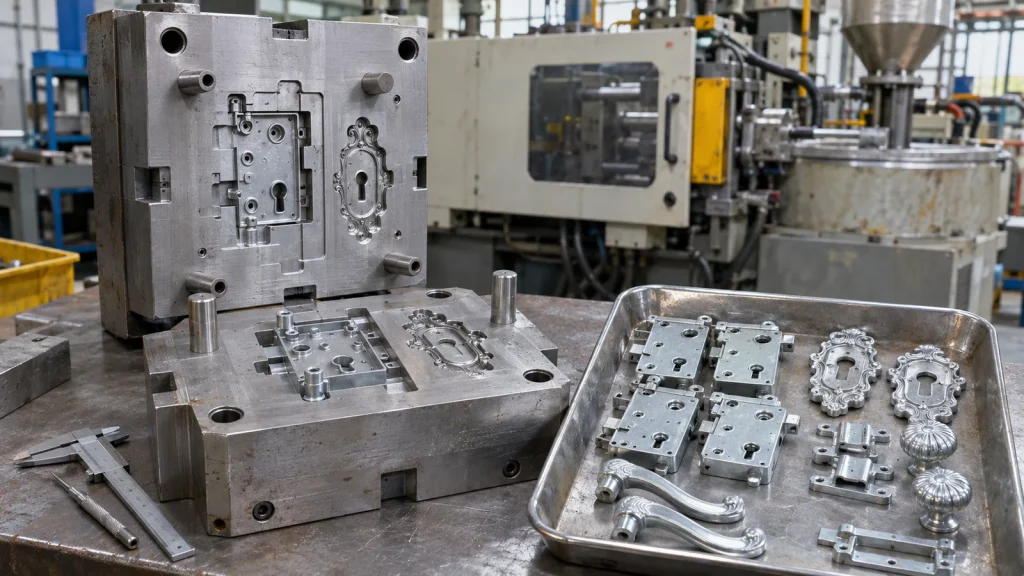
Mould base suppliers sit upstream in the die-casting tooling chain. They are normally not the company that designs the final casting or builds the complete die. They supply the standardised, semi-finished structural foundation that a toolmaker or die maker then turns into a finished die-casting tool. The simplest way to picture the chain is as a straight line:
Steel / material producer → Mould base supplier → Die / mould maker → Die caster → OEM / Tier 1 supplier
Each link adds a specific kind of value. The steel producer supplies certified blocks and plates. The mould base supplier converts those blocks into a dimensional platform: plates milled square, pockets roughed or finished, guide bores bored to tolerance, water lines drilled, heat treatment applied and documented. The die maker adds the part-specific geometry: shaped cavity and core inserts, slides, ejector pins, thermal management, venting, and the shot-sleeve interface sized to a particular machine. The die caster then runs the tool, and the OEM defines the part.
The division of responsibility can be stated crisply: the base supplier owns standardisation; the die maker owns customisation. Everything else in this article follows from that split.
What a die-casting mould base actually contains
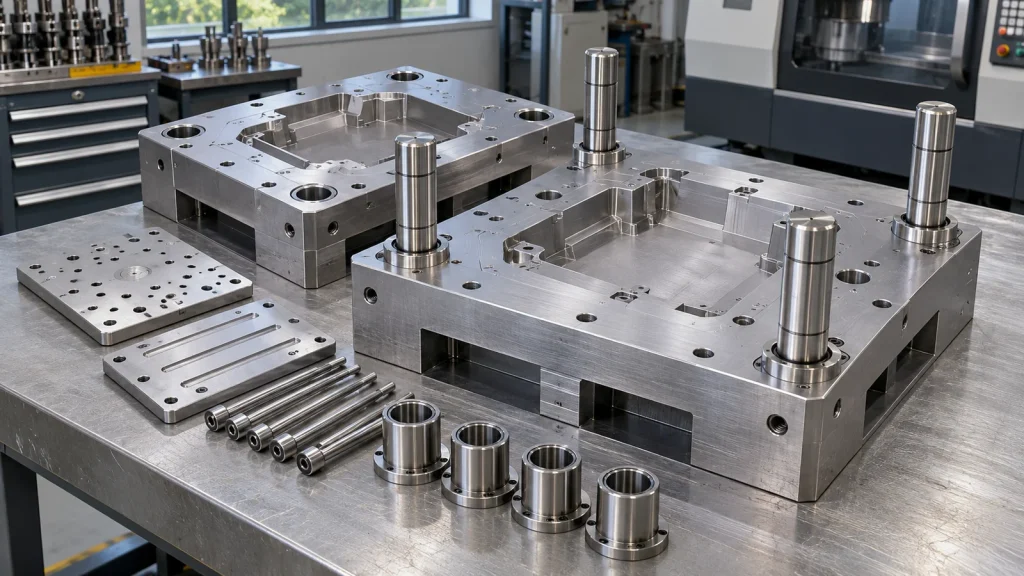
A mould base is not a simple block of steel with holes in it. A typical two-plate die-casting base is a catalogue steel frame assembly comprising a top clamping plate, a cavity plate (the A-plate), a core plate (the B-plate), a support or backing plate, spacer blocks or risers, an ejector plate and ejector retainer plate, guide pillars with guide bushes, return pins with springs, support pillars, lifting provisions, and a locating ring. On the die-casting side there are additional, machine-specific features: the sprue or shot-sleeve bore, the interface for the shot sleeve and plunger tip, water manifold and connector provisions, and clamping slots matched to the platen of a particular cold-chamber or hot-chamber machine.
That machine-specific element is worth underlining. A die-casting base cannot be specified purely from a part drawing. It has to be matched to the platen dimensions, tie-bar spacing, clamping slot pitch, shot position and shot-sleeve diameter of the press it will run on, and to the expected metal pressure and projected area of the casting. The base is therefore both a standardised product and a machine-adapted one — a catalogue frame configured to an application.
Because die-casting injection pressures and intensification forces are high, the base also has a structural duty that plastic moulding bases rarely share to the same degree. The separating force during filling and intensification can reach hundreds of tonnes. If the backing plate deflects, the cavity plate follows, and flash appears at the parting line. Support pillars and adequate plate thickness are not incidental details; they are the difference between a die that holds a tolerance for a hundred thousand shots and one that is shimmed and reworked within a month.
Core responsibility one: standardisation and modularity
Mould base suppliers exist because machining every structural component from scratch is an inefficient use of a toolmaker’s most expensive assets. The supplier manufactures interchangeable steel plates, guide pins, bushings, ejector pins, springs and locating rings to precise tolerances and holds them in catalogue form. The toolmaker buys, rather than makes, the commodity portion of the tool.
The standard systems — HASCO, DME, Progressive, LKM, MISUMI, Meusburger and others — matter far beyond convenience. They establish a shared vocabulary of plate sizes, tolerance classes and component interfaces. A die maker, a die caster and a maintenance workshop in three different countries can all work to the same guide-pin bore size and the same ejector-plate bolt pattern. That interoperability underpins interchangeability of spare parts, simplifies maintenance planning, reduces the number of drawings a tooling engineer has to create, and makes quotations faster and more comparable.
The economic effect is cumulative. Standard bases eliminate rough machining of large plates, eliminate drilling and grinding of standard features, remove the waiting time associated with heat treatment before precision work begins, and reduce scrap risk on expensive forged blocks. They also shift a chunk of the toolmaker’s fixed cost into variable cost, allowing a small tool shop to bid on a large die without owning a gantry machining centre just to square up plates.
A less obvious benefit is knowledge capture. A catalogue base embodies decades of accumulated design practice: rib placement, support-pillar spacing, ejector-plate guidance, cooling-line clearances. A toolmaker who buys standard bases inherits that practice rather than relearning it project by project.
Core responsibility two: material selection and heat treatment
Die casting is a punishing duty cycle. Molten aluminium enters the cavity at around 660–700 °C, the surface heats in milliseconds, and the die then gives that heat back to the cooling channels and the air. The result is thermal shock, thermal fatigue, erosion at the gate, and solder adhesion on hot-work steel. Base suppliers therefore act as materials engineers, not merely as steel cutters.
For cavity and core plates and inserts, hot-work steels dominate: AISI H13 (DIN 1.2344) is the workhorse, hardened and tempered to roughly 44–48 HRC, with 1.2343 (ESR-quality) used where thermal load is severe or where parts have thin walls and long cores. For structural plates, the choice is driven by stress rather than temperature: pre-hardened 1.2311 or 1.2312 (P20 and P20+Ni grades, around 30–34 HRC) for A-plates, B-plates and support plates; 1.1730 carbon steel for low-stress spacer blocks; and 42CrMo (AISI 4140-type) where clamping and bending loads are high.
Heat treatment is where a base supplier’s competence is really tested. Hardening and multiple tempering must achieve the specified hardness through the section, not just at the surface. Stress relief after rough machining — typically in the 600–650 °C range, followed by controlled cooling — is essential for dimensional stability, because a large plate with locked-in residual stress will move during the die maker’s final machining and take the parting line out of flatness with it. Surface treatments such as nitriding, black oxidising or chrome plating address wear, erosion and corrosion depending on the alloy being cast.
The materials side also includes integrity control. Thick plates can carry internal porosity, segregation or banding inherited from the ingot. Ultrasonic testing of heavy sections, control of inclusion content and attention to grain direction are the difference between a base that machines predictably and one that reveals a void after the water lines are drilled — a defect that can leak coolant directly into a die cavity and scrap a casting campaign.
Core responsibility three: rough machining and pre-engineering
Modern base suppliers do considerably more than saw, mill and drill. Working from the toolmaker’s CAD data, they deliver pre-machined pockets, runner channels, fastener holes, ejector bores, lifting holes, clamping slots and increasingly water lines and guided-ejection features. Deep-hole and gun drilling for cooling galleries, in particular, is a specialist capability that many tool shops cannot perform economically in-house.
This pre-engineering has a direct effect on the die maker’s critical path. If the base arrives with pockets roughed, bolt patterns drilled and standard features complete, the toolmaker’s high-value machine tools — the five-axis mills and sinker EDMs — are used only for the work that genuinely requires them: cavity and core inserts, parting-line fits and slides. Fewer set-ups, less roughing on precision machines, less material to remove after heat treatment, and less chance of a dimensional error in features that are already right.
The best suppliers go further and offer design-for-manufacture feedback. They can flag a tolerance stack-up that will not close, cooling lines that interfere with ejector bores, support-pillar positions that fall into a pocket, thin plate sections that will distort under clamping, or a base size that sits outside economical shipping and handling limits. This advisory role is often invisible in a purchase order but has a large effect on first-try success.
Core responsibility four: dimensional consistency as the real deliverable
Ask a die caster what they want from a base supplier and the answer is rarely about steel grade. It is about whether the next base is identical to the last one, and whether its critical features are where the model says they are.
Guide-pin bore positions, A/B plate alignment, flatness and parallelism of the parting surfaces, perpendicularity of guide pillars, and the position of the shot-sleeve bore together define the dimensional baseline on which everything else is built. Typical specifications call for parting-surface flatness in the order of a few hundredths of a millimetre across a full plate, parallelism of major faces to similar values, and guide bores machined to H7-class fits. Achieving that on a plate a metre across requires properly stress-relieved stock, capable machine tools, temperature-controlled machining and inspection with coordinate measuring machines, and — for large bases — laser tracking or granite-plate verification.
When the baseline is wrong, the symptoms appear far downstream: flash and mismatch at the parting line, accelerated wear on guide components, uneven ejection and part distortion, gate misalignment that produces turbulence and porosity, and cooling galleries that do not line up between the two halves, creating hot spots and thermal cracking. All of these look like toolmaker problems or die-caster problems. Many of them are base problems.
Why die casting is harsher than plastic injection for base makers
Mould base suppliers serve both plastic injection and die casting, but the two duties are not equivalent. Injection moulding operates at lower metal temperatures and far lower cavity pressures. Die casting adds thermal cycling that fatigues inserts, metal pressures that load the clamping system heavily, and an interface — the shot sleeve and plunger — whose alignment to the cavity directly affects both flash and sleeve life.
Die-casting bases therefore tend to be more heavily built, with thicker clamping plates, more generous support-pillar arrangements and more robust ejection systems. They carry larger cooling water volumes, because the heat input per shot is an order of magnitude higher, and they must accommodate venting provisions and overflow wells. They are also physically bigger and heavier: a large automotive die-casting base can weigh several tonnes, which changes the logistics, lifting and stress-relief requirements entirely.
A supplier whose experience is exclusively in plastic moulding can produce a dimensionally correct frame that is nonetheless under-supported, under-cooled or wrongly configured at the shot-sleeve interface. Buyers who treat all bases as interchangeable commodities discover this at tryout.
Lead time, capacity and the make-or-buy decision
Base supply is a lead-time business as much as a steel business. Typical industry lead times for die-casting bases run in the region of 7–20 days for standard configurations, extending to roughly 18–25 days when heat treatment and finish machining are included. Compare that with rough-machining large plates in-house, stress-relieving them, and then queueing for hardening: several weeks of the toolmaker’s calendar consumed by work that adds no differentiation.
There is a second, subtler function. Whether a tool shop makes or buys its bases is often driven by internal workload. When order books are full and skilled machinists are the constraint, the base goes out. When the shop is quiet, the base comes back in-house to keep spindles turning. Mould base suppliers therefore act as a flexible capacity buffer for the tooling industry — absorbing peaks that would otherwise become late die deliveries, and releasing capacity when demand softens. For OEM launch programmes with immovable dates, that buffer is worth more than a few percentage points of piece price.
Supplier capacity also has a structural dimension. Large gantry milling, deep-hole drilling and adequately sized heat-treatment furnaces are capital-intensive, and not every region has them. The availability of base capacity, not the availability of toolmakers, is sometimes the binding constraint on a die-casting programme.
The quality gate: how a cheap base becomes an expensive die
A mould base typically represents a modest share of total die cost — frequently in the region of 15–25 percent, against the cavity and core inserts, design, assembly and tryout. Yet it conditions the performance of the entire tool. That asymmetry is why experienced buyers treat the base supplier as a quality gate rather than a steel merchant.
The failure modes are well known. A plate delivered softer than specified loses thread strength and guide-bore geometry within a production campaign. A plate that was not properly stress-relieved moves after final machining, so the parting line never closes cleanly. A substituted steel grade — the wrong alloy delivered as an equivalent — can crack under thermal cycling or fail to hold hardness at temperature. Misplaced water lines create hot spots, distortion and porosity. Internal porosity in a thick section becomes a coolant leak into the cavity. Poorly positioned or undersized guide bores cause misalignment, flash and premature wear on every guide component in the tool.
The consequence is cost multiplication. Rework on a base that has already been fitted with inserts is expensive; rework that only surfaces at tryout, on a die caster’s press, with a launch date approaching, is far worse. Incoming inspection is therefore not bureaucratic overhead. Material certificates to EN 10204 3.1, hardness verification, dimensional reports for critical interfaces, dye-penetrant or ultrasonic examination where specified, and a documented refusal path for non-conforming plates are all part of managing that risk.
The commercial and contractual role
Beyond manufacturing, base suppliers perform commercial functions that shape the supply chain. They provide quotation and specification support at the bid stage, so a toolmaker can price a die with known base costs and lead times rather than estimates. They hold framework agreements, consignment or vendor-managed stock of common plate sizes, and kitting arrangements that bundle base, standard components and hardware into a single delivery.
They also provide continuity for maintenance. Because bases are built to published standards, a die caster’s maintenance shop can order replacement guide pins, bushings and ejector components years after the die was built, from the same standard family, without going back to the original toolmaker. That spare-parts accessibility is a real and often unquantified benefit of standardisation.
Contractually, buyers should be explicit about material traceability, heat-treatment records, permissible weld repairs, dimensional acceptance criteria, marking and documentation, packaging for heavy plates, IP protection for drawings, and lead-time commitments with remedies. The supplier’s own upstream exposure matters too — hot-work steel blocks in large sections can be long-lead items, and a base supplier’s steel procurement is a risk the toolmaker inherits.
Trends reshaping the role
Several developments are changing what a mould base supplier is expected to deliver.
Giga casting and integrated structural parts. Very large machines producing single-piece structural castings have pushed base sizes into territory that only a handful of suppliers can serve, with multi-tonne plates requiring specialised handling, stress relief and machining capacity. This is driving consolidation and long-term partnerships rather than transactional purchasing.
Additive manufacturing and conformal cooling. Hybrid bases that accept printed inserts with conformal cooling channels blur the boundary between base supplier and toolmaker. Some suppliers now deliver the base with cooling inserts already integrated, capturing work that previously belonged downstream.
Smart mould bases. Embedded thermocouples, pressure sensors, strain gauges and RFID identification are turning the base into a data node for die-life monitoring, predictive maintenance and process traceability — particularly relevant in automotive quality systems.
Digital integration. CAD-to-CAD workflows, machine-readable STEP models, automated quoting and model-based inspection reports are compressing the engineering interface between toolmaker and base supplier, and in some cases transferring base design responsibility upstream.
Localisation and dual sourcing. The freight cost and lead time of moving multi-tonne steel across regions, plus geopolitical and tariff risk, are encouraging regional service centres and dual sourcing, especially for OEM programmes with local-content requirements.
Sustainability and remanufacturing. Recycled tool steel, refurbishment of existing bases for new programmes, and take-back arrangements are emerging as differentiators as die casters face pressure to reduce embodied carbon.
How to evaluate a mould base supplier
For buyers, a structured evaluation is more reliable than a price comparison. The essentials include material traceability and steel sourcing, whether heat treatment is in-house or outsourced and how furnace calibration and records are controlled, machining capability in the relevant size range (gantry milling, deep-hole drilling, large-plate grinding), metrology and inspection reporting, quality-system certification such as ISO 9001 or IATF 16949 for automotive work, documented experience with the specific alloy being cast — aluminium, zinc or magnesium — rather than plastics alone, lead-time reliability and on-time delivery history, engineering support and DFM feedback, spare-parts availability, and financial stability.
The buyer’s side of the interface matters just as much. A usable RFQ for a die-casting base includes the die layout and cavity arrangement, complete machine specifications (platen size, tie-bar spacing, clamping-slot pitch, shot position, sleeve diameter), cast metal and shot weight, projected area and expected clamping force, target shot count and die life, the cooling and ejection concepts, the standard system to be used, critical tolerances fit to the toolmaker’s capability, and required documentation, marking and packaging.
Frequently asked questions
Are mould base suppliers the same as mould makers?
No. A mould base supplier manufactures the structural frame and standard components; a mould maker or die maker builds the finished tool around that frame, adding cavity and core inserts, slides, ejection detail, thermal management and the machine interface. Some large toolmakers do both, but in the supply chain they are distinct roles. The base supplier’s product is a platform; the die maker’s product is a functioning tool that produces a specific part.
Can a mould base be reused for a different part?
Often, yes — and this is one of the practical advantages of standardisation. If the new casting fits within the existing plate envelope, the machine interface, the shot-sleeve position and the cooling capacity, the base can be refurbished: inserts are removed, pockets are re-machined or welded and re-cut, guide components are replaced, and the plate is re-verified dimensionally. Reuse is most attractive for large bases, where the plate cost dominates, and least attractive where the new part requires a different machine or substantially different thermal duty.
Do base suppliers handle heat treatment and surface treatment themselves?
It varies. Some operate in-house hardening and tempering furnaces with full documentation; others outsource to specialist heat treaters while retaining responsibility for the result. Either model can work, but the buyer should confirm who is accountable for hardness through the section, stress relief after rough machining, dimensional movement after treatment, and the records that will be supplied. Outsourced heat treatment without clear traceability is a recurring source of disputes.
Which standard should I specify — HASCO, DME, LKM or another?
The right answer is usually the one your die caster and maintenance organisation already work to. Standard choice affects component interchangeability, spare-parts availability and local supply. HASCO and Meusburger are common in Europe, DME and Progressive in North America, LKM and MISUMI widely in Asia and increasingly globally. For multi-region programmes, specify a standard with service and stock presence in every region where the die will be maintained.
What is the biggest risk when sourcing die-casting mould bases?
Substitution and undocumented process variation. The two failure modes with the worst downstream consequences are a steel grade that is not what the certificate claims and heat treatment or stress relief that was skipped, abbreviated or applied without records. Both produce a base that looks correct, measures acceptably when new and fails months later in production. The second-largest risk is a supplier with plastic-moulding experience only, who underestimates support, cooling and shot-sleeve alignment requirements.
How much does base quality actually affect die life?
Indirectly but substantially. The base sets the alignment, the clamping stiffness, the cooling distribution and the ejection behaviour of the whole tool. A well-built base allows the inserts to reach their expected life; a poor one accelerates guide wear, creates flash that must be trimmed and reworked, and produces thermal imbalance that shortens insert life through cracking and distortion. Die life is determined by the inserts, but it is enabled or undermined by the base.
Conclusion
Mould base suppliers occupy a foundational tier in the die-casting supply chain: upstream of the toolmaker, downstream of the steel producer, and structurally underneath every cavity insert that a die caster runs. Their role can be summarised in four responsibilities. They standardise, producing interchangeable plates and components to published systems that make the whole industry interoperable. They engineer materials, selecting hot-work and structural steels and applying the heat treatment that lets a die survive thermal shock and clamping load. They pre-machine, converting raw blocks into near-finished subassemblies with pockets, water lines, fastener patterns and machine interfaces already in place. And they hold dimensional discipline, establishing the baseline against which alignment, flatness and shot-sleeve position are judged for the life of the tool.
Beyond manufacturing, they compress lead times, absorb capacity peaks as a flexible buffer for the tooling industry, and act as a quality gate whose failures surface far downstream as flash, porosity, wear and downtime. Their share of die cost understates their influence on die performance, which is precisely why sophisticated buyers audit them rather than simply price them.
For anyone specifying, purchasing or managing die-casting tooling, the practical implications are clear. Treat the base as a performance component, not a commodity. Specify the standard, the steel grade, the heat-treatment and stress-relief regime, the critical tolerances and the documentation explicitly. Match the supplier’s experience to die casting rather than plastic moulding. Verify incoming bases against the critical interfaces before inserts go in. And build long-term relationships with suppliers who can support large sections, short lead times and the emerging demands of giga casting, conformal cooling and instrumented tooling. The base is the part of the die nobody photographs — and the part that decides whether the photograph is of a successful launch or a recovery plan.
参考资料
- Top 10 Mold base manufacturers in the World 2025
- Custom Die Casting Injection Mold Base With CNC Grinding Drilling
- Custom Standard Mould Components For Die Casting Die/mould Plastic Injection Mold – Expore China Wholesale Standard Mold Components and Plastic Injection Mold, Die Casting Mould, Mould Parts | Globalsources.com
- Die Casting & Two-Shot Mold Base Specialist
- Mold Base vs Die Casting Die: Frame, Cavity, Cost and Lifecycle Compared
- Outsourcing mold bases saves time, money
- Customized Precision Plastic Mold Base For Stamping Tool Die Casting Mold
- Auto Mould/ Auto Parts/ Plastic Mold/ Die Casting Mould
- China Die Casting Mold Manufacturer and Supplier, Factory | PF Mold
- Die Casting Mold