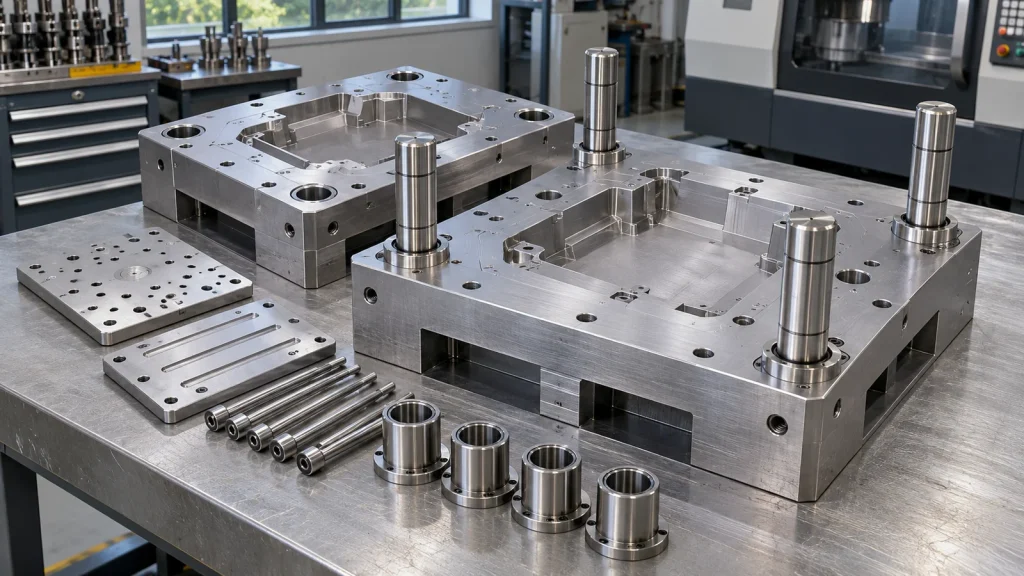
Introduction: A Mould Base Is a System, Not a Part
A general machining workshop can cut metal to a drawing. That is a useful starting point, but it is not the same capability as building the skeleton on which an entire injection mould depends. A mould base is the stack of plates, guide components, ejector plates, support structures, cooling passages and machine interfaces that hold the cavity and core, align the two halves, absorb clamping force and allow the mould to open, eject and close reliably for millions of cycles. Its quality is judged less by whether a single hole matches a print and more by whether hundreds of plates can be produced repeatedly, assembled into a matched stack, and dropped into a press without rework.
That distinction explains why mould base manufacturers and general machine shops can both own CNC mills, surface grinders and CMMs yet operate in different capability universes. The general shop is usually organized around build-to-print parts: one job at a time, tolerances applied per feature, material purchased for the job, and inspection focused on the delivered part. The mould base specialist is organized around a product system: catalogued plate sizes, standard guide-pin and bushing locations, defined ejector patterns, controlled heat treatment, matched-set machining, leak testing and documentation tied to mould standards such as DME, HASCO, Misumi, LKM or Futaba.
The difference is not a single machine or a single tolerance. It is the combination of standardization, large-format precision, deep-hole capability, metallurgical control, engineering support and inspection discipline. Each element reinforces the others. A large surface grinder is valuable only if the plates are stress-relieved so they stay flat after grinding. A gundrilling machine is valuable only if the cooling circuit is designed so the holes do not collide with ejector bores. A CMM is valuable only if the measurement plan reflects how the plates work together. Buyers who compare suppliers on price per kilogram or hourly machining rate often miss this system-level gap, and the hidden cost appears later as fitting time, flashing, premature wear or a mould that never settles into stable production.
1. Build-to-Print vs. Build-to-System
A general machining workshop typically receives a drawing or model and machines the features it specifies. Its contractual world is the individual part: material grade, dimensions, tolerances, surface finish and perhaps a first-article inspection report. The workshop may be highly skilled and can hold tight tolerances on a small component. But it is not normally responsible for whether that component, together with five to eleven other plates, forms a stack that closes squarely, aligns its guide pillars, keeps its ejector plates parallel and seals the parting line under injection pressure.
A mould base manufacturer works from a different starting point. It offers a product family built around mould standards and catalogued dimensions. The customer specifies the mould size, plate thicknesses, steel grade, guide-pin arrangement, ejector pattern, cooling requirements and machine interface. The manufacturer then produces a base that is intended to be interchangeable with standard components and compatible with the mouldmaker’s cavity and core work. It may deliver a semi-finished base, with plate sizes and guide features complete but pockets left for the mouldmaker, or a fully finished package with pockets, water lines, ejector assembly details and clamping slots.
This shift from part to system changes the meaning of capability. The relevant question is not only can you machine this hole, but can you machine this hole in the same relationship to every other hole across a matched set of plates, after heat treatment, with material from a controlled stock, and prove it with a measurement report that the mouldmaker can use. That is why a mould base manufacturer is judged on repeatability across hundreds of identical plates rather than on a single successful one-off part.
2. Standardization and Interchangeability
The first visible capability gap is standardization. A general workshop generally works to customer-supplied tolerances and does not need a catalogue of plate sizes, guide-pin positions or ejector patterns. A mould base manufacturer works inside an ecosystem. DME, HASCO, Misumi, LKM and Futaba are not simply brand names; they represent dimensional conventions for plate sizes, leader pins, bushings, sprue bushings, locating rings, ejector pins, return pins, support pillars and clamping details. A base built to one of these standards allows the mouldmaker to select wear parts from stock and replace them without remachining the mould.
Standardization also changes inventory and lead time. A specialist can stock standard plates and components, group orders by material and thickness, and keep semi-finished bases ready for final machining. It can deliver a base that drops into a moulder’s press without rework because the machine interface, clamping slots, locating ring and ejector pattern already follow a known convention. A general shop typically buys material for each job and treats every dimension as a custom feature. That is flexible, but it is slow and it pushes integration risk back to the mouldmaker.
Interchangeability is more than convenience. In a production mould, guide bushes and leader pins wear, ejector pins bend, and locating rings may be replaced. If the base follows a standard, maintenance is a matter of ordering the correct catalogued part. If the base is a one-off collection of custom dimensions, every replacement becomes a machining job. That difference matters over the life of a mould that may run for years and produce millions of parts.
3. Stack-Up Precision: The Tolerance That Matters Most
A mould base is not a single precision part. It is a stack, often six to twelve plates, including the stationary clamp plate, cavity plate, core plate, support plate, spacer blocks and ejector plates. The critical precision is not only the location of one hole but how the plates relate to one another. The A-side and B-side must close on the same guide system every cycle. The ejector plates must move without binding. The support plate must not deflect under injection pressure. The stack must remain square when clamped.
Mould base manufacturers therefore work to plate-level and assembly-level specifications. Typical requirements include flatness and parallelism of large plates in the range of 0.01 to 0.02 mm over 500 mm or more, squareness of the assembled stack, accurate pocket location and depth so cavity and core inserts sit flush and shut off correctly, and guide features that are bored or reamed in matched sets. In high-precision work, guide-pin holes in stacked plates may be line-bored or co-bored simultaneously so coaxial alignment stays within about ±0.005 mm. The exact values depend on the standard, mould size and application, but the principle is consistent: alignment must survive thermal expansion and repeated clamping.
A general machine shop may be able to hold a tight tolerance on a small part, yet lack the large-format surface grinders, boring mills and CMM routines needed to prove a whole plate stack. It may machine each plate to its own datum and rely on the mouldmaker to fit the assembly. That approach can work for simple tools, but it transfers risk. If the guide holes are not coaxial, the mould may bind when hot. If the plates are not parallel, the parting line may flash. If the pockets are not at the correct depth, inserts may sit proud or recessed. These are not defects that can always be corrected by a little spotting or polishing; they are system errors that affect every cycle.
4. Equipment and Process Capabilities
Large-format surface grinding
The battle for flatness and parallelism is won or lost on large grinding equipment. Mould base manufacturers operate heavy-duty gantry surface grinders and rotary surface grinders capable of holding parallelism within about 0.01 mm per metre across large steel slabs. That capability is necessary because a mould base may be clamped under 50 to 3,000 tonnes or more of clamping force. If the plate faces are not flat and parallel, the stack can rock, the parting line can open, and molten plastic can escape as flash. The mould may also wear unevenly and lose alignment.
A general workshop often relies on face milling, fly-cutting or a small-bed surface grinder. Those processes can produce a good finish on a small part, but they are not equivalent to grinding a large plate in one setup. Setup size matters because every re-setup introduces a new datum and a new opportunity for error. When a supplier says it can grind a large plate, the useful follow-up question is how large a plate it can grind in one setup and what parallelism it can hold over that area.
Deep-hole drilling and gundrilling
Cooling channels and long ejector-pin holes are another capability divide. A mould base may require holes with length-to-diameter ratios greater than 20:1, sometimes more than 30:1, and in large tools the depth can exceed 1,000 mm. A standard twist drill tends to wander over that depth, especially in pre-hardened steel. A gundrilling machine with high-pressure coolant, accurate guidance and multi-spindle capability can hold position and straightness far better. The difference is not cosmetic. A cooling line that drifts may miss the intended circuit, intersect an ejector bore, or leave a thin wall that cracks under pressure.
Mould base specialists also plan the cooling circuit as a system. They install plugs, baffles and connectors, pressure-test the circuit and document leak tests. A general shop may drill a straight hole to print, but it may not design the circuit, install the fittings or verify that the channel does not conflict with other features. That system responsibility is part of what makes a mould base manufacturer different.
Boring, milling and matched-set machining
Guide-pin holes, bushing seats, sprue-bush seats and ejector-guide holes often require boring or reaming rather than simple milling. A mould base manufacturer has boring mills and jig-boring capability and organizes work in matched sets. It may machine the A and B plates together, or at least verify them together, so that the guide system aligns when the stack is assembled. The same logic applies to ejector plates: the ejector plate and ejector backing plate must move together on their guide pins without binding.
A general machine shop can bore a hole, but the value is in the relationship between holes. If the A plate and B plate are machined separately from different datums, the assembly may require reaming, scraping or fitting. That extra work is often invisible in the purchase price of the machining but appears in the mouldmaker’s assembly hours.
Metrology and fit verification
Mould base makers inspect with the assembly in mind. They use CMMs on every critical plate, not only on samples. They check plate-to-plate fit, guide-pin alignment and shut-off faces. Blue-contact or spotting checks may be used on parting-line surfaces. Documentation is tied to the standard, such as HASCO K-series dimensions, so the customer can verify that the base matches the expected interface. A general workshop may perform first-article inspection and then sample production. That is normal for discrete parts, but it is not enough for a matched stack in which every plate affects the alignment of the whole.
5. Integrated Secondary Operations and Heat Treatment
A mould base is rarely just milled. The process chain usually includes stress relief, rough machining, heat treatment, precision grinding, deep-hole drilling, tapping, counterboring and fitting. Each step can distort the steel if it is not controlled. Mould base manufacturers therefore integrate secondary operations rather than treating them as isolated subcontract services.
Stress relief is especially important. Large steel plates accumulate residual stress from rolling and rough machining. If the plate is finished without stress relief, it may move after grinding or after the first heating cycles in the press. A specialist may stress-relieve before finish machining, sometimes between roughing and finishing, and may use controlled heating and cooling cycles. For pre-hardened steels such as P20 or 718H, the goal is to preserve hardness while removing stress. For through-hardening steels, vacuum heat treatment and tempering may be required. Nitriding may be used on guide components or wear surfaces.
Precision grinding after heat treatment restores flatness and parallelism that may have changed during thermal processing. Deep-hole drilling may be sequenced before or after heat treatment depending on the steel and the hole function. Tapping and counterboring for ejector assemblies, support pillars, sprue bushings, locating rings and clamping slots must be done with the final stack in mind. If water lines are required, the supplier may install plugs, baffles and fittings and perform a leak test before shipment.
A general machine shop may be able to arrange heat treatment, but it usually does not own the full sequence. That means more handoffs, more chances for distortion, and less clear responsibility when a plate moves after grinding. For a simple base in mild steel, the difference may be manageable. For a large production mould in pre-hardened or through-hardened steel, integrated thermal control is a core capability, not an optional extra.
6. Material Control and Traceability
Mould base manufacturers buy tool steel in volume. They stock pre-hardened and through-hardening grades such as P20, 718H, S50C, 2311, 2312, H13, 420 stainless and S7. They control hardness, typically around 28 to 34 HRC for pre-hardened P20 or 718 depending on the grade and specification, and they can guarantee consistency from plate to plate. They may use ultrasonic testing to check for internal flaws and hardness testing to verify incoming material. Certificates are retained and linked to the finished base.
A general machine shop may source whatever steel is available for a single job. That is not necessarily wrong, but it creates risk. If one plate in a stack is softer than another, the guide holes may wear differently. If a plate has hidden internal stress or a lamination, it may move or crack during machining. If the hardness is not verified, the mouldmaker may discover the problem only after the base is finished. For a one-off prototype, the risk may be acceptable. For a production mould, material consistency is part of the base’s fitness for purpose.
Traceability matters when something goes wrong. A mould base manufacturer can trace a plate back to its heat number, heat-treatment batch and inspection record. That makes it possible to investigate a failure, compare batches and correct a process. A general shop working job by job may have less complete records. The difference is not visible in a quotation, but it affects the cost of quality over the life of the mould.
7. Engineering Support and DFM for Moulds
A mould base manufacturer often provides design-for-manufacture support that a general machine shop does not. It reviews press tonnage, tie-bar spacing, ejector stroke and base size. It checks whether the support plate thickness is sufficient to prevent deflection under injection pressure. It reviews cooling layout and parting-line clearance. It checks that water lines do not collide with ejector holes or guide bores. It helps select standard components such as ejector pins, guide components, sprue bushings and locating rings.
This support is valuable because many mould base problems are designed in before they are machined. A base that is too small for the press, a support plate that flexes, a cooling circuit that cannot reach the hot spot, or an ejector pattern that conflicts with the guide system will cause problems no amount of machining accuracy can fix. A general workshop typically machines what is on the drawing. It may not flag that the base will flex or that the water lines will intersect the ejector holes, because it is not responsible for the mould’s function.
The best mould base suppliers act as an engineering partner in the early stage. They can propose a standard base size that avoids custom machining, adjust plate thicknesses, recommend a steel grade, and identify interference before cutting starts. That front-end review reduces lead time and rework. It also shifts some of the technical risk to the supplier best equipped to manage it.
8. Quality Regime and Documentation
The quality regime of a mould base manufacturer is broader than first-article inspection. Critical plates are measured on a CMM, not just sampled. Matched A and B plates are checked for fit and guide alignment. Parting-line surfaces may be spotted. Water circuits are leak-tested. Hardness and material certificates are retained. The final report may reference the mould standard so the customer can confirm interchangeability.
This documentation is not bureaucracy. It is the evidence that the base is a system, not a collection of parts. A mouldmaker receiving a base with a CMM report for the matched set can plan assembly with confidence. A mouldmaker receiving a box of plates with individual inspection sheets may still have to verify the stack, ream guide holes and correct pocket depths. The hidden cost of missing documentation is assembly time and uncertainty.
A general CNC shop may have excellent inspection for the parts it makes. But its inspection plan is usually part-centric. It checks the features on the drawing, not the relationship between plates that will be assembled later. That is the difference between conformance to a part specification and conformance to a mould base specification.
9. Commercial and Lead-Time Implications
The capability difference has commercial consequences. A mould base manufacturer can standardize, stock material, batch similar plates and deliver a predictable base in a shorter time. The mouldmaker can outsource the base and focus on cavity and core work, which is where much of the mould’s value and technical difficulty lies. This division of labor is common because it saves time and money when the base is a standard product and the mouldmaker’s expertise is in the cavity.
A general machining workshop may quote a lower hourly rate for simple machining. That can be attractive for a prototype or a non-critical base. But the total cost includes engineering, material verification, heat treatment, grinding, fitting and inspection. If those steps are fragmented, the mouldmaker may spend more time coordinating and correcting than it saved on the machining rate. The lowest quote is not always the lowest cost.
The commercial model also affects risk allocation. A mould base manufacturer that supplies a finished package takes responsibility for the base’s fit and function within the specified standard. A general shop that machines to print takes responsibility for dimensional conformance to the print, but not for whether the stack works. The buyer should decide which risk it wants to retain and which it wants to transfer.
10. How to Vet a Supplier: A Practical Checklist
When evaluating a supplier, ask questions that reveal system capability rather than machine capacity alone.
| Question | Why it matters | What a strong answer looks like |
|---|---|---|
| Which mould standards do you build to? | Shows whether the supplier can deliver interchangeability | Names DME, HASCO, Misumi, LKM or Futaba and explains the dimensional conventions |
| What is the largest plate you can grind in one setup, and what parallelism can you hold? | Reveals large-format precision capability | Gives a specific size and a flatness or parallelism value over that area |
| Are water lines, heat treatment and stress relief in-house or subcontracted? | Shows control of the process chain | Explains the sequence, quality checks and responsibility for distortion |
| Can you provide a CMM report for a matched A and B plate set? | Proves assembly-level inspection | Offers a report with guide alignment, pocket location and flatness data |
| What is your gundrilling depth-to-diameter capability? | Tests deep-hole capability | States L/D ratio, maximum depth and coolant pressure |
| How do you verify material hardness and internal soundness? | Tests material control | Mentions hardness testing, ultrasonic testing and certificates |
| Do you review press tonnage, ejector stroke and cooling layout? | Tests DFM support | Describes a formal review before machining |
| How do you leak-test water circuits? | Tests finished-package capability | Describes pressure, duration and documentation |
A supplier that can answer only the machine-size question is likely a machining workshop, not a mould base manufacturer. A supplier that can answer the standards, process-chain, metrology and DFM questions is operating at the system level. The answers should be specific. Vague claims about precision or experience are less useful than a description of the sequence from material intake to final inspection.
11. When a General Machining Workshop Is Still Appropriate
The distinction does not mean general machine shops have no role. For a simple prototype, a repair, a non-critical base or a mouldmaker with strong in-house grinding and boring capability, a general shop can be a reasonable choice. The key is to define the split of responsibility. If the mouldmaker will perform the final stack alignment, grind the plates, install the guide system and take responsibility for fit, then a general shop may provide useful machining capacity at a lower cost.
The risk rises as the base becomes larger, the steel becomes harder, the cooling circuit becomes deeper, and the production life becomes longer. A small aluminium prototype base may tolerate a part-centric approach. A 2,000-tonne production mould in pre-hardened steel will not. The buyer should match the supplier’s capability to the consequence of failure. For critical work, the system-level capabilities of a mould base manufacturer are usually worth the price.
Frequently Asked Questions (FAQ)
Is a mould base manufacturer just a machine shop with bigger machines?
No. Larger machines are only one part of the difference. A mould base manufacturer also works to mould standards, stocks and certifies tool steel, controls stress relief and heat treatment, machines matched plate sets, drills deep cooling channels, leak-tests water circuits and inspects the assembly. A general shop may have a large machine but lack the standards, process chain and assembly-level inspection that make a mould base reliable.
What tolerances should I expect on a mould base?
Typical requirements depend on the standard, size and application, but common specifications include flatness and parallelism in the range of 0.01 to 0.02 mm over 500 mm or more, squareness of the assembled stack, and guide-pin alignment within about ±0.005 mm when plates are co-bored. Pocket location and depth must be accurate enough for inserts to sit flush. Buyers should ask for the actual specification and the measurement method, not just a general claim of precision.
Why is co-boring or line-boring of stacked plates important?
Co-boring aligns guide-pin and bushing holes across multiple plates in one setup. This keeps the A-side and B-side coaxial when the mould is assembled and heated. If plates are bored separately from different datums, the guide system may bind or wear unevenly, and the mould may not close consistently. Co-boring is a system-level capability that a part-centric machine shop may not offer.
Do all mould base manufacturers offer heat treatment and water lines in-house?
Not all. Some specialize in machining and subcontract heat treatment or water-line work. In-house capability is not automatically better, but it usually gives tighter control of the process chain and clearer responsibility for distortion and leak testing. Buyers should ask who performs each step, how the sequence is controlled and what documentation is provided. For critical bases, a supplier that manages the full chain is often preferable.
How can I compare quotes from a mould base maker and a general machine shop?
Compare the scope, not just the price. Check whether the quote includes material certification, stress relief, heat treatment, grinding, deep-hole drilling, water-line fittings, leak testing, matched-set inspection and documentation. A general shop quote may cover machining only, leaving the mouldmaker to arrange and verify the rest. The lowest machining rate can become the highest total cost once integration and rework are included.
Can a general machining workshop produce a simple mould base?
Yes, for simple or non-critical work it can be appropriate, especially if the mouldmaker has in-house grinding, boring and assembly capability. The risk rises with plate size, steel hardness, cooling-circuit depth and production life. If a general shop is used, define the split of responsibility clearly and require inspection of the matched stack, not just individual plates.
Conclusion
The core difference is system responsibility. A general machining workshop machines parts to print; a mould base manufacturer engineers a repeatable assembly that aligns, seals, cools and ejects reliably under production conditions. Standardization, stack-up precision, large-format grinding, gundrilling, heat treatment, material traceability, DFM support and matched-set inspection are the capabilities that separate the two. Buyers should vet the process chain and the evidence, not just the machine list. For simple work, a general shop can still be useful, but critical moulds usually justify a specialist.
参考资料
- China Top 10 Mold Parts Manufacturers for Global Buyers
- Custom Mold Components Suppliers | Precision Mold Parts Manufacturers | Spark Mould
- Outsourcing mold bases saves time, money
- How to Find a Reliable Plastic Mould Maker: 5 Verified Criteria
- Mold Base Advancements Set a New Standard
- Custom Parts for Industrial Machinery | Build-to-Print Services
- Flyer Vs Machining 11-10-00.pub
- Plastic Injection Mold Maker: How to Tell a Real One From the Rest
- Mold Bases – Jade Molds
- China Top Hot Runner Mold Machining Companies for Global Buyers