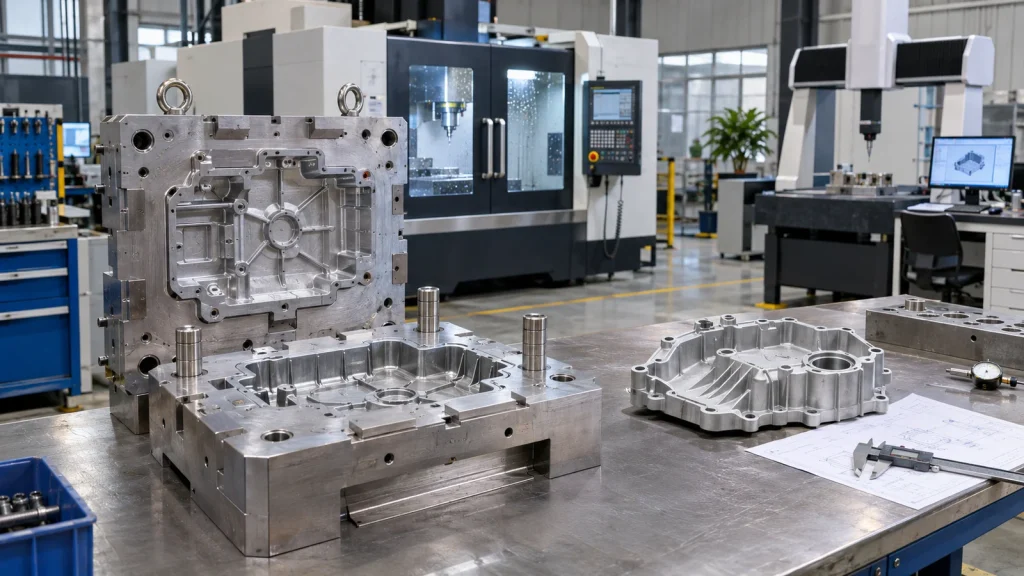
Introduction: Why the Choice Is Strategic, Not Just Technical
Every manufacturer that depends on injection molding eventually confronts a deceptively simple question: should we build and maintain our molds in an internal captive mold shop, or should we buy tooling from an external commercial mold maker? At first glance, the choice appears to be about equipment, headcount, and make-or-buy arithmetic. In practice, it is a strategic decision about control, risk, speed, capital allocation, and the role of tooling in the wider manufacturing system.
Molds are not ordinary purchased parts. They encode product design, process knowledge, quality history, and production capacity. A mold that is late, poorly built, difficult to maintain, or exposed to the wrong third party can delay a product launch, stop a production line, or erode competitive advantage. Conversely, an effective tooling strategy can shorten development cycles, reduce downtime, protect proprietary designs, and lower total cost over the mold lifecycle.
The comparison between an in-house captive mold shop and an external commercial mold maker is therefore not a simple contest between cheap and expensive or fast and slow. Each model has a different economic engine, different incentives, and different failure modes. A captive shop can be indispensable in one business and an expensive underused asset in another. A commercial mold maker can provide world-class capability and flexibility, yet create coordination and confidentiality burdens that a manufacturer is not prepared to manage.
This article examines the differences in depth and translates them into a practical decision framework. It covers ownership and mission, cost structure, capacity, technical expertise, speed, intellectual property, quality accountability, equipment, maintenance, supply chain resilience, talent, and project management. It also explains how a hybrid model often outperforms either extreme, and it provides criteria for deciding which work should remain internal and which should be outsourced.
Definitions and the Underlying Incentive Gap
An in-house captive mold shop is a tooling department owned and operated by the manufacturing company that uses the molds. Its customer is internal. It exists to support the parent company’s production lines, product development programs, and engineering changes. It may build new molds, but it is often valued most for maintenance, repair, troubleshooting, and rapid response. Its budget is usually treated as overhead or as a shared service rather than as a profit center.
An external commercial mold maker is an independent business that designs and builds molds for multiple customers. Its product is the mold itself, and its revenue comes from project-based sales. It must price engineering, machining, assembly, trial runs, risk, and profit into each quotation. It competes for shop capacity across many customers and must maintain enough technical breadth to serve different industries, materials, and standards.
That single distinction, one internal customer versus many external customers, drives almost everything else. A captive shop is optimized for the parent company’s uptime, confidentiality, and process fit. A commercial mold maker is optimized for project throughput, competitive pricing, and repeatable delivery across a portfolio of clients.
Neither incentive is inherently superior. The risk is mismatch. A company that needs same-day repair support may suffer if it relies entirely on an external supplier with a queue of other customers. A company with sporadic mold demand may struggle to justify a captive shop whose machines and skilled toolmakers sit idle between projects. The right model depends on how tooling contributes to competitive advantage and how much uncertainty the business can absorb.
A Structured Comparison
Ownership, Mission, and Customer Base
A captive shop is owned by the parent manufacturer and serves one internal customer. Its mission is to keep production running, protect proprietary designs, and support engineering changes. It does not need to win external orders or generate a margin. Its success is measured by uptime, response time, quality, and cost within the parent organization.
A commercial mold maker is an independent company with dozens or hundreds of external clients. Its mission is to deliver profitable mold projects that meet customer specifications and deadlines. It must balance the needs of different customers, manage an order backlog, and maintain commercial discipline. Its success is measured by revenue, margin, on-time delivery, repeat business, and customer satisfaction.
The captive shop usually has deep knowledge of a narrow product family. It knows the parent company’s presses, resins, quality standards, and historical mold problems. The commercial mold maker has broader knowledge across part types, mold architectures, hot-runner systems, multi-cavity designs, and industry standards. Depth and breadth are both valuable, but they solve different problems.
Cost Structure and Total Cost of Ownership
A captive shop is a fixed-cost operation. The parent company pays for floor space, machines, software, salaries, benefits, training, maintenance, and idle time. There is no supplier markup, but there is also no automatic pressure to right-size the shop when demand falls. The visible cost per repair may look low because the overhead already exists, yet the total cost can be high if utilization is poor.
A commercial mold maker converts much of the manufacturer’s capital investment into variable project cost. The buyer pays per mold or per repair, and the supplier carries the burden of machine investment, workforce utilization, and production scheduling. This can be attractive when demand is uncertain or when the manufacturer lacks the volume to keep a full toolroom busy. However, the quoted price includes engineering, risk, overhead, and profit, so the unit price may be higher than an internal cost estimate that ignores overhead.
The correct comparison is total cost of ownership, not invoice price. Total cost includes mold design, fabrication, trial runs, qualification, transportation, downtime, inventory, maintenance, repair lead time, engineering changes, quality escapes, supplier management, and the opportunity cost of capital. A captive shop may win on total cost when utilization is high and downtime is expensive. A commercial mold maker may win when demand is volatile, specialized capability is needed, or the manufacturer wants to avoid long-term fixed costs.
Capacity, Utilization, and Demand Volatility
Capacity is one of the most important differences. A captive shop is usually sized for the parent company’s average or peak demand. If the business is seasonal or project-driven, the shop may be overloaded during launches and idle during slow periods. Idle capacity is expensive because skilled toolmakers and machines are still on the payroll. Overloaded capacity is also expensive because urgent repairs compete with new mold builds and engineering changes.
A commercial mold maker can manage capacity across many customers. It can accept or decline work, add shifts, subcontract, or schedule projects according to its backlog. From the buyer’s perspective, this flexibility is valuable when demand is sporadic or when several new product lines must be launched at once. The trade-off is queue competition. Your urgent repair may not be the supplier’s top priority if another customer has a larger project or a stronger commercial relationship.
Capacity decisions should be based on the variability of tooling demand, not only on its average volume. A company with steady, predictable mold work may justify a captive shop. A company with lumpy, project-based demand may be better served by commercial partners, even if the average annual spend is significant.
Technical Depth vs Breadth
A captive shop develops deep expertise in the parent company’s products, materials, and molding processes. It learns which molds are fragile, which tolerances are critical, which cooling circuits are prone to fouling, and which repairs can be performed safely during a short window. This accumulated knowledge is difficult to replicate in an external supplier, especially when the parent company has proprietary processes or unusual materials.
A commercial mold maker develops breadth. It sees many part geometries, resin systems, mold standards, and customer specifications. It may have specialized capabilities in large molds, multi-cavity tools, stack molds, hot-runner systems, high-precision inserts, or overmolding. Its engineers can often bring design-for-manufacturability insight from other industries and projects.
The ideal capability profile depends on the source of competitive advantage. If the manufacturer competes on proprietary product design and process know-how, a captive shop’s depth is valuable. If the manufacturer competes on rapid launches, complex tooling, or cost-efficient sourcing, a commercial partner’s breadth may be more important. Many companies need both: depth for maintenance and process continuity, breadth for new mold construction.
Speed, Priority, and Responsiveness
A captive shop has a structural advantage in responsiveness. Its toolmakers are on site, know the production schedule, and can respond to a breakdown within minutes. Urgent jobs can be prioritized without negotiating with an external customer. For high-volume production, medical devices, automotive components, or packaging lines where downtime costs are extreme, this advantage can justify significant fixed cost.
A commercial mold maker can be fast, but speed depends on its backlog, scheduling discipline, and commercial relationship. A new mold may be completed quickly because the supplier has specialized equipment and experienced project managers. A repair may take longer because the mold must be shipped, inspected, quoted, scheduled, repaired, and returned. In a crisis, distance and queue position matter.
The distinction is between planned speed and emergency speed. Commercial suppliers can be excellent for planned new builds with agreed milestones. Captive shops are often superior for unplanned emergencies, engineering trials, and incremental changes that require immediate iteration. A manufacturer should assess how often it needs each type of speed.
Intellectual Property and Confidentiality
A captive shop offers the highest level of control over intellectual property. Drawings, CAD models, process parameters, and mold histories remain inside the company. Access can be restricted, and employees are subject to the parent company’s confidentiality policies. For proprietary designs, defense-related work, or highly competitive consumer products, this control can be a decisive advantage.
A commercial mold maker can protect intellectual property through non-disclosure agreements, security procedures, and contractual controls. Reputable suppliers treat customer designs as confidential and often work for competing companies without leaking information. Nevertheless, using an external supplier necessarily exposes designs to a third party. The manufacturer must manage legal, operational, and reputational risk.
IP protection is not binary. A company can outsource commodity molds while keeping proprietary tools in-house. It can split designs into modules so that no single supplier sees the complete product. It can require data security audits, access logs, and restrictions on subcontracting. The right approach depends on the value of the design and the sensitivity of the process knowledge embedded in the mold.
Quality, Accountability, and Warranty
A captive shop is accountable through internal management systems. Quality problems are visible quickly, and corrective action can be coordinated across engineering, production, and tooling. However, internal accountability can become blurred. If the toolroom is a cost center, there may be less commercial pressure to meet delivery or cost targets. Internal customers may tolerate issues that an external supplier would be forced to resolve.
A commercial mold maker operates under a contract. The scope, specifications, delivery dates, acceptance criteria, warranty terms, and payment milestones are typically defined in advance. This creates commercial accountability. If the mold does not meet the agreed standard, the buyer has contractual remedies. The trade-off is that disputes can be costly and slow, especially when specifications are incomplete or when responsibility is shared between design, tooling, and molding process.
Quality is ultimately a function of capability and management, not ownership. A strong captive shop can deliver excellent quality, and a weak one can become a protected source of defects. A strong commercial supplier can be a valuable partner, and a weak one can create delays and finger-pointing. The buyer must define standards, verify capability, and manage performance regardless of model.
Equipment, Technology, and Automation
A captive shop is limited by what the parent company is willing to invest. It may have excellent machines for the parent’s core work but lag in new technologies such as five-axis machining, high-speed EDM, automated electrode handling, advanced simulation, or automated inspection. Investment decisions compete with production equipment and other capital projects. If the parent company does not see tooling as strategic, the shop may fall behind.
A commercial mold maker must stay competitive to win work. It often invests in new machines, software, automation, and process technology to improve speed, precision, and cost. Because those investments are amortized across many customers, the supplier can justify capability that a single manufacturer could not. This is especially relevant for large molds, complex geometries, multi-cavity tools, and high-precision applications.
Technology leadership is not guaranteed. Some commercial shops compete on low cost and may have older equipment. Some captive shops are highly advanced because the parent company treats tooling as a core competency. The lesson is to evaluate actual capability and investment plans, not assumptions based on ownership type.
Maintenance, Repair, and Lifecycle Support
Maintenance and repair are where captive shops often provide the clearest advantage. The shop that built or has long maintained a mold knows its history, its failure modes, and its critical dimensions. It can perform same-day repairs, make emergency inserts, polish a damaged surface, or modify a cooling circuit without shipping the mold to an external location. This reduces downtime and preserves production continuity.
A commercial mold maker can provide excellent repair service, especially if it built the mold and has good records. However, repairs usually require transportation, inspection, quotation, scheduling, and return shipping. The buyer may also compete with other customers for priority. For a mold that runs continuously and has a high cost of downtime, those delays can be unacceptable.
Lifecycle support should be designed deliberately. A manufacturer may keep a captive shop for preventive maintenance and emergency repairs while relying on the original commercial mold maker for major refurbishment or complex engineering changes. The key is to document mold history, spare parts, process parameters, and repair procedures so that knowledge does not reside only with one team or supplier.
Supply Chain Resilience and Geography
A captive shop shortens the tooling supply chain. It eliminates shipping, customs, travel, and some communication delays. It can respond to disruptions quickly and align tooling work with production schedules. In regions with long lead times, high freight costs, or geopolitical uncertainty, this local control can be valuable.
A commercial mold maker can increase resilience through diversification. If one supplier is capacity constrained, another may be available. Global sourcing can also provide access to lower-cost regions and specialized capabilities. However, global sourcing introduces logistics, language, time-zone, and quality risks. A single-source commercial strategy can be fragile if the supplier experiences labor shortages, equipment failures, or financial distress.
The resilient approach is usually a portfolio. Keep critical repair capability close to production, qualify multiple commercial suppliers for new builds, and maintain contingency plans for major molds. Resilience is not about choosing one model; it is about designing a tooling network that can absorb shocks.
Talent, Culture, and Workforce
A captive shop requires the parent company to recruit, train, and retain skilled toolmakers, machinists, programmers, and engineers. These skills are scarce in many regions. The company must offer competitive pay, career paths, and access to modern equipment. If the toolroom is treated as a secondary function, morale and retention can suffer, and the shop may struggle to keep up with technology.
A commercial mold maker specializes in tooling talent. Its business depends on attracting and developing skilled workers. It may have apprenticeship programs, specialized engineering teams, and a culture focused on mold making. The buyer can access that talent without building an internal team. However, the buyer also depends on the supplier’s workforce stability. A sudden loss of key toolmakers at a commercial supplier can delay projects.
Talent strategy should be part of the make-or-buy decision. If the manufacturer can build a strong internal team with sufficient workload, a captive shop can become a durable capability. If the workload is too small or too variable to support a full team, a commercial partner may be the more practical way to access expertise.
Project Management and Communication
A captive shop communicates through internal channels. Engineers, production managers, and toolmakers can meet face to face, review samples, and make decisions quickly. This proximity can accelerate problem solving, especially during product development and ramp-up. It can also create informal processes that lack discipline. Without clear project management, internal work can drift, priorities can conflict, and deadlines can slip.
A commercial mold maker operates through formal project management. Quotations, design reviews, progress reports, trial approvals, and change orders create a documented trail. This discipline can improve accountability and reduce misunderstandings. It can also add overhead and slow decision making if communication is poor or if the supplier is geographically distant.
The best model is not necessarily the one with less process. It is the one with the right process for the risk. Critical molds need clear specifications, design reviews, stage gates, and acceptance criteria regardless of whether they are built internally or externally. A captive shop should not be exempt from project discipline simply because it is internal.
Financial Lens: Fixed Cost, Utilization, and Break-Even
The financial case for a captive shop depends heavily on utilization. A toolroom with expensive machines and salaried toolmakers needs enough work to spread fixed costs across many hours. If the shop is busy year-round with maintenance, repairs, engineering changes, and new builds, the effective hourly cost can be competitive. If the shop is idle for long periods, the parent company is paying for capacity it does not use.
A simple break-even analysis should compare the annual fixed cost of the captive shop with the avoidable cost of outsourcing. Fixed cost includes salaries, benefits, floor space, equipment depreciation, software, maintenance, utilities, supervision, and training. Avoidable cost includes commercial quotations, freight, supplier management, quality inspection, downtime, and the risk of delays. The comparison should also account for the value of faster response, IP control, and process knowledge, which are difficult to quantify but real.
Capital allocation matters. Building a world-class captive shop requires investment in CNC machining, EDM, grinding, inspection, software, and automation. That capital could alternatively be used for production capacity, product development, or acquisitions. A commercial mold maker spreads the cost of specialized equipment across many customers, so the manufacturer pays only for the capacity it uses. For companies with limited capital or uncertain demand, this can be a significant advantage.
However, outsourcing does not eliminate cost; it shifts cost from fixed to variable and adds supplier margin. The manufacturer may also incur hidden costs such as supplier qualification, travel, design reviews, incoming inspection, and production delays. A rigorous total cost of ownership model should include these factors rather than comparing a commercial quote with an internal labor rate that excludes overhead.
When a Captive Shop Is the Better Choice
A captive shop is often the better choice when mold downtime is extremely expensive. High-volume production lines, medical devices, automotive components, and packaging operations may lose more money in a few hours of downtime than a toolroom costs in a month. Having toolmakers on site, with knowledge of the molds and immediate access to repair equipment, can be worth the fixed cost.
It is also the better choice when molds are highly proprietary. If a design embodies trade secrets, unique process know-how, or sensitive customer requirements, keeping tooling in-house reduces exposure. The company can control access, protect data, and avoid reliance on third-party confidentiality arrangements.
A captive shop makes sense when the manufacturer needs frequent engineering changes, trials, and rapid iteration. Product development teams often need to modify gates, runners, cooling, ejector systems, or inserts quickly. An internal shop can turn around these changes faster and with less administrative friction.
Finally, a captive shop is justified when there is enough steady work to keep it productive. If the company has a large installed mold base, regular maintenance needs, and a pipeline of new projects, the shop can achieve good utilization. In that case, the fixed cost is spread across valuable work, and the company gains control without paying for idle capacity.
When a Commercial Mold Maker Is the Better Choice
A commercial mold maker is often the better choice when mold demand is sporadic or project-based. If the company launches a few new products each year and has limited maintenance work, a captive shop may be underutilized. A commercial supplier converts the cost into project-based spending and avoids long-term fixed commitments.
It is also the better choice when specialized capability is required. Large molds, multi-cavity tools, stack molds, complex hot-runner systems, high-precision inserts, and advanced automation may require equipment and expertise that the manufacturer does not have. A commercial specialist can provide that capability without the manufacturer investing in underused assets.
Commercial mold makers are attractive when the manufacturer wants competitive quotes and access to different regions or cost structures. A competitive bidding process can reveal market pricing, encourage innovation, and reduce dependence on a single source. It can also provide flexibility during peak demand when internal capacity is fully utilized.
Finally, outsourcing may be the right choice when the company wants to focus capital and management attention on its core business. Mold making is a specialized industry. Some manufacturers are better served by partnering with experts than by building a toolroom that is not central to their competitive advantage.
The Hybrid Model and How to Govern It
In practice, many mature manufacturers use a hybrid model. They keep a small captive toolroom for maintenance, repairs, engineering changes, and urgent work, while outsourcing new mold builds to commercial specialists. This combines the responsiveness and process knowledge of an internal shop with the scale, breadth, and flexibility of external partners.
The hybrid model works best when roles are clearly defined. The captive shop should focus on work that benefits most from proximity and institutional knowledge: preventive maintenance, emergency repairs, minor modifications, spare parts, and trial support. Commercial suppliers should handle work that benefits from scale or specialization: new molds, major refurbishments, complex multi-cavity tools, and projects that exceed internal capacity.
Governance is essential. The company should establish clear criteria for deciding which work goes where. It should track utilization, turnaround time, quality, and cost for the captive shop. It should also maintain a qualified supplier panel, standardize mold specifications, and require documentation from both internal and external sources. Without governance, the hybrid model can become a source of conflict, duplication, and unclear accountability.
A useful practice is to treat the captive shop as an internal service provider with defined service levels. The shop should report on uptime, repair turnaround, budget performance, and project delivery. At the same time, commercial suppliers should be managed with the same rigor as other critical vendors, including performance scorecards, audits, and contingency plans.
Decision Framework: A Practical Scoring Model
A robust decision should consider several dimensions. First, assess the strategic importance of the mold. Does it embody proprietary design or process knowledge? Does it support a core product? Would exposure to a third party create unacceptable risk? If the answer is yes, a captive shop or a highly controlled supplier relationship may be appropriate.
Second, assess downtime cost. How much does the company lose per hour or per day when a mold is unavailable? If downtime is extreme, internal repair capability is valuable. If downtime is moderate and planned, external repair may be acceptable.
Third, assess demand variability. Is tooling work steady throughout the year, or is it concentrated in project launches? High variability favors outsourcing or a hybrid model. Stable, high-volume work favors a captive shop.
Fourth, assess technical capability. Does the company have the equipment, software, and skilled people to build and maintain the required molds? If not, can it hire and invest, or should it partner with a specialist?
Fifth, assess total cost. Compare fixed and variable costs, including overhead, supplier margin, freight, inspection, downtime, and risk. Do not compare a fully loaded internal cost with a commercial quote that excludes hidden costs, or vice versa.
Sixth, assess supply chain risk. How dependent will the company be on one supplier or one region? What contingency plans exist? A balanced portfolio often reduces risk better than a single-source strategy.
A simple scoring model can help. Assign weights to strategic importance, downtime cost, demand stability, technical capability, total cost, IP sensitivity, and supply risk. Score each candidate mold or family of molds against those criteria. The result will not make the decision automatically, but it will expose assumptions and encourage consistent choices.
Common Pitfalls and How to Avoid Them
One common pitfall is underestimating the fixed cost of a captive shop. Companies often compare a commercial quote with an internal hourly rate that excludes overhead, idle time, and capital. A realistic total cost model should include all fixed costs and assume a reasonable utilization rate.
Another pitfall is assuming that outsourcing automatically lowers risk. External suppliers can fail, delay projects, or expose designs. The buyer must qualify suppliers, define specifications, monitor progress, and maintain contingency plans. Outsourcing transfers work, not responsibility.
A third pitfall is letting the captive shop become a protected internal monopoly. Without service levels, performance metrics, and competition for appropriate work, the shop may become complacent. Internal customers should have clear expectations and, where sensible, the option to escalate or outsource.
A fourth pitfall is choosing a supplier on price alone. The lowest quote may exclude engineering, trials, warranty, or maintenance support. It may also come from a supplier with limited capacity or weak quality systems. The total cost of a poor mold can far exceed the savings from a low bid.
A fifth pitfall is failing to document mold history. Whether a mold is built internally or externally, the manufacturer should maintain records of design changes, process parameters, repairs, spare parts, and performance. This documentation reduces dependence on any single person or supplier and improves lifecycle management.
Future Trends Shaping Tooling Strategy
Several trends are changing the calculus. Digitalization is making it easier to share designs, simulate molding, monitor mold performance, and collaborate remotely. This reduces some disadvantages of external suppliers, but it also raises data security requirements. Manufacturers must balance collaboration with protection of intellectual property.
Automation and advanced manufacturing are raising the capital intensity of mold making. Five-axis machining, high-speed EDM, automated electrode handling, robotic polishing, and automated inspection can improve quality and speed, but they require investment. Commercial mold makers may be better positioned to amortize these investments across many customers, while large manufacturers may justify them for captive shops with high utilization.
Reshoring and regionalization are also influencing decisions. Supply chain disruptions have encouraged some manufacturers to shorten supply chains and rely more on local suppliers or internal capability. At the same time, global competition continues to pressure costs. The result is often a hybrid strategy: local captive capability for critical repairs, and a global or regional supplier network for new builds.
Sustainability is becoming more relevant as well. Mold making consumes energy and resources, and molds influence scrap rates, cycle times, and material efficiency. Companies may evaluate suppliers on energy use, waste management, and the ability to build durable, repairable molds. A captive shop can align more closely with corporate sustainability goals, while a commercial supplier may offer specialized expertise.
Frequently Asked Questions
1. Is an in-house mold shop always cheaper because it avoids supplier profit?
No. A captive shop avoids supplier margin, but it carries fixed costs for salaries, machines, floor space, software, maintenance, and idle time. If utilization is low, those fixed costs can make the internal shop more expensive than outsourcing. The correct comparison is total cost of ownership, including overhead, downtime, quality, and risk.
2. How can a manufacturer protect intellectual property when using an external mold maker?
Use a combination of legal and operational controls. Require a strong non-disclosure agreement, define ownership of designs and data, restrict subcontracting, audit security practices, and limit access to sensitive files. Where possible, separate proprietary modules so that no single supplier sees the complete design. For highly sensitive molds, keep the work in-house or use a trusted supplier with a long-term relationship.
3. What work should remain in a captive toolroom under a hybrid model?
Keep work that benefits most from proximity and institutional knowledge: emergency repairs, preventive maintenance, minor engineering changes, spare parts, trial support, and urgent modifications. Outsource new mold builds, major refurbishments, and specialized projects that require scale or capabilities the internal shop lacks. Define service levels and decision criteria so that the boundary is clear.
4. How should we evaluate a commercial mold maker beyond price?
Evaluate technical capability, relevant experience, project management, quality systems, equipment, capacity, financial stability, intellectual property controls, warranty terms, and service response. Ask for references and sample molds, review their design and trial process, and assess their ability to communicate. The lowest price is not valuable if the mold is late, difficult to maintain, or produces inconsistent parts.
5. Can a captive shop compete with commercial shops on new mold builds?
Yes, if it has sufficient utilization, skilled staff, modern equipment, and disciplined project management. A captive shop can be competitive when it builds molds for the parent company’s core products and benefits from deep process knowledge. However, it may struggle with specialized or large projects that require capabilities or capacity beyond its normal workload. The decision should be made project by project.
6. What signs indicate our tooling strategy should change?
Warning signs include rising mold downtime, long repair queues, increasing external spend, poor utilization in the captive shop, repeated quality problems, missed launch dates, and growing dependence on a single supplier. A periodic review of tooling demand, capability, cost, and risk can reveal whether the current mix is still appropriate. Strategy should evolve as the business, technology, and supply market change.
Conclusion
The difference between an in-house captive mold shop and an external commercial mold maker goes far beyond ownership. It is a difference in incentives, economics, capacity, expertise, speed, confidentiality, and lifecycle support. A captive shop is a dedicated cost center built around one company’s production needs. It excels at urgent repairs, process knowledge, IP control, and engineering changes, but it requires sufficient workload and investment to justify its fixed cost. A commercial mold maker sells tooling as a product. It offers broader capability, flexible project capacity, and competitive market pricing, but it requires strong supplier management and exposes designs to a third party.
The best choice is rarely all or nothing. Most manufacturers benefit from a hybrid model: keep a small captive toolroom for maintenance, repairs, and urgent work, and use commercial partners for new mold builds, specialized projects, and peak capacity. This approach protects uptime and confidentiality where they matter most while accessing scale and expertise where internal capability is limited.
The decision should be based on total cost of ownership, downtime cost, demand variability, technical requirements, IP sensitivity, and supply chain risk. Companies should define clear roles, measure performance, document mold history, and review their strategy regularly. With the right mix, tooling becomes more than a support function. It becomes a source of operational resilience and competitive advantage.