Introduction: Why the Supplier Question Is Really an Interface Question
Hot chamber die casting looks deceptively simple from the outside. A machine holds a pot of molten metal, a gooseneck and nozzle inject the alloy into a steel die, and finished zinc or magnesium parts come out at high speed. The tooling, however, is not a generic block of steel. It is an engineered system designed around a specific alloy, a specific machine interface, a specific thermal load, and a specific production plan. That is why the question of who supplies hot chamber die casting molds is not just a vendor-list question. It is a question about where design responsibility ends, where production responsibility begins, and who owns the risk when the two do not line up.
Buyers encounter several supplier models. Some are full-service die casters that build tooling and run production under one roof. Some are dedicated mold shops that engineer and machine dies but do not cast parts. Some are production foundries that prefer to use customer-owned tools. Others are zinc-alloy specialists, insert and maintenance toolmakers, prototype-to-production suppliers, digital sourcing platforms, or captive tooling divisions inside large OEMs. Each model solves a different problem, and each carries a different accountability structure.
The second half of the question is equally important. Mold making and die casting are separate businesses even when one company performs both. The mold maker builds the printing press; the die caster operates it and produces the printed pages. Confusing the two roles leads to unclear specifications, mismatched machine interfaces, disputed tryout results, and maintenance gaps. A clear understanding of supplier types and role boundaries helps buyers choose the right mix, write better contracts, and avoid expensive rework after steel has already been cut.
What Makes Hot Chamber Tooling Different
Hot chamber die casting is mainly used for low-melting-point alloys such as zinc, certain magnesium alloys, and lead or tin alloys. The injection system is submerged in the molten metal bath, which enables fast cycles and good process stability for high-volume small and medium parts. Common zinc parts include housings, brackets, locks, gears, connectors, and decorative or functional components. Because the alloy is delivered through a gooseneck and nozzle rather than a cold-chamber shot system, the die must be designed for that specific machine interface.
This matters for supplier selection in several ways. First, the die is not a standalone product. It must match the caster’s machine tonnage, die height, tie-bar spacing, platen layout, gooseneck and nozzle position, ejection stroke, and slide actuation method. A tool that is geometrically correct but incompatible with the press is not a working tool. Second, hot chamber dies face a particular combination of thermal cycling, high-speed filling, and thin-wall flow. Cooling layout, venting, gate and runner geometry, and die steel selection all affect cycle time, porosity, flash, and tool life. Third, trim tooling is often part of the scope. Degating and deburring are not afterthoughts in high-volume zinc casting; they influence labor cost, part consistency, and automation.
As a result, buyers rarely buy just a mold from a generic vendor. They buy from different supplier types depending on whether they need tooling only, parts only, or tooling plus production. The correct question is not simply who can machine a die. It is who can take responsibility for the die in the context of the machine, the alloy, the part specification, and the production volume.
The Main Types of Hot Chamber Mold Suppliers
The supplier landscape can be mapped by scope. At one end are integrated suppliers that own design, tooling, casting, trimming, and finishing. At the other end are narrow specialists that provide inserts, repairs, or machine recommendations. Most sourcing strategies use a combination rather than a single category.
1. Full-Service Die Casting Foundries and Turnkey OEM Suppliers
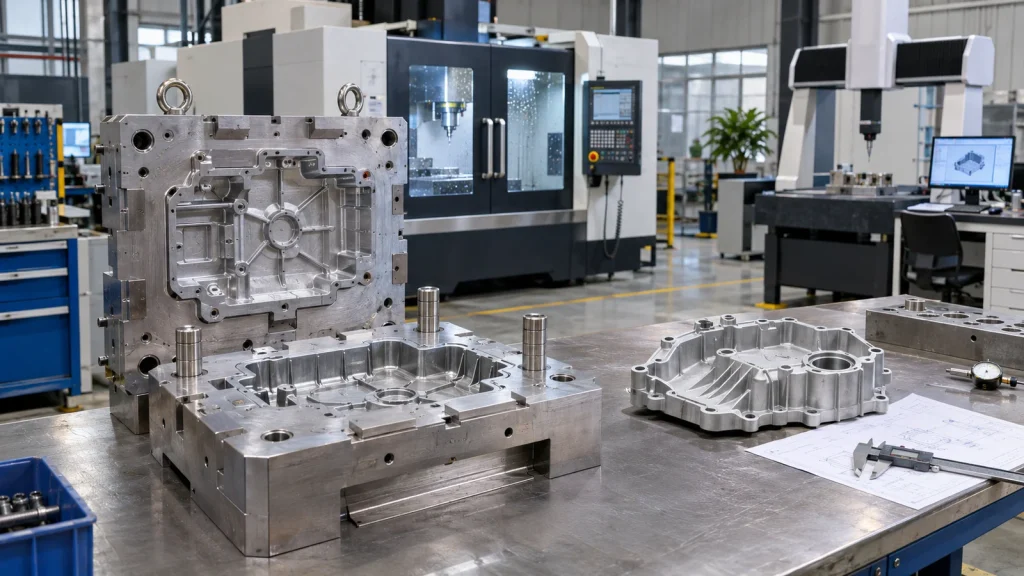
Full-service foundries design, build, sample, and run production castings in-house. They may also provide machining, finishing, assembly, and testing. For hot chamber work, this model is attractive because tooling and production sit under the same roof. When a die produces flash, porosity, or dimensional drift, there is no debate about whether the tool or the press is at fault. The same organization controls die design, tryout, process parameters, maintenance, and production approval.
This model is often the best fit for buyers who want finished parts and do not want to manage a separate toolmaker. It simplifies accountability for shot-to-shot consistency, cycle time, defect troubleshooting, and delivery. It can also shorten the loop between design changes and production because the tool shop and the casting team share the same engineering environment. The trade-off is that the buyer may have less direct control over the tool itself. If the tool is owned by the foundry, moving to another caster later may be difficult. If the tool is customer-owned, the buyer should confirm access to maintenance records, spare inserts, and dimensional reports.
2. Dedicated Precision Mold and Tooling Shops
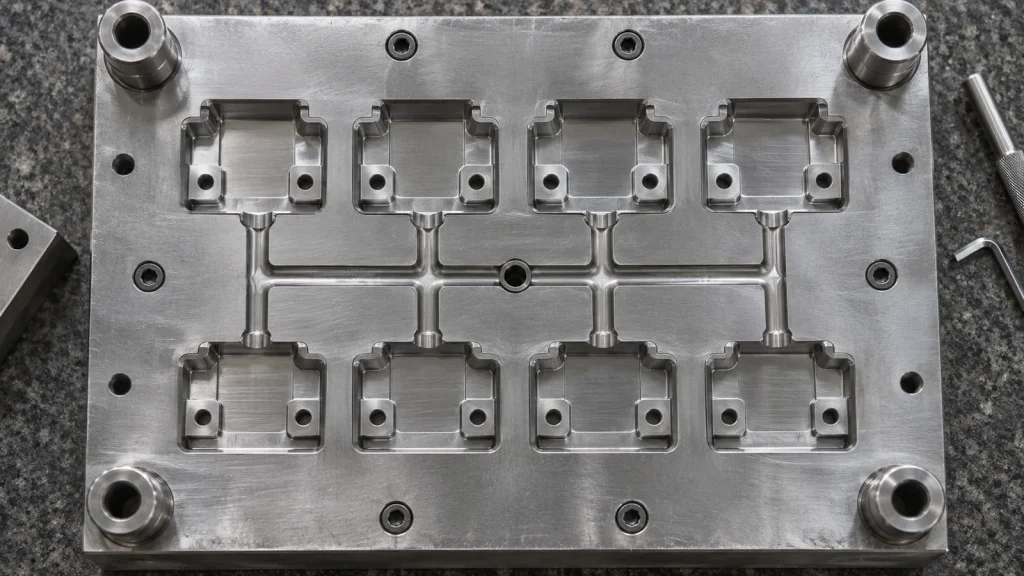
Dedicated toolmakers focus on engineering and machining steel dies, inserts, slides, cores, and trim dies. They typically do not run production casting. Their output is the tool: a one-off engineered steel system that must produce dimensionally correct parts, run reliably, and last for the planned tool life. They interpret the part drawing, design the cavity and core layout, define the parting line, gate and runner geometry, cooling and venting, ejection, and slide movements. They then machine, heat treat, fit, assemble, and trial the die.
This supplier type is best when the buyer already has a die caster or wants to own the tool and move it between casters. It gives the buyer direct control over tool design, steel selection, spare parts, and maintenance strategy. The risk is that the toolmaker may not know the target machine’s details unless the buyer or the caster provides them. A dedicated mold shop can build an excellent die that is still a poor fit for the press if machine compatibility is not managed explicitly.
3. Die Casting Production Houses with Tooling Management
Some die casting production houses cast parts using customer-owned or in-house dies. They may offer tooling management, maintenance, and refurbishment, but they do not necessarily build the die themselves. This model suits buyers who already have tooling or who want a production partner without transferring tool design responsibility. The caster focuses on machine setup, melt control, cycle time, release agent, trimming, inspection, and routine die maintenance.
The key distinction is between managing a tool and building a tool. A production house may be excellent at running a die and keeping it alive, but that does not mean it has the engineering depth to design a new hot chamber tool from a blank sheet. Buyers should clarify who is responsible for major rework, insert replacement, dimensional correction, and tool-life improvement. If the production house subcontracts toolmaking, the buyer should know who holds the technical warranty.
4. Zinc-Alloy and Hot Chamber Process Specialists
Some suppliers specialize in zinc hot chamber tooling and casting, optimizing for thin walls, tight tolerances, high-volume small parts, and demanding surface requirements. They understand the flow behavior of Zamak alloys, the thermal balance of small dies, the interaction between gooseneck temperature and die temperature, and the wear modes that appear in long zinc runs. This specialization can be valuable for components such as housings, brackets, locks, gears, and connectors.
A process specialist is not automatically the right choice for every project. The buyer should check whether the specialist’s machine range matches the part size, whether the supplier can provide trim tooling and secondary operations, and whether the quality system fits the end market. A zinc specialist with strong experience in small precision parts may be less suitable for a large, deep-draw housing or a part with complex slide action.
5. Precision Insert, Component, and Maintenance Toolmakers
Not every tooling supplier builds a complete die. Some focus on cavity inserts, cores, slides, ejector components, and replacement tooling. Others specialize in repair, refurbishment, polishing, texturing, and multi-cavity tooling support. This category is important because hot chamber dies are not permanent. They wear, crack, erode, and lose dimensional capability over time. A maintenance specialist can extend tool life and reduce replacement cost.
Buyers should treat insert and maintenance suppliers as part of the tooling ecosystem, not as a last resort. A well-managed spare insert program can reduce downtime when a cavity fails. A maintenance shop with measurement and heat-treat capabilities can correct dimensional drift before it becomes scrap. The limitation is scope: an insert maker may not be able to validate the whole die system or take responsibility for production approval.
6. Prototype-to-Production and Short-Run Tooling Suppliers
Some suppliers offer prototype dies, short-run tooling, design-for-manufacturing feedback, and then hardened production dies. This model is useful for new product development, where the buyer needs to validate geometry, alloy choice, draft, wall thickness, and assembly fit before committing to full production tooling. A prototype tool can be built from lower-cost materials or simplified inserts, but it must still respect the hot chamber process if the results are to be meaningful.
The risk is that prototype tooling can create false confidence. A die that runs a few hundred parts in a trial may not survive high-volume production. Buyers should define what the prototype is expected to prove, what data will be carried forward, and how the production tool will differ in steel, cooling, venting, and slide design. The handoff from prototype to production should be documented, not treated as a simple scale-up.
7. Digital Manufacturing Platforms and Sourcing Brokers
Digital manufacturing platforms and sourcing brokers quote from CAD files, coordinate tooling fabrication and production runs across vetted partner facilities, and manage quality documentation and logistics. They can be useful for buyers who want a single commercial interface without building a direct supplier base. They can also shorten the search process for global buyers who need multiple processes or a supplier in a specific region.
The key question is where technical responsibility sits. A broker may coordinate the mold shop and the caster, but it may not employ the die designer or the process engineer who solves a shrinkage porosity problem. Buyers should ask who signs the first article inspection report, who owns the tool warranty, who approves deviations, and who has authority to stop production. Digital sourcing can be efficient, but it does not eliminate the need for technical due diligence.
8. Captive or In-House Tooling and Casting Divisions
Large OEMs in automotive, electronics, and consumer products sometimes maintain internal engineering and manufacturing units that build and operate dies exclusively for proprietary components. This captive model protects intellectual property, controls priority, and keeps critical process knowledge inside the company. It can be highly effective for high-volume programs with dedicated equipment and a long product lifecycle.
The disadvantage is capital intensity and limited flexibility. An in-house tool shop must be staffed, equipped, and maintained even when demand fluctuates. It may also lack the external benchmarking that comes from a competitive supplier base. For smaller companies, captive tooling is rarely practical. For large OEMs, the make-or-buy decision should consider total cost, confidentiality, capacity, and access to specialized hot chamber expertise.
9. Machine and System Suppliers as Adjacent Partners
Machine and system suppliers provide hot chamber machines, goosenecks, furnaces, thermal control systems, and sometimes recommended die specifications. They are not usually mold suppliers, but they influence tool design because the die must interface with their equipment. In some cases, the machine supplier can recommend a die builder who knows the platform, or can review die drawings for interface compatibility.
Buyers should not treat the machine supplier as a substitute for a tool designer. The machine supplier knows the press; the toolmaker knows the die. The best results come when both are involved early, especially for new machine installations or unusual part geometries.
A practical summary of these supplier types is shown below.
| Supplier type | What it typically provides | Best fit | Main watch-out |
|---|---|---|---|
| Full-service foundry | Design, tooling, sampling, casting, finishing, assembly | Buyers who want one accountable partner for parts | Tool ownership and mobility may be restricted |
| Dedicated mold shop | Die design, machining, heat treat, assembly, tryout | Buyers who own the tool or already have a caster | Must receive exact machine interface data |
| Production house | Casting with customer or in-house dies, tool management | Buyers with existing tooling and high-volume needs | May not build or warrant new tooling |
| Zinc specialist | Hot chamber zinc tooling and casting for precision parts | Thin-wall, tight-tolerance zinc components | Check size range and secondary operations |
| Insert and maintenance shop | Inserts, cores, slides, repairs, refurbishment | Tool life extension and emergency repair | Limited whole-die validation |
| Prototype-to-production supplier | Prototype dies, short-run tooling, DFM feedback, production tools | New product development | Prototype may not predict production tool life |
| Digital platform or broker | Quoting, supplier coordination, documentation, logistics | Buyers who want a single commercial interface | Technical responsibility can be diffuse |
| Captive tooling division | Internal design, build, and casting for proprietary parts | Large OEMs with dedicated programs | High fixed cost and limited flexibility |
| Machine supplier | Presses, goosenecks, furnaces, interface recommendations | Setting up or expanding a casting cell | Not a substitute for die design |
Mold Maker vs. Die Caster: Two Different Businesses
Many companies perform both mold making and die casting, but the two functions remain distinct. They have different outputs, different equipment, different success metrics, and different failure modes. When a buyer understands the distinction, it becomes easier to assign responsibility and to evaluate whether an integrated supplier is genuinely integrated or simply reselling tooling.
Output and Primary Goal
The mold maker’s output is the die itself: a one-off engineered steel tool with cavity inserts, cores, slides, cooling channels, vents, ejector systems, and a shot-sleeve or nozzle interface. The primary goal is to build a dimensionally accurate, durable tool that can form the part reliably over its target shot life. The die caster’s output is finished cast parts. The primary goal is to run high-volume production cycles with consistent part quality, minimal defects, and low per-part cost.
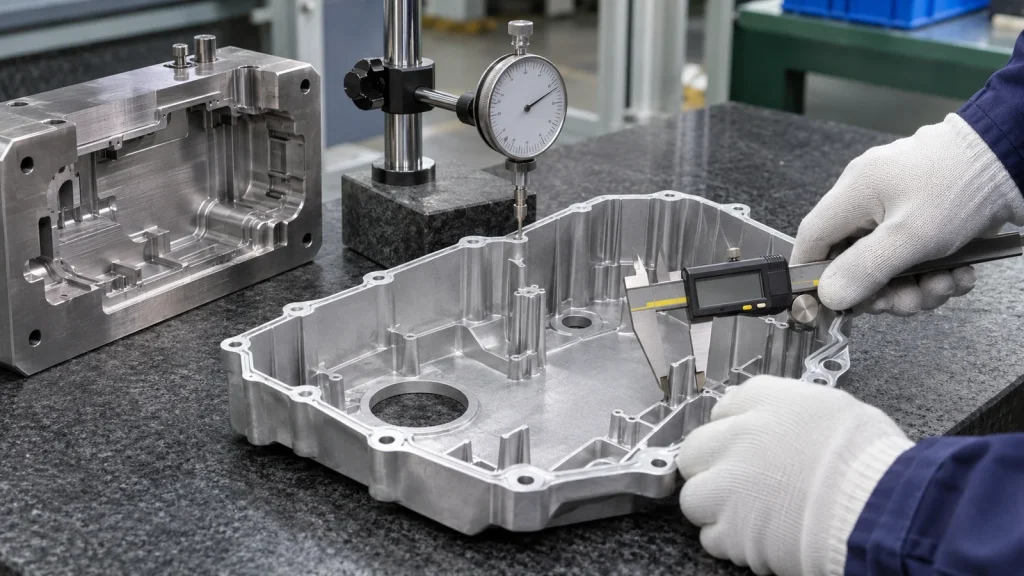
This difference in output shapes everything else. The mold maker is judged at the point of tool acceptance and over the tool’s life. The die caster is judged lot by lot, shift by shift, and delivery by delivery. A tool that passes tryout but cannot hold tolerance in production has not really succeeded. A caster that runs a marginal tool efficiently may still be producing unacceptable parts. The handoff between the two must therefore include clear acceptance criteria.
Core Activities and Equipment
The mold maker works with CAD, CAM, and CAE simulation; multi-axis CNC machining; EDM; grinding and polishing; heat treatment; and metrology. The work includes design for manufacturability, parting-line and gating layout, slide and core-pull design, cooling and venting, steel selection, machining, fitting, assembly, and initial tool sampling. The die caster works with hot chamber machines, melting and holding pots, goosenecks, trim presses, thermal controllers, release agents, and finishing and quality equipment. The work includes installing the die, setting machine parameters, controlling melt temperature and alloy quality, managing cycle time, spraying release agent, ejecting parts, trimming and deburring, inspecting lots, and maintaining the die during production.
The equipment difference explains why a mold shop cannot simply become a caster by adding a press. Casting requires process knowledge in melt chemistry, thermal balance, machine dynamics, and defect troubleshooting. Likewise, a caster cannot simply become a toolmaker by hiring a machinist. Toolmaking requires die engineering, steel heat treatment, precision fitting, and tool trial expertise.
Success Metrics and Failure Modes
For the mold maker, success means the die produces dimensionally correct parts, runs reliably, and lasts for the planned tool life. Common failure modes include improper draft or parting line, poor gate and runner geometry, inadequate venting or cooling, insufficient steel hardness or heat treatment, and slide or ejection interference. For the die caster, success means consistent part quality, yield, cycle time, and on-time delivery. Common failure modes include thermal drift, worn ejector pins or slides, inconsistent shot pressure or speed, alloy contamination, inadequate lubrication or release, and die erosion over long runs.
The failure modes interact. A poorly cooled die can force the caster to run slower or to spray more release agent, which may create porosity or surface defects. A caster that ignores die temperature control can crack a well-built die. A toolmaker that designs a thin core without adequate cooling may blame the caster for soldering or distortion, while the caster may blame the tool for poor thermal balance. The only way to resolve these disputes is to define the process window, the maintenance schedule, and the acceptance criteria before production starts.
Commercial and Cost Role
The mold maker drives upfront capital cost and initial lead time before mass production begins. This includes design, machining, heat treatment, assembly, tryout, and any corrections. The die caster drives recurring unit cost, throughput, and ongoing tool maintenance or refurbishment over the life of the program. The buyer should separate these cost pools in the commercial agreement. A low tooling price can be offset by high maintenance cost, short tool life, or poor cycle time. A low piece price can be offset by high scrap, frequent downtime, or expensive tool repairs.
A useful comparison is shown below.
| Dimension | Mold maker | Die caster |
|---|---|---|
| Primary output | The die and trim tooling | Finished cast parts |
| Primary goal | Dimensional accuracy, durability, target tool life | Consistent quality, yield, cycle time, delivery |
| Core activities | DFM, die design, CNC, EDM, heat treat, fitting, tryout | Machine setup, melt control, injection, ejection, trimming, inspection |
| Main equipment | CAD/CAM/CAE, CNC, EDM, grinding, metrology | Hot chamber machines, pots, goosenecks, trim presses, thermal controls |
| Key failure modes | Poor draft, gating, venting, cooling, heat treat, fit | Thermal drift, worn pins, pressure variation, contamination, erosion |
| Cost role | Upfront NRE and lead time | Recurring unit cost and maintenance |
| Main risk owner | Tool performance and tool life | Process stability and production yield |
Where the Handoff Breaks Down, and How to Manage It
Most sourcing problems in hot chamber die casting occur at the boundary between toolmaker and caster. The die may be well made but incompatible with the press. The caster may be capable but lacks the maintenance history of the tool. The buyer may own the tool but not the data. These boundary risks are manageable if they are addressed before steel is cut.
Machine Compatibility
The mold maker must know the caster’s machine tonnage, die height, tie-bar spacing, platen size, gooseneck and nozzle location, ejection pattern, and slide actuation method. If the die is designed without this data, the caster may need to modify the press, the robot, the trim press, or the die itself. In the worst case, the die cannot be installed at all. The buyer should require a machine interface checklist signed by both parties before detailed die design begins. For new products, a kickoff meeting with the toolmaker, caster, and machine supplier is often worth the cost.
Tool Ownership and Mobility
The contract should state who owns the die, who pays for maintenance, who can move it, and what happens if the buyer changes casters. If the buyer owns the tool, the toolmaker and caster should provide drawings, steel certificates, heat-treat records, maintenance logs, and spare parts lists. If the caster owns the tool, the buyer should understand the conditions for transfer, replacement, and amortization. Tool ownership is not just a legal issue; it affects bargaining power and continuity of supply.
Tryout Versus Production Approval
A die that runs in tryout is not the same as a die approved for production parts. Tryout may use a temporary setup, a different alloy lot, or a manual cycle. Production approval requires demonstrated capability, defined process windows, first article inspection, and agreement on defect limits. The buyer should specify PPAP or first-article requirements, cavity sampling, dimensional reports, material certifications, and acceptance criteria. The toolmaker and caster should both sign off on the tryout report and the production approval plan.
Maintenance and Refurbishment Responsibility
Routine cleaning and minor repair usually sit with the caster. Major rework, insert replacement, and dimensional correction usually sit with the mold maker. The boundary should be defined by type of work, not by convenience. A maintenance matrix can list who is responsible for polishing, vent cleaning, ejector pin replacement, slide repair, cavity welding, heat treatment, and dimensional re-certification. The matrix should also define response times and spare parts inventory.
Documentation, Change Control, and Liability
Hot chamber tooling generates a large amount of technical data: die drawings, steel certificates, heat-treat records, cooling and venting layouts, simulation results, tryout reports, process parameters, maintenance logs, and inspection records. The buyer should require this documentation as a deliverable, not as an afterthought. Change control should be formal. If the caster changes a process parameter, the toolmaker should know. If the toolmaker changes a gate or cooling line, the caster should approve. Without change control, liability becomes impossible to assign.
Commercial Models and Contract Structures
The supplier type often determines the commercial model. In a turnkey foundry model, the buyer may pay a tooling charge and a piece price, with the tool owned by the foundry. In a dedicated tool shop model, the buyer pays for the tool directly and then contracts with a caster for production. In a production house model, the buyer may own the tool and pay the caster for casting, maintenance, and storage. In a broker model, the buyer may pay a single program price that bundles tooling, sampling, production, and logistics.
Each model has different risk allocation. A turnkey supplier may offer a tool-life guarantee and a piece price that includes maintenance, but the buyer may have less visibility into tool cost. A direct tool purchase may give the buyer more control and asset ownership, but it also transfers more coordination risk. A broker may simplify administration but can obscure technical responsibility. The buyer should compare total cost of ownership, not just tooling price or piece price.
Useful contract terms include tool life definition, spare insert quantities, maintenance intervals, response time for breakdowns, access to maintenance records, ownership of drawings, rights to transfer the tool, warranty for dimensional capability, and acceptance criteria for first article and production. For automotive or medical markets, the contract should also address PPAP, APQP, traceability, change notification, and recall responsibility. For consumer or industrial markets, the terms may be lighter, but the technical acceptance criteria should still be explicit.
How to Choose the Right Supplier Mix
The right supplier mix depends on what the buyer is trying to own and control. A simple decision framework helps.
If the buyer needs finished parts and wants one accountable partner, an integrated foundry or turnkey supplier is usually the best fit. The buyer should still confirm tool ownership, maintenance access, and transfer conditions. If the buyer wants to own the tool and move it between casters, a dedicated mold shop paired with a qualified hot chamber caster is a better fit. The buyer must manage the interface and require both parties to sign off on machine compatibility and tryout. If the buyer already has tooling and needs production capacity, a die casting production house can be efficient, provided maintenance responsibility is clear. If the buyer is developing a new product, a prototype-to-production supplier can reduce risk, but the production tool must be specified separately. If the buyer needs repair or spare inserts, a specialized maintenance toolmaker is often faster than the original die builder.
A supplier selection checklist should include the following questions. Does the supplier have experience with the specific alloy, part size, and wall thickness? Can it provide unit dies with replaceable inserts, or does it only build full family dies? Does it build trim dies and degating fixtures? What tolerances and quality certifications does it maintain? Can it provide simulation, first article inspection, and PPAP documentation? What is the expected tool life, and how is it guaranteed? Who owns the tool, and what are the transfer conditions? Who handles routine maintenance and major refurbishment? What spare parts are recommended, and what is the lead time? How does the supplier manage engineering changes? What happens if the die does not meet acceptance criteria?
The answers to these questions reveal more than a brochure or a price quote. They show whether the supplier understands the boundary between toolmaking and casting, and whether it can take responsibility for the outcome rather than just the deliverable.
Quality, Certification, and Technical Due Diligence
Quality certification is necessary but not sufficient. ISO 9001 indicates a functioning quality management system. IATF 16949 is relevant for automotive supply chains. PPAP, APQP, MSA, SPC, and first article inspection are useful frameworks for proving capability. But hot chamber tooling also requires technical due diligence that goes beyond certificates.
The buyer should review die steel certificates, heat treatment records, cooling and venting designs, gate and runner calculations, simulation reports, and maintenance logs. For zinc hot chamber work, the supplier should understand Zamak alloy behavior, gooseneck temperature control, die thermal balance, and the wear mechanisms that affect small cores and slides. For magnesium, the supplier should understand the additional safety and process controls required. The buyer should also verify alloy traceability, melt quality controls, and dimensional inspection capability.
A supplier audit should include a walk through the tool room and the casting floor. Look for evidence that the toolmaker and caster communicate: shared drawings, machine interface checklists, tryout reports, and maintenance records. Ask how a dimensional drift issue is investigated. Ask who signs the first article report. Ask what happens when a die cracks during production. The answers will show whether the supplier is truly integrated or simply coordinating separate departments.
Trends Reshaping Hot Chamber Tooling Supply
Several trends are changing how buyers source hot chamber molds. Digital quoting and distributed manufacturing platforms are making it easier to compare suppliers across regions, but they also make technical due diligence more important. Simulation and additive manufacturing are improving cooling channel design and reducing trial cycles. Tool life monitoring and preventive maintenance programs are becoming more common in high-volume zinc casting. Reshoring and supply-chain diversification are pushing some buyers to qualify new casters and toolmakers in parallel.
These trends do not change the fundamentals. The die must still match the machine, the alloy, and the part. The toolmaker must still design and build a durable tool. The caster must still run a stable process. The buyer must still define who owns what. Digital tools can improve coordination, but they cannot replace a clear interface agreement.
FAQ
Is a mold maker the same as a die caster?
No. A mold maker designs and builds the die. A die caster installs the die, sets process parameters, melts the alloy, runs production, trims parts, inspects lots, and maintains the die during production. Some companies perform both functions, but the roles remain distinct. The mold maker is responsible for tool performance and tool life. The die caster is responsible for process stability and production yield.
Can I buy a mold from one supplier and cast with another?
Yes, and this is common when the buyer wants to own the tool. The critical requirement is machine compatibility. The mold maker must receive the caster’s machine interface data, and both parties should sign off on the die design before machining. The contract should define tool ownership, maintenance responsibility, access to records, and transfer conditions. A trial run should be witnessed by both parties.
What should I check for machine compatibility?
Check machine tonnage, die height, platen size, tie-bar spacing, gooseneck and nozzle location, shot position, ejection pattern, slide actuation method, trim press interface, and automation clearance. Also confirm cooling water and hydraulic connections, safety interlocks, and the available process window. A machine interface checklist signed by the toolmaker and caster is a simple but effective control.
Who is responsible for maintenance?
Routine cleaning, release agent management, and minor repairs usually sit with the caster. Major rework, insert replacement, cavity welding, heat treatment, and dimensional correction usually sit with the mold maker. The best practice is a maintenance matrix that lists each task, the responsible party, the response time, and the spare parts requirement. The matrix should be part of the contract, not an informal understanding.
What certifications matter for hot chamber tooling?
ISO 9001 is a baseline for quality management. IATF 16949 is relevant for automotive programs. Depending on the market, buyers may also require PPAP, APQP, first article inspection, material certificates, and traceability. Certification should be supported by technical evidence: die steel certificates, heat-treat records, simulation reports, maintenance logs, and dimensional inspection data.
What is the difference between a unit die and a full die?
A unit die uses replaceable cavity inserts held in a master frame. It can be more flexible for multiple part families and easier to maintain when one cavity wears out. A full die or family die is built as a dedicated tool for a specific part or part family. Unit dies can reduce replacement cost and downtime, but they may have different thermal and clamping characteristics. The choice depends on volume, part variety, maintenance strategy, and machine compatibility.
Conclusion
Hot chamber die casting molds are supplied by a range of organizations: full-service foundries, dedicated mold shops, production houses, zinc specialists, insert and maintenance toolmakers, prototype-to-production suppliers, digital sourcing platforms, captive tooling divisions, and machine suppliers in adjacent roles. The right choice depends on whether the buyer needs tooling only, parts only, or tooling plus production, and on how much control the buyer wants over the tool asset.
The difference between a mold maker and a die caster is the difference between building the tool and running the process. The mold maker owns die design, steel selection, machining, heat treatment, assembly, and tryout. The die caster owns machine setup, melt control, injection, ejection, trimming, inspection, and routine maintenance. Both roles affect quality, cost, and lead time, but they do not carry the same risks or success metrics.
The most reliable sourcing strategy is to make the interface explicit. Define machine compatibility before design, agree on tool ownership and maintenance responsibility, separate tryout from production approval, require documentation, and choose a supplier model that matches the buyer’s technical capability. An integrated supplier can simplify accountability. A dedicated toolmaker plus a qualified caster can maximize control. Either way, the buyer should manage the boundary, because that is where most expensive problems begin.
参考资料
- How do they match: 51-4072.00 – Molding, Coremaking, and Casting Machine Setters, Operators, and Tenders, Metal and Plastic
- https://moldiecasting.com/blog/die-cast-tooling-design-materials-and-best-practices/
- Hot Chamber Die Casting Solutions | Dynacast
- Hot Chamber Die Casting Service – Minghe Casting
- Hot Chamber Die Casting – Redstone Manufacturing
- https://anebonmetal.com/top-10-hot-chamber-die-casting-manufacturers-and-suppliers-in-china/
- https://xometry.sg/die-casting/
- https://cwmdiecast.com/die-cast-tooling-101/
- https://www.aluprototype.com/News/NewsInfo?NewsId=1861
- Mold Base vs Die Casting Die: Frame, Cavity, Cost and Lifecycle Compared