Introduction
Canada’s mold-making and die-casting supply system is often described in broad strokes, but its real structure is highly specific. It is not a national industry evenly spread across provinces. It is a tightly coupled, export-oriented, Tier 2 and Tier 3 ecosystem anchored by automotive, with a small number of large integrated players at the top and a long tail of specialized small and mid-sized shops underneath. The system is best understood as one dominant cluster, one secondary hub, a Quebec specialty base, and a thin national tail. That structure matters because sourcing decisions depend on geography, supplier tier, process, alloy, press tonnage, tool complexity, and program scope.
For a buyer, the practical question is not simply whether Canada has mold makers or die casters. It is where the relevant capability sits, which layer of the supply base owns it, how integrated the supplier is, and what risks come with the chosen program. This article explains how the Canadian system is constituted, what each supplier layer actually does, where capabilities are concentrated, and how structural forces such as EV lightweighting, reshoring, and vertical integration are reshaping the landscape.
A Concentrated Map: One Core, One Secondary Hub, One Specialty Base
Windsor-Essex and Chatham-Kent: the undisputed mold-making capital
Windsor-Essex is the center of gravity for Canadian mold-making. Its proximity to Detroit automakers fostered a dense cluster of complex, large-tonnage injection mold and die builders. Companies such as Cavalier Tool, CenterLine, and Integrity Tool & Mold are representative of a cluster that serves not only Canadian customers but also United States-based OEMs and Tier-1 suppliers. Industry testimony and parliamentary committee citations describe Windsor-Essex as home to the largest cluster of mold makers in North America, with roughly 150 mold shops employing almost 5,000 workers and generating an estimated $2 billion in annual economic activity. Windsor-Essex alone is also described as exporting about $2.4 billion annually, while Canadian mold-making exports approximately $7 billion annually to the United States.
Older industry estimates put the concentration even more starkly: about 80% of Canadian mold makers in Ontario, with 50% of those in Windsor, and another large concentration around Toronto. Whether one uses the 75% figure or the older 80% estimate, the message is the same: Ontario dominates, and Windsor-Essex is the core. That concentration matters for sourcing because lead times, talent, sub-supplier networks, and engineering support are all densest in Windsor-Essex. A buyer sourcing a complex automotive mold or die-casting die will usually find the deepest bench of experienced toolmakers, tryout presses, repair capacity, and specialized subcontractors in this region.
The 401 corridor and Golden Horseshoe: Tier-1 casters and precision molders
The corridor along Highway 401, including the Golden Horseshoe and the Kitchener-Waterloo-Guelph area, houses major Tier-1 die casters, precision molders, and tooling suppliers. Linamar, Magna, Stackpole, and Meridian Lightweight Technologies in Strathroy are examples of the industrial scale present in this corridor. This region is less about the pure mold-building cluster of Windsor-Essex and more about high-volume production, integrated manufacturing, and Tier-1 program management. It benefits from proximity to Toronto, Hamilton, and the broader southern Ontario manufacturing belt, as well as from highway access to the United States border.
Greater Toronto Area: packaging, medical, and custom injection tooling
The Greater Toronto Area has a different specialization. It focuses on high-cavitation packaging molds, medical tooling, and custom injection molding. Husky Injection Molding Systems in Bolton is a globally recognized example of the region’s strength in injection molding technology and high-cavitation tooling. The GTA also supports a broader base of precision machine shops, mold makers, and automation integrators that serve consumer goods, packaging, medical devices, and industrial markets. For buyers who need small precision molds, multi-cavity packaging tools, or medical-grade tooling, the GTA and southern Ontario are natural places to look.
Quebec: aerospace, recreational vehicles, and structural aluminum
Quebec, especially Montreal and the Eastern Townships, is a secondary hub with a distinct specialty. It is known for aerospace tooling, recreational vehicle components connected to the BRP ecosystem, and structural aluminum die casting. Quebec’s industrial base is less automotive-centric than Ontario’s, which can be an advantage for buyers seeking aerospace-grade documentation, low-volume specialty castings, or a different risk profile. The province also has a concentration of aluminum and zinc die casters, precision machining shops, and aerospace suppliers that serve both domestic and export customers.
The national tail: thin but relevant
The rest of Canada is scattered. British Columbia, Alberta, and Manitoba have smaller pockets of mold-making, foundry, and specialty machining capacity serving resource, defense, and specialty industrial work. These are not high-volume automotive clusters, but they can be relevant for regional repair, low-volume castings, or niche applications. The national tail is thin compared with Ontario, but it completes the picture: Canada is not only Windsor-Essex and the GTA. It is a set of regional capabilities layered onto a dominant southern Ontario core.
The Four-Layer Supplier Structure
Canada’s mold-making and die-casting supply base is best understood as four overlapping layers rather than a clean hierarchy. The layers differ in customer type, scale, capability, and business model.
| Layer | Primary focus | Typical capabilities and scale | Representative examples |
|---|---|---|---|
| Tier-1 mega-suppliers and integrators | High-volume automotive powertrains, structural megacastings, and complete system integration | Multi-plant global footprints, 2,500 to 4,500+ ton die-casting presses, in-house CNC machining, research and development | Linamar, Magna, Martinrea |
| Dedicated custom die casters | High-pressure die casting of aluminum, magnesium, and zinc for automotive, EV, and industrial markets | Medium-to-large press fleets from roughly 400 to 3,000 tons, secondary machining, automated finishing | Meridian, Burlington Technologies, Dynacast |
| Specialized tool and die shops | Design, engineering, and fabrication of complex injection molds and die-cast dies for OEMs and Tier-1s | Small-to-midsize shops with 20 to 150 employees, high-speed 5-axis CNC, EDM, tryout presses, rapid repair and engineering changes | Cavalier Tool, CenterLine, Integrity Tool & Mold, and many independent Windsor-Essex shops |
| Captive tool rooms | Maintenance, repair, and overhaul plus minor tooling builds inside larger molding or casting plants | Focus on minimizing press downtime, preventive maintenance, and urgent cavity repairs rather than new greenfield builds | In-house tooling departments at large molders and die casters |
Tier-1 mega-suppliers and integrators
The top layer consists of large automotive suppliers and OEM-adjacent manufacturers that either own tooling and casting capacity or buy it in bulk. These companies are deeply involved in high-volume automotive powertrains, structural megacastings, and complete system integration. They typically operate multi-plant global footprints, run 2,500 to 4,500+ ton die-casting presses, and maintain in-house CNC machining and research and development. Linamar, Magna, and Martinrea are examples of this layer. For a mold maker or custom die caster, these companies are both customers and competitors: they buy tooling and castings, but they also internalize critical capabilities and consolidate demand. Their program requirements are demanding in terms of quality systems, launch discipline, and financial stability.
Dedicated custom die casters
Below the mega-suppliers is a layer of dedicated custom die casters. These companies specialize in high-pressure die casting of aluminum, magnesium, and zinc for automotive, EV, and industrial markets. Their press fleets typically range from about 400 to 3,000 tons, and many offer secondary machining and automated finishing. Meridian, Burlington Technologies, and Dynacast are representative names. Many of these shops are integrated: they build or maintain dies in-house, cast parts, machine them, and sometimes assemble them. That integration is important for buyers because it reduces handoff risk and shortens the path from tool tryout to production. It also means the supplier can take responsibility for dimensional quality, porosity control, and downstream machining tolerances.
Specialized tool and die shops
The third layer is the specialized tool and die shop. These companies design, engineer, and fabricate complex injection molds and die-cast dies for OEMs and Tier-1 suppliers. Most are small to mid-sized, with 20 to 150 employees. Their capabilities include high-speed 5-axis CNC machining, EDM, tryout presses, and rapid repair and engineering changes. This is the layer that gives Windsor-Essex its density and flexibility. Many shops are family-owned, with 10 to 100 employees, and specialize in one process, material, or end market, such as zinc versus aluminum, large structural versus small precision, or automotive versus medical and packaging. Mid-size specialists with 50 to 200 employees can often take a full program: design, build, tryout, production support, and secondary machining or assembly.
Captive tool rooms
The fourth layer is the captive tool room. These are maintenance, repair, and overhaul operations inside larger molding or casting plants. Their focus is minimizing press downtime, preventive maintenance, and urgent cavity repairs rather than new greenfield builds. Captive tool rooms are often invisible to outside buyers, but they are a critical part of the ecosystem. A large die caster or molder cannot afford to wait days or weeks for an external tool shop to repair a damaged cavity. The captive tool room keeps production running. For external tool shops, captive tool rooms are both a source of competition and a source of overflow work when internal capacity is stretched.
SME dominance and consolidation pressure
The Canadian industry shares characteristics with the United States: advanced technology, a primary focus on automotive, and a large number of establishments with fewer than 50 employees. In practice, that means a long tail of small shops, a group of mid-size specialists, and a small number of large integrated companies. Consolidation, mergers, restructuring, and shorter production runs have been part of the automotive landscape for these suppliers. Extended payment terms have also been cited as a persistent pressure on die, mold, and tool firms. These financial dynamics matter to buyers because they affect supplier stability, capacity investment, and willingness to take on long-lead or high-risk programs.
The Tooling Layer: Where Mold-Making Capability Actually Sits
The tooling layer designs and builds the production tool itself: injection molds, die-casting dies, stamping dies, fixtures, and precision machining. The Canadian Association of Mold Makers describes this group as mold makers plus a broader network of tooling, machining, automation, and advanced manufacturing firms. The tools they make are required to manufacture products across automotive, aerospace, medical devices, packaging, consumer goods, construction, and industrial equipment. This is a critical point: Canadian tooling is not only automotive, even though automotive is the anchor. The same precision machining, EDM, tryout, and metrology skills can be redirected toward medical, packaging, and aerospace work when automotive programs slow.
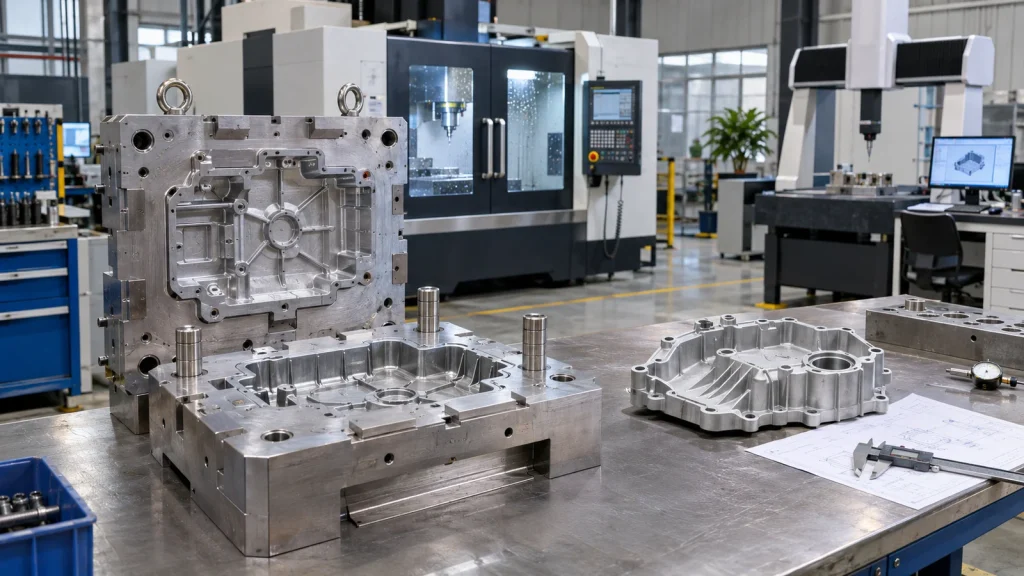
A typical specialized tool shop combines several capabilities. High-speed 5-axis CNC machining is used for complex cores, cavities, and structural dies. EDM and wire EDM produce sharp internal corners, deep ribs, and fine details that are difficult to machine conventionally. Deep-hole drilling supports cooling channels and ejector holes. Polishing, texturing, and surface finishing determine part appearance and release behavior. Tryout presses allow the shop to validate the tool before shipment. CMM and other metrology equipment verify dimensions and geometry. Flow simulation and mold-flow analysis are increasingly used to predict filling, cooling, warpage, and porosity before the first cut is made.
The material and component supply base is part of the tooling layer. Hot-work tool steels from distributors such as Uddeholm and Böhler are essential for die-casting dies and high-wear injection molds. Hot-runner system manufacturers such as Mold-Masters in Georgetown and Husky provide critical thermal management and runnerless molding technology. Heat-treating and PVD coating houses, many clustered along Highway 401, provide hardening, nitriding, and wear-resistant coatings. Mold bases, standard components, ejector systems, and sensors round out the supply chain. This density of subcontractors is a hidden advantage of the Canadian cluster. A tool shop in Windsor-Essex can source steel, heat treatment, texturing, polishing, tryout, and repair within a short driving distance, which compresses lead times and supports rapid engineering changes.
The tooling layer is also where the competition between Canada and offshore suppliers is most visible. Low-complexity, long-lead-time molds frequently go to Asia. Canadian shops tend to dominate in complex multi-shot molds, large structural dies, rapid engineering changes, and emergency North American reshoring or repair work. The reason is not simply cost. It is proximity, engineering interaction, intellectual property protection, and the ability to respond quickly when a tool needs repair or a design change. Many mid-sized mold makers have expanded into part sampling, low-volume production, or full automation integration to smooth out the cyclical nature of OEM tooling programs. That vertical integration makes them more than pure tool shops; they become program partners who can support launch and production ramp-up.
The Die-Casting and Foundry Layer: Alloys, Tonnage, and Integration
The die-casting and foundry layer runs the dies to make parts. In Canada, this segment typically covers high-pressure die casting of aluminum and zinc, plus permanent-mold aluminum, magnesium, and sand or investment casting. The parts include engine blocks, transmission housings, structural brackets, EV battery enclosures, thermal management components, and decorative parts. Many shops are integrated: they build or maintain dies in-house, cast, machine, and assemble. That integration is particularly important for automotive and EV customers who need leak-tight, dimensionally stable, and traceable castings.
Press tonnage is a useful way to segment the die-casting base. Dedicated custom die casters often run press fleets from about 400 to 3,000 tons. Tier-1 mega-suppliers may run 2,500 to 4,500+ ton presses for large structural megacastings. The higher the tonnage, the larger the part and the more capital-intensive the operation. EV battery trays, shock towers, and large structural components require high-tonnage presses, vacuum assist, and sophisticated die thermal management. Not every Canadian die caster has this capability. Buyers seeking large structural aluminum or magnesium castings need to verify press size, alloy capability, vacuum or squeeze casting options, and in-house machining capacity.
Alloy selection is another important dimension. Aluminum alloys such as A380, A383, and ADC12 are common for general high-pressure die casting. Structural and permanent-mold applications may use A356 or A357. Magnesium alloys such as AZ91 and AM60 are used for lightweight components. Zinc alloys are used for small precision parts, hardware, and decorative applications. Each alloy brings different fluidity, shrinkage, corrosion behavior, and machining characteristics. A supplier that is excellent in zinc may not be the right choice for large structural aluminum. A supplier that specializes in aluminum HPDC may not have the aerospace documentation or low-volume flexibility of a Quebec specialty foundry.
Quality systems and process control are central to the die-casting layer. Automotive suppliers typically maintain IATF 16949 certification, while NADCA standards guide die-casting design, tooling, and quality. Porosity control is a major technical challenge. Vacuum-assisted die casting, squeeze casting, flow simulation, die thermal management, and careful gate and overflow design are used to reduce porosity and improve mechanical properties. X-ray and CT inspection, leak testing, coordinate measuring, and metallurgical analysis are common. Secondary machining, washing, impregnation, and surface treatment are often part of the scope. For EV battery enclosures and thermal components, leak-tightness and dimensional stability are especially critical.
Supporting Ecosystem: Associations, Materials, Automation, and Workforce
The Canadian ecosystem is supported by a set of institutions and suppliers that are easy to overlook but important for capability and competitiveness. The Canadian Association of Mold Makers, based in Windsor, represents tooling shops, machinery vendors, and design houses across the country. Automate Canada shares leadership and office space with CAMM, reflecting how tightly industrial automation and robotics are integrated into modern Canadian tool shops. The North American Die Casting Association’s Ontario Chapter, Chapter 10, connects Canadian die casters, alloy suppliers, and die-steel and tooling providers for technical standards and workforce training.
The materials and equipment supply base includes hot-work tool steel distributors, hot-runner system manufacturers, heat-treating and PVD coating houses, mold base suppliers, automation integrators, and metrology providers. Many of these are clustered along Highway 401, which reinforces the density advantage of southern Ontario. The workforce is supported by colleges, apprenticeship programs, and industry training, but skilled trades shortages remain a persistent challenge. Toolmakers, CNC machinists, die-cast operators, maintenance technicians, and automation specialists are all in demand. For buyers, workforce depth is not an abstract issue; it affects lead times, quality, and the supplier’s ability to ramp up or recover from a disruption.
Cross-border logistics are also part of the ecosystem. The Detroit-Windsor border crossing and the Highway 401 corridor connect Canadian suppliers to the United States automotive heartland. Many Canadian shops function as North American suppliers rather than purely domestic ones. Just-in-time delivery, customs clearance, and cross-border engineering collaboration are routine. That proximity is a competitive advantage for complex, urgent, or repair-intensive work, even when simple high-volume molds can be sourced more cheaply offshore.
Structural Dynamics: EV Shift, Reshoring, and Integration
The Canadian mold-making and die-casting system is changing. The most important structural shift is EV and lightweighting. Traditional powertrain die casters and molders have pivoted toward large structural aluminum and magnesium castings, such as battery trays, shock towers, and thermal management components. These parts require massive capital investment in higher-tonnage presses, vacuum systems, machining centers, and leak-testing equipment. The trend toward megacasting, sometimes called giga-casting, is also influencing the industry. Large single-piece structural castings can replace multiple stamped and welded parts, but they demand very large presses, complex dies, and advanced process control. Not every Canadian supplier can play in this segment, but the Tier-1 integrators and the most advanced custom die casters are investing.
The second dynamic is the tension between offshore competition and reshoring. Low-complexity, long-lead-time molds frequently go to Asia. Canadian shops, by contrast, dominate in complex multi-shot molds, large structural dies, rapid engineering changes, and emergency North American reshoring or repair work. Customers increasingly value supply chain resilience, intellectual property protection, and proximity to engineering teams. That does not eliminate offshore competition, but it creates a durable niche for Canadian toolmakers. The same logic applies to die casting: high-volume simple parts may be sourced globally, but complex, integrated, or urgent programs benefit from a North American supplier base.
The third dynamic is vertical integration. Many mid-sized mold makers have expanded into part sampling, low-volume production, or full automation integration to smooth out the cyclical nature of OEM tooling programs. Die casters have moved into machining, assembly, and leak testing. Tier-1 suppliers have consolidated tooling and casting capacity. This integration changes the buyer’s options. Instead of sourcing a tool from one shop, castings from another, and machining from a third, a buyer may choose an integrated supplier that can take responsibility for the full program. That reduces coordination risk but also reduces transparency and bargaining power. Buyers need to decide which model fits their program.
Sourcing Playbook: Matching Needs to the Canadian Supply Base
A practical sourcing strategy starts with the type of work. The following table summarizes where different needs are best served.
| If you need | Where to look |
|---|---|
| Large, complex automotive injection molds or die-casting dies | Windsor-Essex plus GTA mid-size specialists |
| High-volume aluminum or zinc die castings with machining and assembly | Ontario die casters and Quebec zinc or aluminum shops |
| Small precision, medical, packaging, or multi-cavity molds | GTA, southern Ontario, and Quebec specialists |
| Aerospace, defense, or low-volume specialty castings | Quebec, British Columbia, and Alberta niche foundries |
| A full program: tool, tryout, and production | Integrated mid-size or large shops, not pure tool shops |
Before selecting a supplier, buyers should verify process fit, alloy capability, press tonnage, tool size, cavitation, tolerance, surface finish, leak-tightness, and quality certifications. For die casting, ask about vacuum assist, squeeze casting, porosity control, X-ray or CT inspection, leak testing, and in-house machining. For tooling, ask about 5-axis CNC capacity, EDM, tryout presses, flow simulation, hot-runner experience, steel grades, heat treatment, and repair response time. Also assess financial stability, customer concentration, capacity utilization, and succession planning, especially for family-owned shops.
A strong request for quotation package includes 3D models, 2D drawings, GD&T, material specification, cavitation, annual volume, launch timing, PPAP requirements, tool life expectations, and maintenance responsibility. Buyers should clarify tool ownership, tryout and sample approval, engineering change procedures, and spare parts. For cross-border programs, logistics, customs, currency, and payment terms should be agreed early. Extended payment terms are a known pressure in the tooling sector, so buyers should not assume that every shop can absorb long payment cycles without affecting pricing or capacity.
Risks, Challenges, and Future Outlook
The Canadian supply base faces several risks. Automotive cyclicality is the most obvious. When automotive production slows, work at Tier-1 and Tier-2 suppliers, including mold makers, slows too. Customer concentration is another risk: many shops depend on a small number of OEM or Tier-1 programs. Skilled labor shortages, capital intensity, energy costs, and sustainability pressure add to the challenge. Offshore competition continues to pressure simple, long-lead work. Consolidation and restructuring are likely to continue.
The future outlook is not uniformly negative. Automation, digital simulation, predictive maintenance, and additive manufacturing for conformal cooling are improving productivity and capability. High-integrity die casting and large structural EV castings create new opportunities for suppliers that can invest. Reshoring and supply chain resilience favor Canadian shops for complex, urgent, and engineering-intensive work. Canada’s niche is not lowest-cost simple tooling or high-volume commodity castings. It is complex, engineering-intensive, high-mix, and urgent work that benefits from proximity, skilled trades, and a dense subcontracting network.
Conclusion
Canada’s mold-making and die-casting supply system is a concentrated, automotive-anchored, export-oriented ecosystem. Windsor-Essex is the dominant mold-making cluster, the 401 corridor and GTA provide Tier-1 casting, precision molding, packaging, and medical tooling, and Quebec adds aerospace, recreational vehicle, and structural aluminum specialties. The supply base is layered: Tier-1 integrators, dedicated custom die casters, specialized tool and die shops, and captive tool rooms. Supporting institutions and suppliers reinforce the cluster. EV lightweighting, reshoring, and vertical integration are reshaping the industry, but the core logic remains: Canada is strongest in complex, urgent, and engineering-intensive work rather than simple, low-cost, long-lead programs.
Frequently Asked Questions
Is Canada’s mold-making industry concentrated in one region?
Yes. Ontario dominates, with about 75% of Canadian mold-making and the largest cluster in Windsor-Essex. Older estimates put Ontario at 80% and Windsor at 50% of Canadian mold makers. The GTA and southern Ontario form a secondary concentration, while Quebec has a specialty base in aerospace, recreational vehicles, and structural aluminum. The rest of Canada has a thinner tail of regional shops.
What is the difference between a mold maker, a die caster, and a Tier-1 integrator?
A mold maker designs and builds the tool, such as an injection mold or die-casting die. A die caster runs the die to produce castings, often with in-house machining and assembly. A Tier-1 integrator is a large supplier that manages complete systems for OEMs and may own tooling or casting capacity. The three roles overlap, but they represent different layers of the supply chain.
Can Canadian suppliers handle large structural EV castings?
Some can, but capability is not universal. Tier-1 integrators and advanced custom die casters are investing in higher-tonnage presses, vacuum assist, and machining capacity for battery trays, shock towers, and thermal components. Buyers should verify press size, alloy capability, leak-testing, and experience with structural parts before awarding a program.
How does the Canadian supply base compare with Asia for mold sourcing?
Asia is often competitive for simple, long-lead, low-complexity molds. Canada is stronger for complex multi-shot molds, large structural dies, rapid engineering changes, and emergency repair or reshoring work. Proximity, intellectual property protection, and engineering collaboration are key advantages. The right choice depends on tool complexity, program timing, and total cost rather than piece price alone.
What should a buyer verify before selecting a Canadian die caster?
Verify IATF 16949 or relevant quality certification, press tonnage, alloy capability, vacuum or squeeze casting options, porosity control, X-ray or CT inspection, leak testing, in-house machining, metrology, and capacity utilization. Also assess financial stability, customer concentration, launch experience, and responsiveness to engineering changes.
Are there Canadian suppliers for low-volume or aerospace castings?
Yes. Quebec, British Columbia, and Alberta have niche foundries and precision shops serving aerospace, defense, and low-volume specialty work. These suppliers may not have the high-volume automotive scale of Ontario die casters, but they can offer aerospace documentation, flexible batch sizes, and specialized alloy or process capabilities.
Summary
Canada’s mold-making and die-casting supply system is best understood as a concentrated, layered, and export-oriented ecosystem. Windsor-Essex is the core mold-making cluster, the 401 corridor and GTA provide Tier-1 casting and precision tooling, and Quebec adds aerospace and structural aluminum specialties. The supply base includes Tier-1 integrators, custom die casters, specialized tool and die shops, and captive tool rooms, supported by associations, steel and hot-runner suppliers, heat treaters, and automation firms. EV lightweighting, reshoring, and vertical integration are reshaping the industry, but Canada’s competitive advantage remains in complex, urgent, and engineering-intensive work. Buyers should match their needs to the right region and supplier layer, verify technical and financial capability, and plan for cross-border logistics and program management.
参考资料
- Industrial Castings in or near Ontario (ON) on Thomasnet
- Top 12 Hot pressing mold suppliers based in Canada
- Industry and Technology Committee on April 20th, 2026
- Moldmaking Today
- Glosario de Términos
- Metalworking Machinery Manufacturing in Canada – Market Research Report (2014-2029)
- Canada Automotive Parts Die Casting Market Statistics 2030 | Claight
- Impact of Steel and Aluminum Tariffs on Windsor-Essex, Ontario
- A closer look at tooling | 'Quickly deteriorating' production and an acquisition | Molding history
- Moldmaking Report: The 2009 Moldmaking Survey: Just The Facts – Canadian Plastics