Introduction: Why Hot Chamber Tooling Needs a Lifecycle Repair Partner
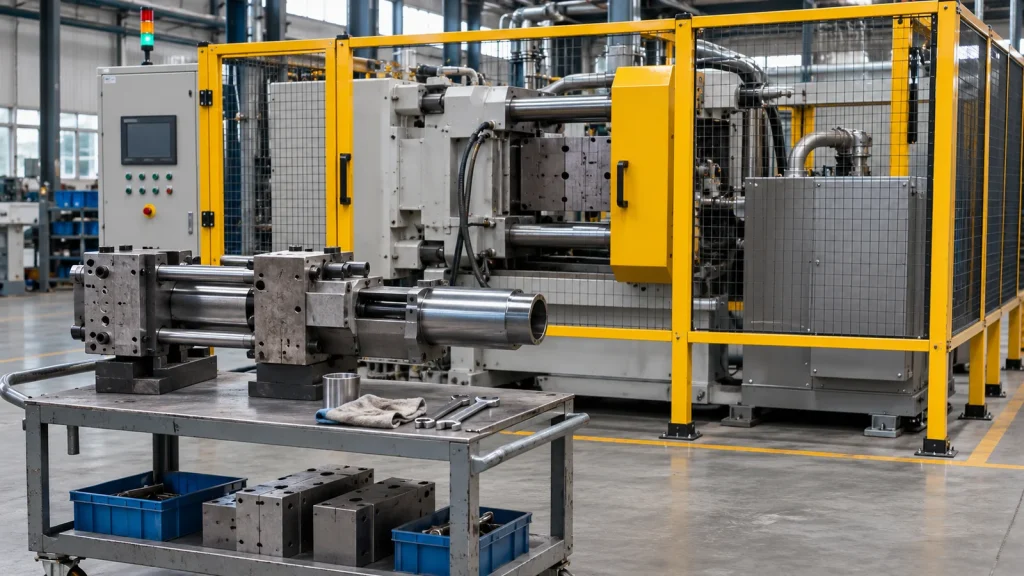
Hot chamber die casting is deceptively simple in principle. A gooseneck mechanism is submerged in molten metal, and each cycle forces a measured charge into a steel mold at high velocity. In practice, the process is extremely demanding on tooling. Because hot chamber machines work with low-melting-point alloys such as zinc, magnesium, and lead, the injection mechanism can sit directly in the melt. That advantage supports very high cycle rates, often from 10 to more than 30 shots per minute, but it also means the mold experiences continuous thermal fatigue, repeated impact, erosive flow at the gate, and a constant risk of soldering and mechanical damage.
A mold repair shop is therefore not simply an emergency room for broken dies. It is a lifecycle partner that maintains dimensional accuracy, surface integrity, and thermal efficiency from the first trial shot to the final production run. Its work prevents premature failure from repeated thermal cycling and molten metal injection, and it helps the die caster protect one of the most expensive and longest-lead-time assets in the plant.
The repair shop intervenes across four broad operational phases. During commissioning and break-in, it helps tune the mold after initial sampling. During scheduled preventive maintenance, it cleans, inspects, replaces wear parts, and relieves accumulated stress. During corrective and unscheduled repair, it restores geometry after heat checking, erosion, soldering, or crashes. During mid-life refurbishment and end-of-life extension, it recoats surfaces, replaces inserts, and adapts the tool for design changes. Around these phases sits a fifth responsibility: quality control, documentation, and feedback that helps the die caster and mold maker improve future tooling.
This article explains what a mold repair shop does across the hot chamber die casting mold lifecycle, why each activity matters, how repair decisions should be made, and what die casters should expect from a capable repair partner.
The Economic Case: Protecting Tooling Value and Manufacturing Uptime
A hot chamber die casting mold is a precision assembly of cavity inserts, cores, slides, ejector systems, cooling circuits, and structural plates. It is engineered for a specific part, alloy, machine, and production volume. Replacing it is expensive, but the greater cost is often lost production. A mold that is waiting for repair, or one that is producing flash, porosity, soldering, or dimensional drift, can stop an entire cell.
A repair shop protects value in several ways. First, it extends the working life of the mold base and inserts. Many failures begin as small surface defects that can be corrected before they propagate into cracks, dimensional loss, or catastrophic mechanical damage. Second, it reduces unplanned downtime by shifting work from reactive repairs to planned maintenance windows. Third, it stabilizes product quality by restoring parting lines, gate geometry, ejection, venting, and cooling performance. Fourth, it reduces scrap and rework caused by flash, incomplete fill, soldering, and ejection marks. Fifth, it supports sustainability by keeping tooling in service longer and reducing the demand for new steel, machining, and energy-intensive mold manufacturing.
There is also a data advantage. A repair shop sees failure modes repeatedly: where heat checking starts, which gates erode first, which ejector pins gall, which water channels scale, and which slides wear. When that information is recorded and shared, it becomes valuable feedback for mold design, process settings, maintenance intervals, and spare-parts planning.
Phase 1: Commissioning and Break-In Support
The first 0 to 10 percent of a mold life is a critical learning period. The mold may be geometrically correct, but production readiness depends on subtle adjustments in flow, venting, ejection, and thermal balance. A specialized repair shop often supports this phase after initial sampling, sometimes called T1 trials.
First-Article Adjustments
After the first parts are molded, the repair shop may perform micro-polishing, adjust parting line shut-offs to eliminate flash, and refine gate and runner dimensions based on flow analysis and X-ray porosity results. These are not crude corrections. They require an understanding of how a small change in gate land, overflow location, or vent depth can alter fill velocity, pressure, and solidification. In hot chamber casting, the margin between complete fill and flash can be narrow, especially in thin-wall zinc parts produced at high speed.
Ejection and Vent Tuning
Ejection problems often appear during break-in. A shop may modify ejector pin lengths, adjust core-pull timing, or correct misalignment in the ejector plate. It may also deepen or widen air vents so that cavity fill is balanced before full-rate production begins. If vents are too shallow, trapped air can cause incomplete fill, burn marks, or porosity. If vents are too deep, flash can form and accelerate wear on the parting line. The repair shop helps find the practical balance.
Baseline Documentation
A good commissioning service also establishes a baseline. The shop records the as-built dimensions, weld repairs, insert fits, water-circuit flow, and surface condition. This baseline becomes the reference for later maintenance. Without it, future repairs are based on memory rather than measurement, and it becomes difficult to distinguish normal wear from a developing failure.
Phase 2: Scheduled Preventive Maintenance
Preventive maintenance is where the lifecycle role of the repair shop becomes most visible. Rather than waiting for part defects, the shop services the mold on a fixed shot-count interval, often every 25,000 to 50,000 cycles depending on the alloy, part complexity, cycle rate, and mold design. The interval should be adjusted using condition data rather than treated as a universal rule.
Deep Cleaning and Descaling
Hot chamber molds accumulate several types of contamination. Zinc or magnesium can solder to cavity surfaces. Release agents can carbonize and build up in corners and vents. Mineral scale can form inside internal water-cooling channels, reducing heat transfer and distorting the thermal profile. Technicians remove these deposits using methods such as ultrasonic baths, dry-ice blasting, and acid flushing. Cleaning is not cosmetic. A scaled cooling channel can cause local hot spots, which accelerate heat checking and soldering. Carbonized release agent can block vents and alter fill patterns.
Wear Component Replacement
High-friction components such as ejector pins, return pins, guide bushings, sprue bushings, and angle pins are inspected for galling, wear, and misalignment. They are replaced before clearances widen enough to cause part misalignment, flash, or ejection failure. Slides and lifters should also be checked for wear, lubrication condition, and timing. In high-cycle hot chamber production, small wear allowances can disappear quickly. Replacing a low-cost guide bushing during a planned shutdown is far cheaper than scrapping parts or recovering from a crashed mold.
Stress-Relief Annealing
For high-volume H13 tool steel cavities, periodic sub-critical stress-relief heat treatments can reduce accumulated thermal tension in the steel surface and delay the onset of micro-cracking. This is especially relevant in hot chamber casting, where the mold surface is repeatedly heated by molten metal and cooled by the die spray and internal water. Stress relief must be planned carefully because it can affect dimensional stability and surface condition, but when used correctly it is a powerful life-extension tool.
Surface Condition Management
Preventive maintenance also includes checking surface treatments such as nitriding or PVD coatings. As these layers wear thin, friction, soldering tendency, and wear resistance can change. The repair shop may polish worn areas, remove local buildup, or recommend recoating before the substrate is damaged.
Condition Monitoring and PM Checklists
A practical preventive maintenance program combines shot count with condition monitoring. Useful indicators include water flow and temperature differential, parting line flash, ejector marks, part dimensions, die spotting, soldering tendency, and unusual noise or resistance during mold closing. The repair shop should provide a written checklist and a report after each service. This record helps the die caster plan spare parts, schedule production, and decide when a larger refurbishment is needed.
Phase 3: Corrective and Unscheduled Repairs
Even with good preventive maintenance, corrective repairs are inevitable. The repair shop restores geometry without requiring a full mold rebuild whenever this is technically and economically feasible.
Thermal Fatigue and Heat Checking Remediation
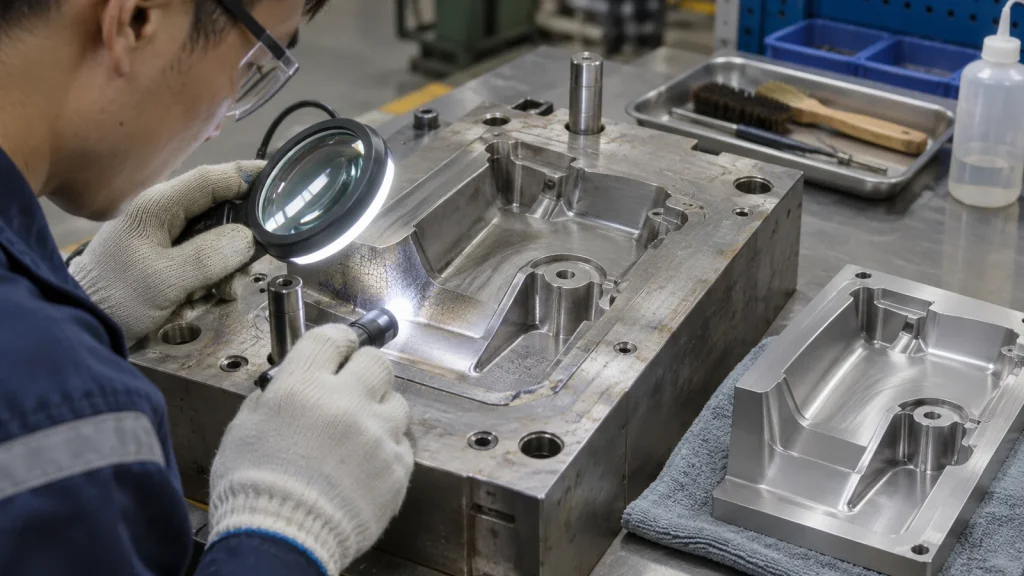
Repeated heating and cooling cause networks of fine surface cracks, commonly called heat checking. In hot chamber dies, this is a normal wear mechanism rather than a sign of poor workmanship. Repair typically involves grinding down the affected area, performing precision micro-TIG or laser welding, and re-machining the cavity back to print using EDM and hand polishing. The goal is not only to remove the crack but to restore the local surface finish and geometry so that soldering and ejection behavior remain stable. Over-welding can introduce new residual stress, so the repair must be controlled by procedure and experienced judgment.
Erosion and Washout Restoration
High-velocity molten metal entering through the gate erodes adjacent steel surfaces over time. Gate lands and sprue spreaders are especially vulnerable. A repair shop welds and re-contours these areas to restore proper fill velocity and surface finish. This work has a direct effect on part quality because gate geometry controls fill patterns, shear, and turbulence. A poorly restored gate can create new porosity or soldering problems even if the cavity itself is dimensionally correct.
Soldering and Die Build-Up
Soldering occurs when molten metal adheres to the die surface, often because of local overheating, inadequate die spray, poor surface finish, or reactive alloy behavior. The repair shop removes the built-up layer without damaging the base steel, then assesses whether the root cause is thermal, coating-related, or process-related. In some cases, polishing and recoating solve the problem. In others, the die caster must adjust cooling, spray, or cycle time.
Crash and Mechanical Damage Recovery
If a part fails to eject and the die closes on it, a double-shot or crash can result. Repair shops straighten or replace bent ejector plates, re-grind crushed parting lines, and re-align damaged slides or lifters. Crash repair requires more than cosmetic correction. The shop must check for hidden cracks, bent guide pins, damaged water lines, and loss of clamp alignment. A mold that appears to close correctly may still have internal damage that will cause premature failure if not inspected properly.
Dimensional Restoration
Over time, parting lines, core pins, and cavity details may wear or deform. The repair shop can re-machine, weld, or replace localized features to restore dimensional tolerance. For critical dimensions, the shop should verify results with measurement equipment and, where appropriate, trial shots before returning the mold to production.
Phase 4: Mid-Life Refurbishment and End-of-Life Extension
At mid-life, a mold may still have a sound base but worn surfaces, degraded coatings, or inserts that have reached their repair limits. This is the point for refurbishment rather than routine maintenance.
Recoating and Surface Hardening
As original surface treatments wear thin, shops can strip and re-apply PVD coatings or nitriding. Coatings can improve wear resistance and reduce soldering tendency, while nitriding can harden the surface of suitable steels. The choice depends on alloy, die material, repair history, and production conditions. Recoating is not a substitute for correct thermal management, but it can extend the interval between repairs.
Insert Replacement and Engineering Changes
When cavity wear exceeds weld-repair limits, the shop can machine and fit new drop-in cavity inserts into the existing mold base. This can extend the master die life by hundreds of thousands of additional cycles, or adapt the tool for customer design revisions. Insert replacement is often more economical than building a complete new mold, especially when the base, slides, and ejection system remain serviceable.
Rebuild Versus Replace Decisions
The decision to repair, refurbish, or replace should be based on several factors: remaining production demand, cost and lead time of a new mold, severity and distribution of damage, availability of spare inserts, dimensional tolerance requirements, and safety risk. A mold with deep cracks across multiple cavities, worn guide bores, distorted plates, and repeated repair history may no longer be a good repair candidate. A mold with localized gate wear and a sound base often is. The repair shop should provide a clear technical assessment rather than simply quoting a welding job.
Quality Control, Validation, and Documentation
Repair quality is not proven by a clean-looking cavity. It is proven by inspection and validation. A capable shop uses incoming inspection, non-destructive testing where appropriate, dimensional checks, hardness verification, water leak and flow testing, and final trial shots. Welding procedures should be controlled, and critical repairs should be documented with weld maps and photographs.
Documentation is part of the lifecycle service. The shop should record shot count, failure mode, repair method, materials used, coating history, and final dimensions. This record supports future maintenance and helps the die caster identify recurring problems. If the same gate erodes repeatedly, the issue may be flow design or process settings rather than repair quality. If the same slide fails, lubrication or alignment may need attention. A repair shop that collects and shares this data becomes a valuable extension of the die caster engineering team.
What a Capable Hot Chamber Mold Repair Partner Should Offer
Not every machine shop is equipped to support hot chamber die casting. The work requires metallurgical knowledge, precision welding, EDM, machining, polishing, coating capability, and an understanding of die casting process behavior. A capable partner should be able to assess heat checking, soldering, erosion, crash damage, cooling-channel condition, and dimensional drift. It should have experience with zinc, magnesium, and lead alloys and the low-melting-point conditions of hot chamber tooling. It should also offer rapid response, planned maintenance contracts, spare-parts management, and clear reporting.
Communication matters as much as technical skill. The repair shop should ask about alloy, cycle rate, die spray, water chemistry, shot count, defect history, and previous repairs. It should explain what can be repaired, what should be replaced, and what process changes may prevent recurrence. A cheap repair that fails after a few thousand shots is not cheap.
Working With a Repair Shop: A Practical Workflow
A robust workflow begins with intake and triage. The die caster provides drawings, material specifications, shot history, defect samples, process parameters, and previous repair records. The repair shop inspects the mold, identifies failure modes, and proposes a repair plan with estimated lead time and cost. After approval, the shop performs cleaning, welding, machining, polishing, coating, or insert replacement as needed. It then validates dimensions, cooling circuits, and ejection, and where possible conducts trial shots. Finally, it returns the mold with a report and recommendations.
For critical molds, the die caster should consider a preventive maintenance contract, a spare insert strategy, and an emergency response agreement. Keeping a spare cavity insert or ejector set can reduce downtime dramatically. Sharing production data with the repair shop helps set realistic maintenance intervals and avoid repeated failures.
Common Misconceptions and Best Practices
One common misconception is that mold repair is only about welding cracks. In reality, much of the value comes from cleaning, inspection, wear-part replacement, stress relief, coating, and process feedback. Another misconception is that repair should wait until parts fail. By then, secondary damage may have increased cost and downtime. A third misconception is that all repair shops are equivalent. Hot chamber die casting has specific demands, and experience with zinc or magnesium soldering and high-cycle thermal fatigue matters.
Best practices include establishing a baseline at commissioning, scheduling maintenance by shot count and condition, tracking water flow and temperature, replacing wear parts before clearances become excessive, maintaining spare inserts and ejector components, validating every significant repair, and reviewing failure data with the mold maker and process engineer. Good storage and handling also matter. A mold that is protected from corrosion and mechanical damage between production runs will need fewer repairs.
FAQ
How often should a hot chamber die casting mold be serviced?
A common starting interval is every 25,000 to 50,000 shots, but the correct interval depends on alloy, part complexity, cycle rate, cooling, die spray, and repair history. High-cycle zinc production may require more frequent inspection of gates, vents, ejector pins, and parting lines. The best approach is to combine shot-count planning with condition monitoring: water flow, flash, soldering, ejection marks, part dimensions, and visual surface condition. The repair shop should adjust the interval as data accumulates.
Can heat checking be repaired permanently?
No. Heat checking is a natural consequence of thermal fatigue in hot chamber die casting, so repair manages the condition rather than eliminating it permanently. Grinding, micro-welding, re-machining, polishing, stress relief, coatings, and better thermal control can extend the interval between repairs. If heat checking is widespread, deep, or connected to cracking in high-stress areas, replacement of an insert may be more reliable than repeated welding.
What is the difference between preventive maintenance and refurbishment?
Preventive maintenance is routine work performed on a planned interval: cleaning, inspection, wear-part replacement, vent checking, water-circuit maintenance, and minor polishing. Refurbishment is a larger intervention, often at mid-life, involving recoating, insert replacement, major dimensional restoration, or engineering changes. Preventive maintenance slows degradation; refurbishment restores capability and extends the mold life.
When should a die caster replace a mold instead of repairing it?
Replacement should be considered when damage is widespread, cracks are deep or recurrent, the mold base or guide bores are worn beyond economical repair, dimensional capability cannot be restored, spare inserts are unavailable, or the remaining production demand is large enough to justify a new tool. Safety and quality risk also matter. A repair shop should provide a technical assessment comparing repair cost, expected remaining life, lead time, and risk.
How do coatings and nitriding affect repair?
Coatings and nitriding change the surface condition, so they must be considered before welding or machining. Worn coatings may need to be stripped before repair, and the mold may need re-nitriding or recoating afterward. The repair shop should know the previous surface treatment and choose a compatible repair procedure. Coatings can reduce soldering and wear, but they do not replace correct cooling, die spray, and maintenance.
What information should a die caster provide to a repair shop?
The die caster should provide drawings, mold material, alloy type, shot count, cycle rate, defect samples, process parameters, cooling and die-spray details, previous repair history, and production deadline. Photographs of the failure and a description of when it appeared are also useful. The more information the shop has, the more likely it can identify the root cause and recommend a repair that lasts.
Conclusion
In the life of a hot chamber die casting mold, a specialized repair shop plays a role that extends far beyond emergency welding. It supports commissioning by tuning gates, vents, ejection, and parting lines. It protects production through scheduled cleaning, wear-part replacement, stress relief, and condition monitoring. It restores tooling after heat checking, erosion, soldering, and crashes. It extends mold life through recoating, insert replacement, and engineering updates. It also provides the inspection, documentation, and feedback that help die casters make better decisions.
The central answer to the original question is clear: a mold repair shop is a lifecycle partner that maintains dimensional accuracy, surface integrity, and thermal efficiency across the entire service life of a hot chamber die casting mold. It prevents small defects from becoming premature failures, reduces downtime and scrap, and helps convert tooling from a consumable cost into a managed manufacturing asset. Die casters get the most value when they choose an experienced partner, share production and failure data, schedule maintenance before defects appear, and treat repair as part of a planned lifecycle strategy rather than a last-minute emergency.
参考资料
- Mold Repair Solutions: Protecting Tooling Value and Manufacturing…
- Die Casting Mould & Die Repair, Inserts | Prime Tools
- 'ER' for molds: Making successful tool repairs
- Eight Essential Die Casting Mold Technical Standards
- Repair and Modernization of Molds and Dies: Extend the Life of Your Tooling
- The Importance of Plastic Injection Mold Repair in Modern Manufacturing | by Texlon Plastics
- Is It Worth Repairing Old Die Cast Molds Instead of Making New Ones?
- Maintenance
- Expert Thin Wall Mold Restoration