Introduction: why the UK die-casting tooling supply chain is specialised
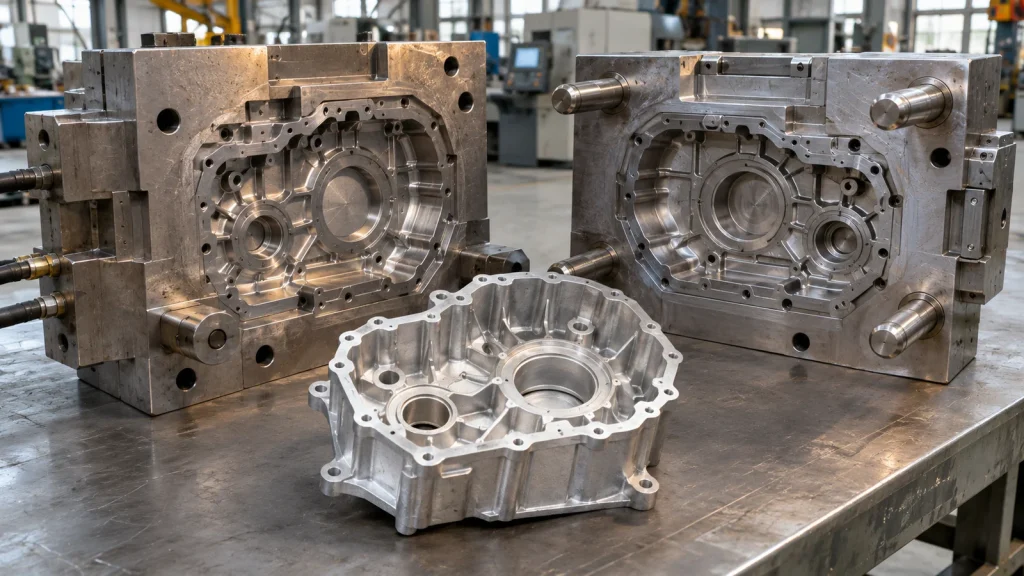
High-pressure die casting (HPDC) places the tool under a combination of mechanical, thermal and chemical loads that are more severe than those seen in most injection moulding applications. A die-casting mould base is therefore not simply a frame that holds the cavity. It must provide stable clamping, support the die inserts, resist shot impact and ejection loads, and remain dimensionally stable through repeated thermal cycling. In the United Kingdom, die-casting mould makers rarely machine the whole base in-house. Most concentrate their skilled labour on the high-value core and cavity work, sliders, assembly, fitting and try-out, while buying standard bases, custom-machined bolsters, certified tool steels, heat treatment and specialist machining from a network of partners.
This division of labour is mature and practical. A typical UK toolroom will use catalogue mould bases where the geometry allows, commission custom base machining where the tool is large or non-standard, buy hot-work steel from a certified stockholder, and outsource at least one bottleneck process such as deep-hole drilling, die-sinking EDM, wire EDM, grinding or vacuum heat treatment. The result is a supply chain that combines standardisation, specialist capacity and local project management. The main UK clusters are in the West Midlands, especially around Birmingham, Coventry and Wolverhampton, and in South Yorkshire around Sheffield. The GTMA directory is a common starting point because it lists mould and die companies covering injection moulding tools, pressure die-casting dies, rubber and composite tooling, and standard mould components.
Standard mould-base and component distributors
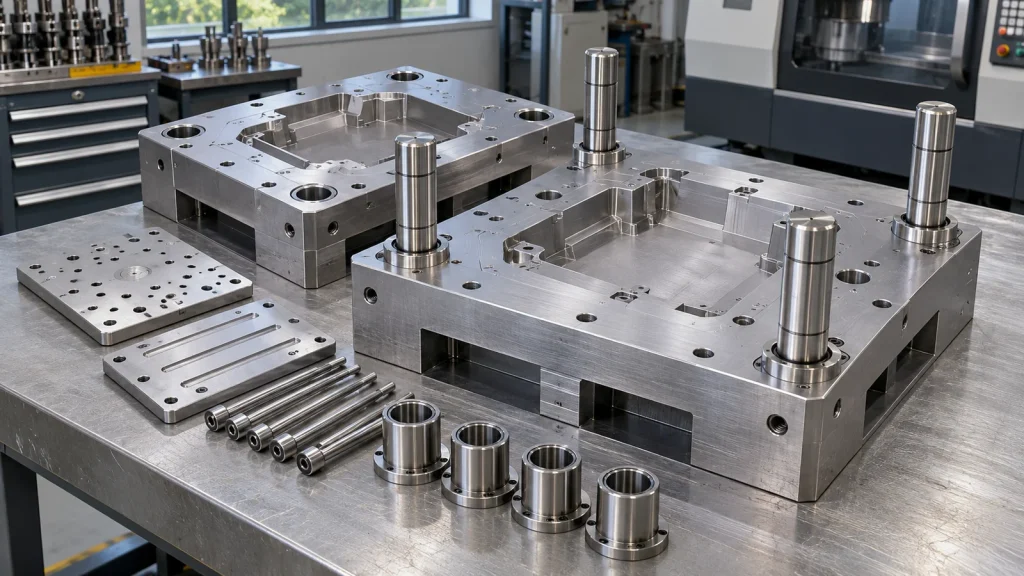
Standard mould-base and component distributors are the backbone of the UK tooling supply chain. They supply catalogue plates, guide pillars and bushes, ejector systems, leader pins, sprue bushes, cooling components and standard die sets to established conventions such as HASCO, DME, Meusburger, LKM and MISUMI. For die-casting, however, a catalogue base cannot simply be selected from an injection-mould catalogue without checking the thermal and mechanical duty. Plates often need to be thicker, ribbed or better supported, and the base may need hot-work steel or a stress-relieved pre-hardened grade rather than a general-purpose injection-mould plate. Mounting dimensions must match the specific die-casting machine platen, tie-bar spacing, shot position and ejector layout. If these details are wrong, the tool may not clamp correctly, the shot sleeve may not align, or the ejector system may be inaccessible.
Several European suppliers are well known in the UK. HASCO, through Hasco Internorm Ltd in Birmingham, supplies standard mould bases, H13 steel plates, thermal insulation sheets and die-casting cooling components. DME Europe UK supplies standard die-casting mould bases, shot sleeves, plunger tips and ejector pins, as well as hot-work components for aluminium and zinc HPDC. DME also offers custom machining services that allow a toolmaker to buy a standard base and have pockets, waterlines, ejector holes and leader-pin bores machined to drawing, freeing internal capacity for cores and cavities. Meusburger supports UK toolmakers with stress-relieved, pre-machined bolsters and standard plates delivered from Austria, which can reduce distortion during subsequent CNC roughing and heat treatment. Strack Norma and Pedrotti are also used for specialised standard hardware, date stamps, slide retainers and pre-ground bolsters in non-standard footprints. LKM and MISUMI conventions are common where international drawings or group tooling standards require them.
A typical order is a standard base plus custom machining. The toolmaker specifies the plate sizes, thicknesses, steel grades, pocket positions, waterline layout and ejector pattern. The distributor supplies the base and may carry out primary machining. The toolmaker then finishes the core and cavity, fits the sliders, assembles the tool and carries out try-out. This approach works well for repeat tools, standard machine sizes and projects where lead time matters more than a completely bespoke base. It also provides a clear chain of material certification and dimensional inspection. The limitation is that standard bases may not suit very large dies, multi-slide tools, non-standard machine interfaces or designs with unusual ribbing and support requirements.
Custom mould-base machinists and heavy bolster specialists
When a base does not fit a catalogue, UK die-casting mould makers turn to custom mould-base machinists and heavy bolster specialists. These firms machine non-standard or oversized bases from plate or block. The scope can include A and B plates, support plates, ejector plates, clamp plates and complete bolster or die-shoe sets. For HPDC, the work often involves thickened plates and ribbed supports to resist heat and clamping pressure, as well as replacement plates for tools already in production. A replacement base may be needed after a crash, after a machine change, or when a tool is being refurbished and the original base has distorted or cracked.
This category is less visible than the catalogue distributors, but it is essential. In the UK, much of this work is carried out by GTMA-listed toolmakers and precision engineers, as well as by specialist subcontract machinists with large-bed CNC equipment. Social media and trade directories now make it easier to find shops advertising CNC-machined custom bases for plastic, stamping and die-casting tools, often with fast turnaround from drawings. The key capability is not simply milling. It is the ability to hold flatness, parallelism, squareness and bore position on heavy plates, to manage machining stress, and to prepare the base for subsequent heat treatment and finishing without introducing distortion.
Large aluminium structural dies are a good example. They may require long waterlines, oil heating channels, deep ejector box pockets and generous cooling passages. These features are often produced by large-bed milling and deep-hole drilling, including gun drilling. A cavity-focused toolroom may not have the bed size or the drilling capacity, so it subcontracts the structural machining and keeps the cavity work in-house. The same applies to multi-slide tools, where slideways, pockets and clearances must be machined accurately before the tool is assembled. In these projects, the custom base machinist becomes a critical partner rather than a simple plate supplier.
Specialist tool steel stockholders and pre-machining services
Die-casting bases and inserts operate in a different thermal regime from injection moulds, so steel selection is critical. Hot-work steels are used for inserts and cores because they must resist thermal fatigue, heat checking, erosion and soldering. Common grades include H11 and H13, together with European equivalents such as 1.2343 and 1.2344. Premium remelted grades are also used for demanding aluminium dies. Uddeholm UK, part of voestalpine High Performance Metals, is based in Oldbury in the West Midlands and supplies grades such as Dievar and Orvar Supreme with technical metallurgy support and rough-machined blocks. Schmolz + Bickenbach, now part of Swiss Steel Group UK, and Bohler supply certified hot-work tool steels with ultrasonic testing so that internal inclusions are identified before expensive cavity machining begins. Carrs Tool Steels and Sheffield-based stockholders serve the West Midlands and South Yorkshire with rapid sawing, surface grinding and block preparation to tight flatness and parallelism tolerances.
Base plates are often made from pre-hardened steels such as P20, 1.2311, 1.2312 or 1.2738. These grades provide a useful combination of strength, machinability and dimensional stability. For die-casting, the plate may need to be through-hardened or stress-relieved to minimise movement after machining. Suppliers commonly provide sawn, ground or pre-machined plate, often with material certificates, ultrasonic testing and pre-hardening. The toolmaker or base machinist then rough machines the plate, has it stress-relieved if required, and finishes it after the stress-relief cycle. This sequence is important because a heavy plate can move when large pockets and waterlines are cut. If the movement is not controlled, the finished base may lose flatness or the guide-pin bores may no longer align with the cavity.
Steel choice also affects die life. Aluminium die casting can cause soldering and washout on cores and cavities, especially in gates, runners and sharp corners. Zinc and magnesium alloys present different thermal and chemical conditions. A certified steel supplier can advise on cleanliness, tempering resistance and coating compatibility. The buyer should not treat steel as a commodity. The difference between a general-purpose H13 and a premium remelted hot-work steel can be significant in a high-cycle aluminium die. For prototype or low-volume tools, a standard grade may be adequate. For production tools, the specification should be linked to the alloy, the shot weight, the cycle time and the expected tool life.
Subcontract machining and EDM partners
Most UK die-casting toolmakers outsource at least one bottleneck process. The most common are heavy CNC milling and turning, EDM and wire EDM, grinding, heat treatment and stress relief, polishing, texturing, coating or nitriding, and CMM inspection. Heavy CNC milling is used for large plate work, deep pockets and cooling channels. EDM and wire EDM are used for die-sinking complex cores, slides, ribs and sharp internal corners that milling cannot reach. GTMA lists dedicated die-sinking suppliers in the UK, including firms offering tool modifications and repairs up to 15 tonnes. This is particularly useful when a tool has been hardened and needs detailed work that would be slow or risky on a milling machine.
Wire EDM is often used for slideways, ejector plate openings, sharp internal corners and deep ribbing after the tool steel has been hardened to around 44 to 48 HRC. Sinker EDM is used for cavities, ribs, shut-off faces and details that require a shaped electrode. A good EDM partner will work from 3D models, electrode drawings and spark-gap specifications, and will provide inspection reports. The toolmaker must allow for the heat-affected zone and for the surface finish that will be produced. In some cases, the EDM work is followed by polishing or hard milling to remove the recast layer and achieve the required surface finish.
Grinding is another critical subcontract operation. It is used for plate flatness and parallelism, leader-pin bores, shut-off faces and wear surfaces. A die-casting base that is not flat may leak, flash or wear unevenly. A base that is not parallel may cause clamping problems or misalignment between the fixed and moving halves. Grinding also plays a role after heat treatment, when plates may have distorted slightly. The grinding partner must be able to handle large plates and to measure flatness and parallelism to tight tolerances. CMM inspection is often used to verify plate geometry, hole positions and cavity form. For complex tools, the inspection report becomes part of the tool history and supports maintenance and repair.
Capacity is a major reason for subcontracting. A toolroom may have enough skilled staff to finish cores and cavities but not enough large-bed milling capacity for a heavy bolster. It may have EDM capacity for small work but not for a 15-tonne die. It may have no vacuum heat treatment at all. Outsourcing these bottlenecks allows the toolmaker to keep finishing, fitting and assembly in-house while avoiding capital investment in equipment that is only occasionally used. The risk is that the supply chain becomes longer and more difficult to coordinate. That is why many UK toolmakers use a small group of trusted subcontractors and a project manager who controls the sequence of operations.
Heat treatment, surface engineering and finishing partners
Heat treatment and surface engineering are not mould-base supply in the narrow sense, but they are essential partners for die-casting mould makers. Vacuum hardening and multi-stage tempering are used to maximise thermal fatigue resistance and to maintain hardness in hot-work steels. Providers such as Bodycote and specialist regional heat treaters in the Midlands and Sheffield perform controlled vacuum hardening, tempering and stress relief. The heat treater must understand the steel grade, the required hardness, the allowable distortion and the subsequent machining allowance. For large bases, stress relief after rough machining is often specified before finish machining. This reduces the risk of movement during final cuts and improves dimensional stability in service.
Surface engineering is equally important. PVD coatings such as CrN or AlCrN and gas or plasma nitriding are used to prevent aluminium soldering and washout on cores and cavities. Nitriding can improve wear resistance on slides and ejector wear areas. Polishing and texturing are used to control release, appearance and thermal fatigue. In die casting, a mirror polish is not always desirable; the surface must be suitable for the alloy and the part. Texturing can help with lubricant retention or part appearance, but it must be applied consistently and without introducing stress raisers. Coating and nitriding suppliers should work from the final cavity geometry and should understand the heat treatment history of the steel.
The sequence of operations is important. Rough machining is followed by stress relief. Finish machining is followed by heat treatment. Heat treatment is followed by grinding, EDM, polishing, coating or nitriding. If the sequence is wrong, the tool may distort, the coating may not adhere, or the die may fail prematurely. A good project manager will define the sequence at the start and will ensure that each subcontractor knows what has been done before and what will happen next. This is especially important when the base, inserts and slides are made by different suppliers.
Full-service die-casting toolmakers and project managers
Some UK firms act as the prime contractor rather than just a base supplier or machining partner. They offer CAD, CAE and CAM, MAGMA simulation, design for HPDC, managed tooling projects, UK project management and weekly updates. They may source tool steels in European or Chinese grades and deliver production-ready tooling for machines from 60 tonnes to 6,600 tonnes. These firms are useful when a buyer wants one accountable partner to coordinate the base supplier, steel supplier, machinists, heat treaters and finishers. They are also useful for overseas builds, where a UK project manager can coordinate an overseas base maker while retaining UK inspection and try-out.
The advantage is accountability. The buyer does not have to manage every interface between the base machinist, the steel stockholder, the EDM shop and the heat treater. The project manager can control the schedule, the quality plan and the technical decisions. The disadvantage is that the buyer may have less visibility of the individual suppliers and may pay a management premium. For complex or high-value tools, the premium can be justified. For simple tools, it may be unnecessary. The key is to agree the scope, the inspection points, the documentation and the communication rhythm at the start.
Full-service toolmakers also bring process knowledge. HPDC tooling is not simply injection moulding with a different steel. The gating, overflow, cooling, ejection and thermal balance must be designed for the casting alloy and the machine. Simulation can identify filling problems, porosity risk, thermal fatigue hot spots and die-lock conditions. A project manager who understands these issues can challenge the base design, the steel selection and the heat treatment before the tool is cut. This is often more valuable than a lower base price.
How UK die-casting mould makers choose partners
The choice of partner depends on the tool type, the alloy, the machine tonnage, the lead time and the in-house capacity. For a standard or repeat tool, the typical route is a catalogue base from a HASCO, DME or Meusburger distributor plus in-house finish machining. This is fast, cost-effective and well supported by documentation. For a large, bespoke or multi-slide tool, the route is often a custom base machinist plus a specialist steel supplier. The base machinist handles the heavy structural work, while the steel supplier provides certified hot-work steel and pre-machined blocks. For a capacity crunch, the toolmaker may outsource roughing, EDM and grinding while keeping finishing, fitting and assembly in-house. For an export or overseas build, a UK project manager may coordinate an overseas base maker, with UK inspection and try-out.
The selection criteria should include technical capability, quality system, traceability, lead time, capacity, communication and total cost. Technical capability includes bed size, maximum plate weight, drilling depth, EDM capacity, grinding capacity and heat treatment capability. Quality system includes certification, inspection equipment and documentation. Traceability includes material certificates, ultrasonic testing reports, heat treatment records and CMM reports. Lead time and capacity are critical because a late base can delay the entire tool. Communication is important because die-casting tooling involves many interfaces and changes. Total cost should include not only the purchase price but also the cost of rework, delay and risk.
A practical approach is to dual-source critical items. A toolmaker may have a preferred base supplier but also a second source for oversized plates or urgent work. The same applies to EDM and heat treatment. Dual sourcing reduces the risk of a single point of failure, but it also requires more administration. The buyer should keep a supplier list with capabilities, contacts, lead times and performance history. The GTMA directory and regional trade networks are useful for finding new suppliers, but they should be followed by a supplier audit and a trial order.
Practical specification and procurement checklist
A clear drawing and specification reduce the risk of misunderstanding. The drawing should include the base dimensions, plate thicknesses, ribbing and support details, steel grades, machining allowance, heat treatment and stress relief requirements, waterline and oil channel layout, ejector holes, leader-pin bores, lifting points and identification marks. It should also include the machine interface: platen size, tie-bar spacing, shot position, ejector pattern and clamp slot positions. For die casting, the drawing should state the alloy, the shot weight and the expected production volume so that the supplier can advise on steel and heat treatment.
The quality plan should define the inspection points. Incoming steel should be checked against the certificate. Rough-machined plates should be checked for flatness and parallelism before stress relief. After stress relief, the plates should be checked again. After finish machining, the base should be checked for flatness, parallelism, squareness, bore position and surface finish. The final inspection should include a CMM report for critical features and a trial assembly report if possible. For coated or nitrided surfaces, the supplier should provide coating thickness, hardness and adhesion records.
Commercial terms should cover lead time, delivery, packaging, insurance, payment and warranty. The buyer should also consider confidentiality and intellectual property, especially when drawings are shared with overseas suppliers. For overseas builds, the buyer should agree the inspection standard, the shipping method, the customs arrangements and the try-out responsibility. A UK project manager can help with these issues, but the buyer should still understand the supply chain and the critical path.
FAQ
What is the difference between a standard and a custom die-casting mould base?
A standard base is selected from a catalogue and is usually based on a proven design for a range of machine sizes. It is cost-effective and fast to supply, but it may not suit unusual platen dimensions, large dies, multi-slide tools or heavy ribbing. A custom base is machined to a specific drawing. It can be oversized, heavily ribbed, made from a specified steel grade and designed around a particular machine interface. Custom bases are more expensive and have longer lead times, but they provide the freedom needed for complex HPDC tools.
Which UK distributors supply HASCO, DME and Meusburger standard parts?
HASCO standard parts are available through Hasco Internorm Ltd in Birmingham, which supplies standard mould bases, H13 plates, insulation and cooling components. DME standard die-casting components are supplied through DME Europe UK, including bases, shot sleeves, plunger tips and ejector pins. Meusburger supplies UK toolmakers directly from Austria with stress-relieved, pre-machined bolsters and standard plates. Strack Norma and Pedrotti are also used for specialised hardware. The exact distributor arrangement can change, so buyers should confirm current UK sales and support arrangements before ordering.
Why is hot-work steel important for die-casting moulds?
Hot-work steel is designed to resist thermal fatigue, heat checking, softening and erosion at the temperatures used in die casting. Grades such as H11, H13, 1.2343 and 1.2344, and premium remelted grades such as Dievar and Orvar Supreme, provide better toughness and temper resistance than general-purpose steels. The steel must also be clean and consistent, because inclusions can initiate cracks. For aluminium die casting, the steel and surface treatment must resist soldering and washout. The choice of steel should be linked to the alloy, the shot weight, the cycle time and the expected tool life.
When should a toolmaker outsource EDM or heavy machining?
A toolmaker should outsource when the work exceeds in-house capacity, when the machine is too small, when the lead time is too short, or when the process requires specialised equipment. Heavy plate work, deep-hole drilling, large die-sinking EDM, wire EDM of hardened slides and 5-axis hard milling are common examples. Outsourcing can free internal capacity for core and cavity work, fitting and assembly. The risk is longer logistics and more interfaces, so the toolmaker should use a trusted subcontractor with clear drawings, inspection requirements and delivery dates.
How can buyers verify the quality of a UK-made die base?
Buyers should ask for material certificates, ultrasonic testing reports, heat treatment records, stress-relief records and CMM inspection reports. They should check flatness, parallelism, squareness, bore position and surface finish against the drawing. A trial assembly or dimensional report can confirm that the base matches the machine interface. For critical tools, a third-party inspection or a visit to the supplier may be justified. The quality plan should be agreed before machining starts, not after the base is finished.
Can a UK project manager coordinate overseas mould base manufacturing?
Yes. A UK project manager can coordinate an overseas base maker, steel supplier, machinist and heat treater, while retaining UK inspection and try-out. This is useful when the buyer wants a lower base cost but does not want to manage the overseas supply chain directly. The project manager should define the drawing standard, the inspection standard, the documentation and the delivery schedule. The buyer should still check the project manager’s track record, the overseas supplier’s capability and the total cost, including freight, duty and rework risk.
Conclusion
The UK die-casting tooling supply chain is mature, specialised and highly networked. Standard mould-base distributors such as HASCO, DME, Meusburger, Strack Norma and Pedrotti provide catalogue bases, components and pre-machined bolsters. Custom base machinists and heavy bolster specialists provide oversized, ribbed and non-standard bases for large or complex dies. Tool steel stockholders such as Uddeholm, Swiss Steel, Bohler, Carrs and Sheffield-based suppliers provide certified hot-work and pre-hardened steels with pre-machining and testing. Subcontract machining and EDM partners provide heavy milling, deep-hole drilling, die-sinking, wire EDM, grinding and CMM inspection. Heat treaters and surface engineers provide vacuum hardening, tempering, nitriding and PVD coatings. Full-service toolmakers and project managers provide a single accountable route for complex or overseas projects.
The practical conclusion is that UK die-casting mould makers rarely make the whole base in-house. They combine catalogue bases, custom machining, certified steels, specialist finishing and disciplined project management to deliver production-ready tooling. The right partner mix depends on the alloy, the machine tonnage, the tool complexity, the lead time and the in-house capacity. Buyers should specify the machine interface, steel grade, heat treatment, inspection and documentation clearly, and should audit critical suppliers before placing orders. Used well, the UK supply chain allows die-casting mould makers to focus on what they do best: the core and cavity, the sliders, the assembly and the try-out that determine whether the tool produces good castings.
参考资料
- Mould & Die Suppliers Suppliers – GTMA
- SG mold base offers high precision custom plastic mold base for injection molding. Serving auto, medical & home appliance industries. Share your drawings for quotation.
#MoldBase #InjectionMold #MoldMaking #SG #Bossgoo #PlasticMold - CNC Machining IGS ADC10 Aluminum Die Casting Mold from China Factory
- Precision Engineered Die Cast Tooling. Built for Performance.
From complex aluminium, magnesium and zinc die cast moulds to fully managed tooling projects, Toolcast delivers precision, reliability and quality at every stage.
✔ High-pressure die cast moulds for 60T–6600T machines
✔ European or Chinese grade tool steels
✔ Advanced CAD/CAE/CAM & MAGMA simulation
✔ Weekly project updates with progress photos
✔ UK project management and warranty support
✔ Delivered from design approval through to production-ready toolingWhether you're launching a new product or optimising an existing casting, our experienced engineering team ensures every tool is built to your specification, budget and production requirements.
📩 Get in touch to discuss your next die casting project.
#DieCasting #DieCastTooling #HighPressureDieCasting #HPDC #Tooling #Manufacturing #Engineering #AluminiumCasting #ZincCasting #MagnesiumCasting #MouldTool #ProductDevelopment #PrecisionEngineering #Automotive #Aerospace #IndustrialManufacturing #Toolcast #UKEngineering
- DME – Global Mold Base Supplier – Homepage
- Custom Moulds, Casting & Prototyping UK | Concept to Batch | Prop Options
- ALM ARCHITECTURAL MOULDS LTD
- Die Casting & Two-Shot Mold Base Specialist
- Die Casting Mould Design Manufacturer – Singer Cast
- Services – Western Tool & Mold Limited