1. Executive summary: a control-tower chain rather than a mine-to-hardware chain
Singapore and Southeast Asia do not form a simple mine-to-hardware supply chain for zinc alloy hardware. The region lacks a dominant local zinc mining base, and Singapore in particular imports almost all of its zinc-bearing raw materials. What the region has instead is a layered, cross-border system that can be described as hub-and-spoke or core-and-satellite. Singapore acts as the control tower: it hosts engineering teams, precision tool rooms, design-for-manufacturing specialists, quality and compliance managers, trading companies, and regional logistics providers. The metal is usually poured elsewhere, in Malaysia, Thailand, Vietnam, Indonesia, or China, where land, labor, plating capacity, and environmental permits are more available and operating costs are lower.
This structure matters to anyone sourcing door hardware, furniture fittings, cabinet handles, locks, hinges, electrical enclosures, telecom parts, or automotive components. The apparent supplier may be a Singapore company, but the actual value chain can cross four or five borders. A mold may be designed in Singapore, built partly in Johor, shipped to a foundry in Thailand, plated in Vietnam, assembled in Malaysia, and exported through Singapore. Each handoff adds cost, lead time, and quality risk, but it also allows the chain to combine Singapore’s precision and commercial trust with Southeast Asia’s manufacturing scale.
The rest of this article explains the chain in sequence: alloy sourcing, tooling, casting, finishing, assembly, logistics, and sourcing models. It then sets out the main risks and a practical playbook for buyers. The central conclusion is that the mold and die casting supply chain in Singapore and Southeast Asia is best managed as a regional system, not as a search for one factory that does everything.
2. Why the regional division of labor exists
2.1 Economics and land use
Singapore is a high-cost, land-constrained economy. Precision engineering, tool making, automation, and supply-chain coordination can justify Singapore costs because they are skill-intensive and create intellectual property. High-volume die casting, manual polishing, and wet electroplating are more land-, labor-, energy-, and water-intensive. They are therefore pushed to lower-cost locations within a few hours of travel. Johor in Malaysia benefits from proximity to Singapore. Batam in Indonesia benefits from sea links and special economic zone incentives. Penang and Kedah in Malaysia offer mature industrial parks and semiconductor or medical-device supply chains. Thailand’s Eastern Seaboard offers automotive-scale clusters. Vietnam offers fast-growing capacity and competitive labor.
2.2 Environmental regulation
Singapore has strict controls on wastewater discharge and industrial emissions. Wet electroplating, chromating, and other chemical surface treatments are therefore limited and costly. This is one of the strongest reasons why zinc hardware is rarely finished in Singapore. Most copper-nickel-chrome plating, PVD, powder coating, and passivation takes place in designated industrial zones in Malaysia, Thailand, or Vietnam. Buyers who ask for a fully Singapore-made zinc hardware item often discover that the casting may be regional and the plating almost certainly is.
2.3 Intellectual property and commercial trust
Singapore is valued for IP protection, contract enforcement, English-language business practice, and financial services. Brand owners and OEMs often prefer to sign engineering and tooling contracts with a Singapore entity. The Singapore entity may own the mold, control the drawing, approve the first article, and manage the offshore factory. This does not mean the mold is always built in Singapore. It means the commercial and technical responsibility is anchored there.
2.4 Trade policy and China-plus-one
Tariffs, rules of origin, and supply-chain diversification have accelerated the China-plus-one model. Many Singapore companies now position themselves as regional headquarters with production in Malaysia, Vietnam, Thailand, or Indonesia. China remains a major source of die-casting zinc alloy and high-volume castings, but buyers increasingly ask for a second production site outside China. The result is a hybrid map: China for alloy supply, fast sampling, and high-volume casting; Southeast Asia for tariff diversification, regional assembly, and local content.
3. Upstream: zinc, alloy ingots, and specification control
3.1 Where the zinc comes from
Singapore has negligible domestic mining and imports more than 95 percent of its raw zinc-bearing materials. Zinc pricing is therefore linked to the London Metal Exchange and global concentrate availability rather than local extraction. Refined zinc ingots and die-casting alloys are imported from smelters and alloy producers in Australia, South Korea, China, India, and other suppliers. Singapore and Port Klang in Malaysia function as trading and distribution points for ingots and alloys before material moves to foundries.
In Southeast Asia, refined zinc production is fragmented. Thailand, Malaysia, and Vietnam host smaller smelters and alloy producers serving domestic galvanizing and die-casting industries, but the region is still a net importer of both refined zinc and ready-to-cast alloy. A recent SMM trade analysis showed Southeast Asia as the dominant destination for China’s die-casting zinc alloy exports, with Vietnam alone taking a large share. This is an important structural fact: even when a hardware item is branded, engineered, or shipped through Singapore, the alloy may have originated in China and been cast in Vietnam or Malaysia.
3.2 The alloy family: Zamak and ZA
Most hardware uses the Zamak family. Zamak 3 is the standard alloy for general hardware because it offers good dimensional stability, casting fluidity, and surface finish. Zamak 5 contains more copper and offers higher hardness and tensile strength, making it suitable for locks, hinges, and load-bearing fittings. ZA-8 and ZA-12 are zinc-aluminum alloys used for heavier-duty parts where higher strength, creep resistance, and wear resistance are needed. The choice is not cosmetic. It affects die life, shrinkage, machining, plating compatibility, and the risk of dimensional drift.
Table: alloy selection for hardware
| Alloy | Main characteristic | Typical hardware use | Supply-chain note |
| Zamak 3 | Good castability, dimensional stability, excellent plating finish | Cabinet handles, decorative fittings, general hardware | Most widely stocked; easiest to dual-source |
| Zamak 5 | Higher strength and hardness than Zamak 3 | Locks, hinges, load-bearing brackets, door hardware | Slightly less fluid; confirm die and process capability |
| ZA-8 | Higher strength and creep resistance | Heavy-duty brackets, mechanical parts, wear surfaces | Less common in small foundries; check availability |
| ZA-12 | High strength and bearing properties | Industrial hardware, pulleys, bushings | Requires experienced caster and machining control |
3.3 Alloy quality control
Alloy quality is a common hidden failure point. Impurities such as lead, cadmium, tin, and iron can affect fluidity, surface finish, and corrosion resistance. A low-cost ingot supplier may meet the nominal zinc content but exceed impurity limits. Buyers should require ingot certificates, lot traceability, and periodic spectrochemical analysis. For visible hardware, the combination of alloy chemistry, die temperature, and plating chemistry determines whether the final product shows blisters, pits, or color variation.
Recycled zinc is increasingly important. It can be technically sound, but recycled feedstock requires tighter control of impurities and provenance. Automotive and medical customers often require documented material declarations and conflict-mineral or environmental compliance. The practical answer is not to reject recycled zinc, but to qualify it through the same incoming inspection and first-article process as virgin ingot.
4. Tooling and mold engineering: the highest-value link
4.1 What Singapore retains
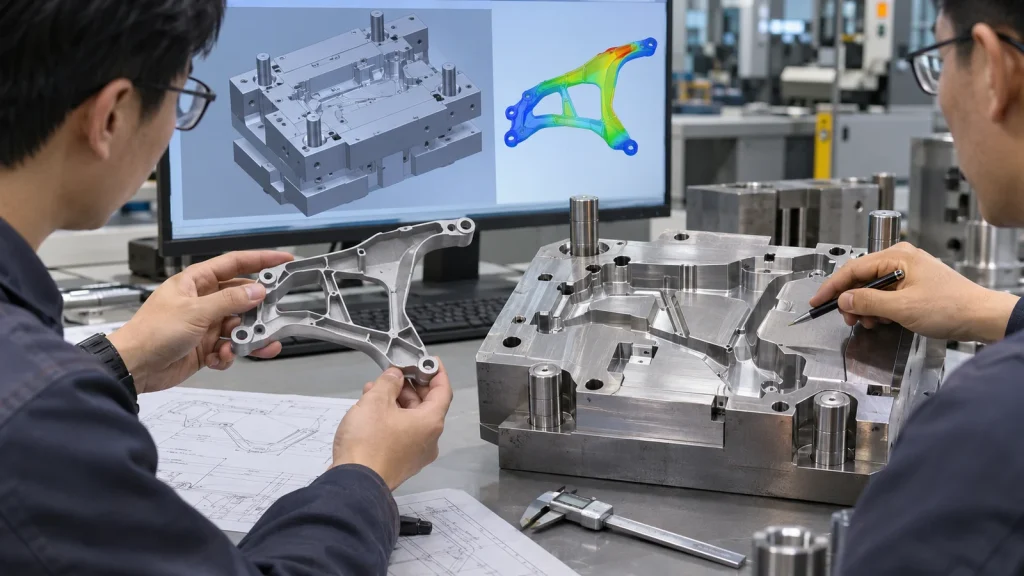
Singapore retains precision tool rooms, die design, prototyping, mold-flow simulation, and DFM capability. Companies such as Dynacast Singapore, Guan Ming, SSOSS Cast, and others maintain in-house tool building or engineering oversight. Dynacast is known for multi-slide zinc die casting and in-house precision tool building. Guan Ming produces dies through its own CNC machine shop. SSOSS Cast lists zinc die casting, aluminum die casting, plastic injection molding, tool room, and surface finishing. These capabilities are valuable because the mold determines cycle time, yield, dimensional consistency, and the cost of every part produced over the tool’s life.
A zinc die-casting mold is not a simple block of steel. It includes core and cavity inserts, slides, ejector systems, runners, gates, overflows, cooling channels, and thermal management. High-grade tool steel such as H13 is machined by high-speed CNC milling and EDM. Mold-flow simulation is used to check fill patterns, air entrapment, shrinkage, and thermal balance. For hardware with visible surfaces, the mold also determines polishability and plating quality. A poorly gated mold may cast acceptable parts initially but create flash, porosity, or short shots as the tool wears.
4.2 The Singapore-Johor tooling corridor
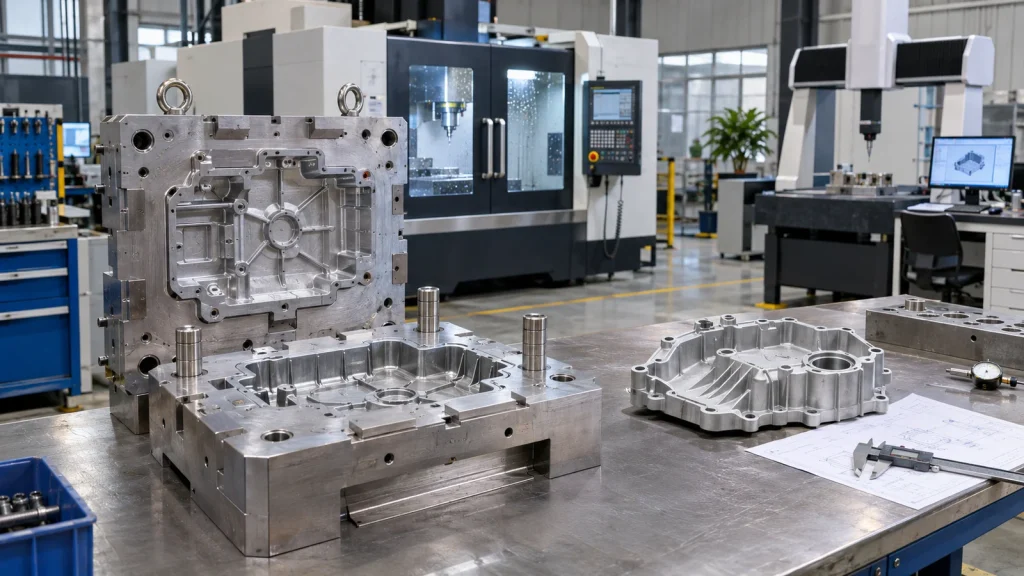
The Singapore-Johor corridor is a practical compromise. A Singapore engineering firm may manage the CAD, mold-flow simulation, and customer approval, while subcontracting bulk mold-base machining to partner shops in Johor Bahru. Under the Johor-Singapore Special Economic Zone framework, this can reduce tooling costs by roughly 25 to 40 percent while keeping technical control in Singapore. The most critical core and cavity inserts may still be built in Singapore for accuracy and longevity. The complete mold is then shipped to the chosen foundry.
This corridor works best when the buyer defines the tooling standard clearly. Important details include steel grade, hardness, surface finish, cooling layout, gate type, expected tool life, and maintenance responsibility. A tool built for 100,000 shots is not the same as a tool built for 500,000 or one million shots. For high-volume hardware, the extra cost of a robust mold is usually recovered through lower downtime and better yield.
4.3 Tooling ownership and validation
Tooling ownership is a commercial decision with long-term consequences. In a turnkey model, the Singapore contract manufacturer may own the mold and amortize it into the part price. In a buyer-owned model, the buyer pays for the mold and retains the right to move it. Buyer-owned tooling offers leverage and supply-chain flexibility, but it also requires the buyer to manage maintenance, insurance, and transfer logistics. If the mold is moved to another country, the new caster must validate it again.
Validation usually follows a T0/T1/T2 sequence. T0 checks the mold is safe and complete. T1 produces initial samples for dimensional and visual review. T2 incorporates corrections and produces samples for customer approval. For automotive or medical hardware, the process may extend to PPAP, capability studies, and measurement system analysis. The buyer should not release mass production until the mold has demonstrated stable dimensions, acceptable porosity, and plating compatibility.
5. Casting: where the metal is poured
5.1 Process basics
Zinc alloy hardware is usually produced by hot-chamber die casting because zinc melts at roughly 380 to 420 C. Hot-chamber machines use a gooseneck assembly immersed in the melt, allowing fast cycle times and thin-wall capability. Typical machines in the region range from about 20 to 250 tonnes of clamping force. Small machines make precision components for electronics and medical devices; larger machines make brackets, handles, and enclosures.
The casting process is sensitive to die temperature, injection velocity, metal pressure, cooling time, and vacuum assistance. Porosity is the main internal defect. It can come from gas entrapment, shrinkage, or turbulence. For hardware that will be plated, porosity can cause blisters after plating. For structural hardware, porosity can reduce strength. Good casters control these variables with machine settings, die thermal management, and in-process inspection.
5.2 Singapore’s casting role
Singapore still has local casting, but it skews toward small, high-precision, high-mix parts rather than high-volume commodity hardware. Export data lists about 80 zinc-casting suppliers in Singapore, with Dynacast Singapore, McLean Technologies, and HTF Industries accounting for a large majority of reported exports. Microcast is another example, producing zinc pressure die-cast components for telecoms, computers, consumer products, medical equipment, aerospace, automotive, and heavy machinery. These companies compete on precision, reliability, and customer intimacy rather than on low labor cost.
5.3 The regional casting map
Table: regional roles in zinc hardware casting
| Location | Typical role | Key strengths | Typical constraints |
| Singapore | Engineering, DFM, tooling oversight, small precision parts, QC, trading, re-export | IP protection, English business environment, precision engineering, logistics | High cost, limited land, strict environmental rules for plating |
| Malaysia: Johor, Penang, Kedah | Integrated casting, CNC machining, finishing | Proximity to Singapore, mature industrial parks, IATF 16949 and ISO 13485 capabilities | Labor availability varies; plating capacity can be tight |
| Thailand | Automotive and heavy hardware, locksets, appliances | Scale in Zamak 3 and Zamak 5, deep finishing ecosystem, Eastern Seaboard logistics | Language and program management complexity; automotive capacity cycles |
| Vietnam | Fast-growing casting and assembly base | Competitive labor, hot-chamber zinc capacity, export orientation | Tooling depth varies; plating quality and compliance need auditing |
| Indonesia: Batam and Java | Casting and labor-intensive assembly | Proximity to Singapore, special economic zone incentives, domestic market | Infrastructure and skill variation; customs and logistics planning |
| China: Guangdong, Zhejiang, Fujian | High-volume casting and alloy supply | Deep supplier base, fast sampling, low cost at scale | Tariffs, geopolitical risk, IP concerns, longer logistics to some markets |
Malaysia is a good example of the China-plus-one shift. EKO Metal Industries in Penang and Kedah operates aluminum and zinc high-pressure die casting alongside CNC machining and sheet metal fabrication, with ISO 9001, ISO 14001, IATF 16949, and ISO 13485 certification. In Thailand, PCF Patiya positions itself around aluminum and zinc die casting, electroplating, polishing, and precision tooling. Groups such as Everflow and Lightever list zinc die casting, brass and zinc gravity casting, forging, CNC, stamping, electroplating, PVD, and painting across Thailand and Vietnam factories. These examples show that the region can offer integrated services, but the exact bundle varies by country and supplier.
5.4 Certifications and compliance
Automotive and medical hardware increasingly require IATF 16949 or ISO 13485 controls. General hardware may only need ISO 9001, but buyers should still check incoming inspection, traceability, and corrective-action systems. Environmental certification such as ISO 14001 matters for plating and wastewater. For export to Europe, REACH and RoHS declarations are common. For the United States, California Proposition 65 and conflict-mineral requirements may apply. The compliance burden is one reason why work migrates from informal workshops to certified Malaysian, Thai, and Vietnamese plants.
6. Secondary operations, finishing, and assembly: the bottleneck
6.1 Secondary machining
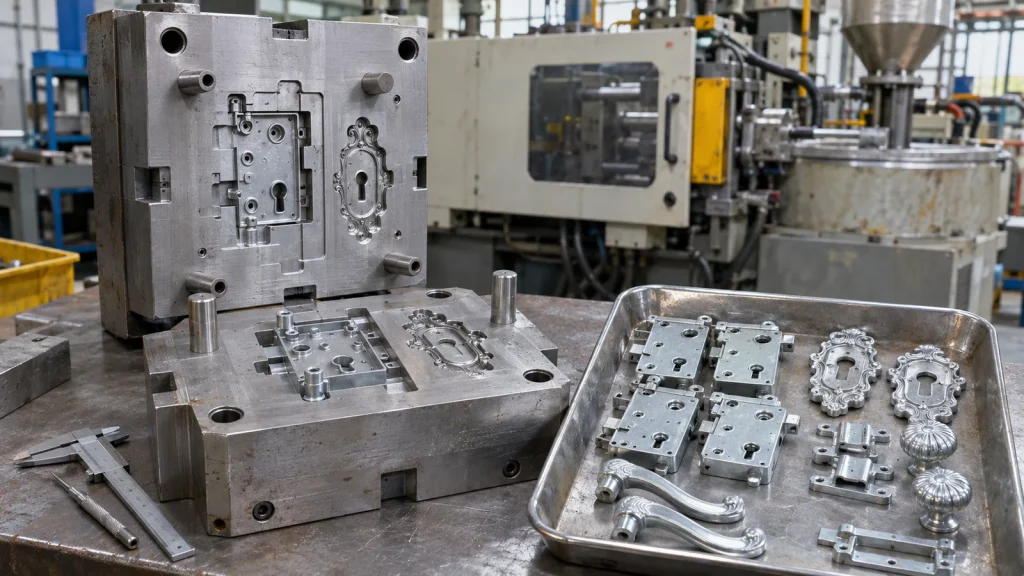
Zinc hardware rarely ships straight from the die. It is trimmed, deflashed, tumbled, and inspected. Many parts require CNC machining for threads, bores, mating faces, or tight tolerances that cannot be held in the casting. Tapping and drilling are common for hinges, locks, and electrical enclosures. Manual or robotic buffing prepares visible surfaces for plating. These operations are labor-intensive and can become a bottleneck when volumes rise.
6.2 Surface treatment
Surface treatment is the most delicate part of the chain. Zinc hardware usually receives chromating or passivation, copper-nickel-chrome electroplating, PVD, powder coating, or spray painting. Plating provides corrosion resistance and decorative appeal, but it also exposes every upstream defect. Poor casting quality, inadequate polishing, or contaminated plating baths can cause blisters, pits, poor adhesion, and color inconsistency.
Electroplating is also the most regulated step. Because Singapore restricts wastewater discharge, almost all wet electroplating and chemical surface treatment takes place in designated industrial zones in Malaysia, Thailand, or Vietnam. This creates a cross-border handoff: castings may be produced in one country and plated in another. Buyers should confirm that the plating supplier has valid environmental permits, wastewater treatment, and consistent chemical control. For visible hardware, color consistency across lots is a common challenge. A good supplier will use color standards, salt-spray testing, and adhesion testing.
6.3 Assembly and inspection
Assembly may include installing hinges, locks, handles, brackets, latches, fasteners, magnets, or electronic components. Some suppliers also handle packaging and retail-ready presentation. Inspection should cover dimensions, appearance, plating thickness, salt-spray corrosion, and functional testing. For locks and hinges, cycle testing and load testing may be required. For electrical enclosures, grounding and fit checks matter. The buyer should define the inspection standard before production, not after.
7. Sourcing and operating models
7.1 Singapore turnkey contract manufacturer
In this model, the buyer contracts a Singapore-registered precision engineering firm. The firm owns the customer relationship, warranty, and IP. It designs the mold in Singapore or manages the design, then runs production in its own subsidiary plant in Johor, Batam, Vietnam, or Thailand. This is the simplest model for buyers who want one throat to choke. The trade-off is that the buyer may have less visibility into the actual factory and less control over tooling ownership.
7.2 Cross-border tooling plus regional foundry
In this model, a specialist Singapore mold maker builds the tool for guaranteed accuracy and longevity. The tool is then shipped to a high-volume Tier-1 foundry in Thailand or Malaysia for mass production. The buyer manages two contracts: one for tooling and one for casting. This can optimize cost and quality, but it requires more project management. The buyer must ensure that the foundry can run the mold properly, maintain it, and return it in good condition at the end of the program.
7.3 China-plus-one hybrid
In this model, mold design and initial T1/T2 sampling are executed in Shenzhen or Dongguan for speed. Production molds are then transferred to Vietnam or Malaysia to bypass Western tariffs and diversify supply risk. This model is common for consumer hardware and furniture fittings. It works best when the mold is designed for portability and the receiving factory is involved early. If the mold is moved after production starts, the buyer should budget for revalidation and possible modifications.
7.4 Singapore front door, offshore factory
Many Singapore firms operate as a Singapore front door with an offshore factory. SSOSS Cast, for example, presents itself as coordinated and engineered from Singapore with production in China to optimize efficiency and pricing. Another model is a Singapore headquarters with Vietnam or Thailand subsidiaries and regional partnerships for tooling, molding, and precision components. For buyers, the key question is who holds technical responsibility. A Singapore front door is valuable only if the engineering, quality, and commercial accountability are real, not just a sales office.
8. Logistics, end markets, and trade policy
Singapore is a logistics hub and gateway for premium die-cast zinc alloy components used in high-end electronics and medical devices. It bridges regional raw material sources and global design standards. Many companies use Singapore for regional warehousing, re-export, and supply-chain financing. The port and airport provide fast connections to global markets, which matters for high-value hardware and urgent spares.
End markets include door hardware, furniture fittings, cabinet hardware, locks and latches, hinges, handles, electrical enclosures, telecom parts, consumer goods, and automotive components. Each market has different priorities. Door hardware and furniture fittings compete on finish and cost. Locks and hinges require strength and cycle life. Electrical enclosures require dimensional accuracy and grounding. Automotive parts require IATF 16949 and PPAP. Medical hardware requires ISO 13485 and validation. A supplier that is excellent for decorative handles may not be qualified for automotive brackets.
Trade policy affects routing. Rules of origin under RCEP and other agreements can favor regional content. US and EU tariffs on Chinese-origin goods have pushed some production to Vietnam, Malaysia, and Thailand. But tariff engineering must be done carefully. A product that is merely assembled in Vietnam from Chinese castings may not qualify for preferential origin. Buyers should check substantial transformation, regional value content, and documentation before assuming a tariff benefit.
9. Risk map and mitigation
Table: key risks and practical mitigations
| Risk | Why it matters | Mitigation |
| Zinc price volatility | Zinc is LME-linked; margins can move quickly | Agree on a pricing formula with a metal-index reference; hedge where appropriate; review quotes regularly |
| Tooling lead time and quality | A bad mold is expensive and delays launch | Use DFM review, mold-flow simulation, T1/T2 approval, and a clear tooling standard; inspect before shipment |
| Plating quality | Blisters, poor adhesion, color mismatch, corrosion | Qualify the plating line separately; require salt-spray and adhesion tests; use color standards |
| Capacity concentration | A few exporters dominate reported Singapore zinc-casting exports | Dual-source between a Singapore-managed plant and a second Southeast Asian plant |
| Compliance | Automotive and medical customers require certified systems | Require IATF 16949 or ISO 13485 as applicable; audit before awarding |
| Geopolitical and logistics disruption | Tariffs, port delays, and border issues can interrupt supply | Keep buffer stock; qualify two countries; review Incoterms and customs classification |
| Environmental and ESG risk | Plating and smelting face increasing scrutiny | Check permits, wastewater treatment, and recycled-content documentation |
The most underrated risk is the interface between casting and plating. A caster may meet dimensional tolerances but produce surface porosity that only appears after plating. A plater may meet thickness requirements but use a chemistry that causes adhesion failure. The buyer should treat casting and plating as one quality system, even if they are separate companies in separate countries.
10. A practical playbook for buyers
Step 1: define the hardware and the duty cycle
Start with the product, the load, the visible surface, and the expected life. A decorative cabinet handle needs excellent finish and moderate strength. A door hinge needs strength, cycle life, and corrosion resistance. An electrical enclosure needs dimensional accuracy and grounding. A lock body needs wear resistance and precise machining. The duty cycle determines the alloy, the tooling standard, and the quality tests.
Step 2: choose the alloy and the casting process
For most hardware, Zamak 3 is the default. Move to Zamak 5 for higher strength, and to ZA-8 or ZA-12 for heavier-duty parts. Confirm that the chosen caster routinely runs the alloy. A foundry that mostly runs Zamak 3 may not have the process window for ZA-8. Also confirm the plating compatibility of the alloy and the expected surface finish.
Step 3: decide where the mold will be built
If precision, IP protection, and long tool life are critical, build the mold in Singapore or under Singapore engineering oversight. If cost is the main driver and the part is simple, a Malaysian or Chinese mold may be adequate. If the program is a China-plus-one hybrid, build the mold in China for speed but design it for transfer to Vietnam or Malaysia. In all cases, specify the steel grade, hardness, tool life, and maintenance plan.
Step 4: select the casting hub
Use Singapore for small, high-precision, high-mix parts and for supply-chain coordination. Use Johor or Penang for integrated casting and machining with good certification. Use Thailand for automotive-scale volumes and deep finishing ecosystems. Use Vietnam for cost-competitive casting and assembly. Use Indonesia for Batam-based proximity to Singapore. Use China for high-volume casting and alloy supply when tariffs and IP risk are acceptable.
Step 5: qualify finishing and assembly
Do not assume the caster can also plate well. Qualify the plating line separately. Check wastewater permits, chemical control, color consistency, salt-spray performance, and adhesion. If assembly is labor-intensive, confirm the training and inspection plan. For visible hardware, ask for golden samples and limit color variation.
Step 6: plan logistics and dual sourcing
Map the flow of material, mold, castings, plated parts, and finished goods. Decide who owns the mold, who pays for freight, and who handles customs. Keep a second qualified source for critical parts. For high-volume programs, split production between two countries or two suppliers to reduce concentration risk.
FAQ
Is Singapore still a viable manufacturing location for zinc die casting?
Yes, but not for high-volume commodity hardware. Singapore remains viable for small, high-precision, high-mix zinc parts, prototypes, medical and electronics components, and supply-chain coordination. Its advantages are engineering talent, IP protection, English-language business practice, and logistics. Its disadvantages are cost, land, and environmental limits on plating. Most high-volume hardware will still be cast and finished elsewhere in Southeast Asia, with Singapore providing engineering and commercial control.
Should the mold be built in Singapore, Malaysia, Thailand, or China?
It depends on the part and the program. Singapore is best for precision, IP-sensitive work, and long-life tools. The Singapore-Johor corridor can reduce cost while keeping engineering control. Malaysia and Thailand are good for regional tooling when the caster has a strong in-house tool room. China is often fastest and cheapest for complex molds and sampling, but buyers should consider IP risk, tariff exposure, and mold transferability. A common compromise is to design in Singapore, build critical inserts in Singapore or Johor, and source the mold base regionally.
Which zinc alloy should I use for door hardware, locks, and electrical enclosures?
For general door hardware and decorative fittings, Zamak 3 is usually sufficient. For locks, hinges, and load-bearing parts, Zamak 5 is often preferred for higher strength and hardness. For heavy-duty brackets and wear parts, ZA-8 or ZA-12 may be appropriate. Electrical enclosures often use Zamak 3 or Zamak 5 depending on strength and grounding requirements. The final choice should be confirmed with the caster and the plating supplier, because alloy chemistry affects castability, machining, and finish.
Why is electroplating usually done outside Singapore?
Singapore has strict environmental and wastewater discharge regulations, and industrial land is scarce and expensive. Wet electroplating consumes water and generates chemical waste, so it is usually located in designated industrial zones in Malaysia, Thailand, or Vietnam. This does not mean Singapore cannot support finishing, but the economics and permits favor offshore plating. Buyers should qualify the plating supplier as carefully as the caster, because plating defects often appear only after the part is finished.
What certifications should I require from a Southeast Asian caster?
At minimum, require ISO 9001 for quality management. For automotive hardware, require IATF 16949. For medical hardware, require ISO 13485. For environmental performance, require ISO 14001, especially if plating or wastewater is involved. Also ask for material certificates, RoHS and REACH declarations, and evidence of incoming inspection. Certificates are not enough; audit the factory and review corrective-action records.
How can buyers reduce tooling and zinc-price risk?
For tooling, use a clear specification, DFM review, mold-flow simulation, T1/T2 approval, and a maintenance plan. Keep ownership of the mold if supply-chain flexibility matters. For zinc price risk, agree on a pricing formula linked to the LME or a recognized alloy index, review quotes regularly, and consider hedging for large programs. Dual sourcing and buffer stock reduce the impact of price spikes and capacity shortages.
Conclusion
The zinc alloy hardware mold and die casting supply chain in Singapore and Southeast Asia is a regional system built on specialization. Singapore provides engineering, tooling oversight, quality control, IP protection, trading, and logistics. Malaysia, Thailand, Vietnam, Indonesia, and China provide casting, machining, finishing, and assembly at different cost and capability levels. The mold is the highest-value link, the alloy is the most price-sensitive input, and finishing is the most common bottleneck.
For buyers, the practical lesson is to manage the chain as a whole. Define the alloy and duty cycle, choose the tooling location deliberately, qualify casting and plating as one quality system, and plan for dual sourcing. Singapore is not a low-cost casting center, but it remains a strong control tower for precision hardware. Southeast Asia is not a single factory floor, but it offers a flexible set of hubs that can be combined into a resilient supply chain. The companies that succeed are those that understand the handoffs, control the tooling, and validate every step from ingot to finished hardware.
参考资料
- Precision Engineering Singapore | Die Casting & CNC Machining
- Asia's Zinc Market Report 2026 – Prices, Size, Forecast, and Companies
- Zinc Castings Suppliers from Singapore – Volza
- Manufacture/repair of dies, moulds, tools, jigs and fixtures
- zinc castings Suppliers & Manufacturers
- DYNACAST SINGAPORE PTE LTD
- Analysis of Die-Casting Zinc Alloy Imports and Exports in Q1 2026: Weak Imports vs Robust Exports
- Thailand & Vietnam Factories | Lightever Southeast Asia — Lightever Industrial (Thailand) Co., Ltd
- Pressure Die Casting, aluminium, zinc or magnesium alloy, links starting with L÷R
- Mitigating supply chain risk in die casting | Dynacast