Introduction
The question of hot-chamber versus cold-chamber die casting for zinc alloys is often framed as a simple machine choice, but it is really a question about alloy chemistry, metal transfer, thermal exposure, cycle economics, and defect risk. Zinc is unusual among die-casting metals because most conventional zinc alloys can be cast in hot-chamber machines, where the injection mechanism sits directly in the molten-metal bath. That arrangement is fast, consistent, and well suited to high-volume production of thin-walled, detailed components. However, not every zinc alloy behaves the same way in a submerged injection system. Higher-aluminum zinc alloys, especially ZA-12 and ZA-27, require higher casting temperatures and can accelerate iron pickup, erosion, and mechanical wear on gooseneck and plunger components. For those alloys, a cold-chamber approach is usually more practical even though it gives up some of the speed and transfer cleanliness of hot-chamber casting.
The practical answer is therefore not that one process is universally better. The right process depends on the alloy, part size, wall thickness, tolerance requirements, porosity acceptance criteria, production volume, and the capabilities of the die caster. For most Zamak 3, Zamak 5, Zamak 2, and Zamak 7 parts, hot-chamber die casting is the industry default. For ZA-12 and ZA-27, cold-chamber die casting is generally expected. For ZA-8, very large zinc parts, or unusual foundry constraints, the decision may require a more careful review. This article explains the underlying mechanisms and provides a decision framework that can be used in design reviews, supplier discussions, and cost estimates.
The Fundamental Difference: How Molten Metal Reaches the Die
The clearest way to understand the two processes is to follow the metal. In a hot-chamber machine, the injection system is immersed in the molten zinc holding furnace. In a cold-chamber machine, the melting furnace is separate from the injection unit, and molten metal is transferred into a shot sleeve for each cycle. That single architectural difference drives most of the advantages and limitations associated with each process.
Hot-chamber die casting
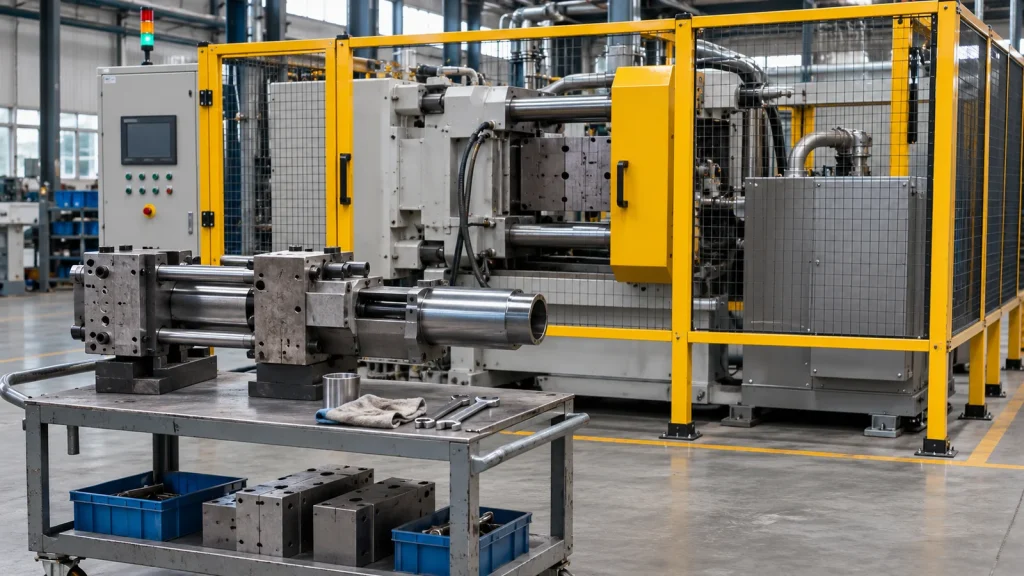
In a hot-chamber machine, a gooseneck channel and a plunger are submerged in the molten zinc bath. When the plunger retracts, molten zinc flows through an inlet port into the gooseneck. When the plunger advances, it seals the port and pushes the metal through the gooseneck and nozzle into the closed steel die. The metal remains in contact with the heated injection assembly and does not need to be ladled from an external furnace on every shot. The result is a short, repeatable transfer path with relatively little exposure to air during the critical filling stage.
The term hot-chamber refers to the fact that the injection chamber is continuously hot because it is inside the molten bath. This is possible with zinc because standard zinc alloys have relatively low melting and casting temperatures. Zamak alloys typically melt in the range of roughly 380 to 390 degrees Celsius and are cast at approximately 400 to 430 degrees Celsius, depending on the alloy, part geometry, and machine setup. At these temperatures, molten zinc does not attack steel injection components as aggressively as molten aluminum does, so a submerged gooseneck and plunger can survive in production for a reasonable service life. The process is not maintenance-free, but it is proven and economically effective for conventional zinc alloys.
Cold-chamber die casting
In a cold-chamber machine, melting and holding take place in a separate furnace. For each cycle, molten alloy is transferred by ladle or dosing system into a shot sleeve, and a plunger pushes the metal into the die cavity. The shot sleeve is not surrounded by a molten bath, which is why the process is called cold-chamber, even though the sleeve reaches elevated temperatures during operation. The transfer step introduces a short but important interval in which the metal is exposed to the environment and may lose temperature or pick up oxides.
Cold-chamber machines are the standard for aluminum and magnesium because those metals are cast at higher temperatures and can severely attack a submerged injection system. For zinc, cold-chamber equipment is not the default, but it becomes relevant when the alloy or part size pushes beyond the practical limits of hot-chamber processing. Higher-aluminum ZA alloys are the main alloy-driven example. Very large zinc castings that exceed the shot capacity or pot size of available hot-chamber machines are another. In some cases, a die caster may also use cold-chamber equipment for a zinc job because that is the equipment available, but that is a production constraint rather than an inherent metallurgical advantage.
Why Zinc Is Normally a Hot-Chamber Metal
Zinc alloys are a natural fit for hot-chamber die casting because their melting points are low enough to limit chemical attack on steel components, while their fluidity and dimensional behavior are well suited to high-speed injection into complex dies. Standard Zamak alloys, including Zamak 3, Zamak 5, Zamak 2, and Zamak 7, are routinely hot-chamber cast. The submerged gooseneck keeps the metal hot and ready for the next shot, which supports fast cycles and stable filling conditions.
The low melting point also helps with thermal management. In cold-chamber casting, every shot involves a transfer from furnace to shot sleeve, and that transfer can create temperature loss and turbulence. In hot-chamber casting, the metal is already in the injection system and is pushed directly into the die. This tends to reduce the opportunity for cold shuts and incomplete fill in thin sections, provided the die thermal balance and injection parameters are properly controlled. Hot-chamber processing is therefore associated with thin walls, fine surface detail, small features, and high dimensional consistency in small to medium zinc parts.
Another practical reason is cycle speed. Hot-chamber machines do not require a ladling step between shots. For small parts, production rates can be very high, and the process can run hundreds to more than a thousand shots per hour depending on part size, die design, cooling, and machine capability. That speed is a major reason why zinc die casting is competitive for high-volume components such as hardware, connectors, housings, gears, brackets, lock components, and decorative parts.
The limitation is that the injection system is physically connected to the molten bath. Machine size and shot capacity are constrained by the furnace, gooseneck, and related hardware. Very large zinc castings may exceed the practical capacity of hot-chamber equipment, even if the alloy itself would otherwise be suitable. The gooseneck and plunger also wear over time and require maintenance, though the wear rate with standard Zamak alloys is generally manageable compared with what would occur at higher temperatures or with more aggressive alloys.
Hot-Chamber Die Casting in Practice
In production, hot-chamber die casting for zinc is a high-throughput process built around stable thermal conditions. The die is closed, the plunger injects metal through the gooseneck and nozzle, the metal solidifies under pressure, the die opens, and the casting is ejected. The cycle repeats with minimal manual transfer. The metal temperature, nozzle temperature, die temperature, injection velocity, and pressure must be balanced to avoid defects and maintain dimensional control.
Hot-chamber processing is particularly effective for thin-wall parts because the metal remains hot in the injection system and can fill small features quickly. It is also well suited to parts that require fine surface detail, sharp lettering, small bosses, and closely toleranced holes or inserts. However, thin walls are not automatically easy. The die must be designed with appropriate gates, runners, overflows, cooling, and venting. A poorly balanced die can produce cold shuts, incomplete fill, or porosity even on a hot-chamber machine.
Maintenance is a normal part of hot-chamber operation. Gooseneck components, plungers, nozzles, and related hardware are exposed to molten zinc and thermal cycling. Nozzle freeze-off, zinc buildup, and wear can affect shot consistency if not managed. The holding furnace must be controlled to avoid excessive dross and temperature variation. Despite these maintenance needs, the process is mature and widely used because the productivity and quality advantages for standard zinc alloys are substantial.
Machine selection also matters. A hot-chamber machine must have enough clamping force, shot capacity, and die space for the part. The pot size and gooseneck arrangement limit the maximum shot weight and influence thermal stability. For a small part with a high annual volume, a hot-chamber cell can be extremely efficient. For a large, thick-walled part, the same process may be constrained by machine capacity or thermal control, which is where cold-chamber processing or a different manufacturing route may enter the discussion.
Cold-Chamber Die Casting for Zinc: When It Is Necessary
The main alloy-driven reason to use cold-chamber die casting for zinc is the presence of higher aluminum content. ZA-12 and ZA-27 are zinc-aluminum alloys with higher strength, wear resistance, and in some cases higher temperature capability than standard Zamak alloys. They also require higher casting temperatures, often in the range of roughly 450 to 560 degrees Celsius depending on alloy, section thickness, and process conditions. Keeping a hot-chamber gooseneck submerged at those temperatures with a higher-aluminum melt increases the risk of iron dissolution and erosion, often described as iron pickup. It can also increase plunger binding, wear, and premature failure of submerged components.
A cold-chamber machine avoids a continuously submerged gooseneck. The melt is held separately, and the shot sleeve is filled per cycle. This reduces the chemical and thermal exposure of the injection hardware to the higher-aluminum alloy. The trade-off is that cold-chamber processing is generally slower because each shot requires metal transfer and dosing. The transfer can also introduce turbulence and oxidation, which may increase porosity risk if the process is not well controlled. Cold-chamber dies often require higher injection pressures to fill the cavity effectively, and minimum wall sections may need to be thicker than those used for hot-chamber Zamak parts.
Cold-chamber processing for zinc is also used when the part is too large for available hot-chamber capacity. A very large zinc casting may exceed the shot weight, platen size, or pot capacity of a hot-chamber machine. In that case, a cold-chamber machine may provide the required capacity, even though the alloy could otherwise be hot-chamber cast. The decision then becomes a machine-capability question rather than an alloy-compatibility question.
Finally, cold-chamber processing may be selected for supply-chain reasons. A die caster that already runs cold-chamber machines for aluminum may be able to quote a zinc job without investing in hot-chamber equipment. That can be practical for low-volume or prototype work, but the buyer should verify that the supplier has appropriate experience with zinc, because zinc behaves differently from aluminum in terms of fluidity, thermal balance, and die wear. Cold-chamber equipment alone does not guarantee good zinc castings.
Alloy Selection Guide
The alloy is usually the first decision point because it narrows the process choice. The following guide summarizes common expectations, but the final decision should always be confirmed with the die caster and, where necessary, with material and design specialists.
| Zinc alloy | Typical process | Practical notes |
|---|---|---|
| Zamak 2 | Hot-chamber | High strength and creep resistance, but lower ductility than Zamak 3 or 5. Used where strength and dimensional stability matter. |
| Zamak 3 | Hot-chamber | General-purpose alloy with excellent castability, good surface finish, and broad availability. Often the default for zinc die casting. |
| Zamak 5 | Hot-chamber | Higher strength and hardness than Zamak 3 with somewhat lower ductility. Common in hardware and mechanical components. |
| Zamak 7 | Hot-chamber | Modified alloy with improved fluidity and dimensional stability. Useful for thin walls and parts that require tight tolerances. |
| ZA-8 | Usually hot-chamber, sometimes cold-chamber | Higher strength than Zamak alloys. Process choice can depend on part size, foundry practice, and thermal load. Verify with the die caster. |
| ZA-12 | Cold-chamber | Higher-aluminum alloy with good strength and wear resistance. Higher casting temperatures make cold-chamber processing the usual choice. |
| ZA-27 | Cold-chamber | Highest strength and wear resistance among common ZA alloys, but requires careful casting and machining practice. Generally cold-chamber. |
This table should not be read as a universal rule for every plant. Some foundries may have specific experience, equipment, or customer approvals that lead to a different choice for a particular part. ZA-8 is a good example of an alloy that can sit near the boundary. It is often hot-chamber cast, but a large part or a demanding thermal condition may lead a supplier to prefer cold-chamber processing. The important point is to ask the supplier to justify the process choice in terms of alloy, shot weight, wall thickness, and quality requirements.
Side-by-Side Process Comparison
The following comparison summarizes the main differences that affect design and purchasing decisions.
| Feature | Hot-chamber die casting | Cold-chamber die casting |
|---|---|---|
| Metal supply | Submerged gooseneck and plunger in the holding furnace | Separate furnace; metal is ladled or dosed into a shot sleeve |
| Typical zinc alloys | Zamak 2, Zamak 3, Zamak 5, Zamak 7, and often ZA-8 | Primarily ZA-12 and ZA-27; also some large zinc parts or special cases |
| Cycle speed | Fast because there is no ladling step between shots | Slower because each shot requires metal transfer and dosing |
| Thin-wall capability | Generally excellent for small and medium parts | Generally more limited; thicker minimum walls are often needed |
| Surface detail | Very good for fine features and decorative detail | Good, but transfer-related turbulence and temperature loss require more control |
| Porosity risk | Lower risk from metal transfer because the system is sealed, but porosity can still occur from die and shrinkage effects | Higher risk from transfer turbulence and oxidation, but controllable with good process design |
| Dimensional consistency | High in well-controlled high-volume production | Good, but thermal variation from ladling can affect consistency |
| Scrap and metal loss | Generally lower for standard zinc alloys | Often higher due to ladling, dross, and larger biscuits |
| Machine size limits | Limited by pot, gooseneck, and shot capacity; best for small to medium parts | Can handle larger parts and higher shot weights |
| Maintenance focus | Gooseneck, plunger, nozzle, and furnace maintenance | Shot sleeve, plunger, ladle or dosing system, and die maintenance |
| Best fit | High-volume Zamak parts with thin walls and fine detail | Higher-aluminum ZA alloys, large zinc parts, or foundries without hot-chamber capacity |
The table shows why hot-chamber is the default for conventional zinc. It is not simply a matter of speed. The entire metal-delivery path is shorter and more stable, which supports consistent filling and reduces the opportunity for transfer-related oxidation. Cold-chamber processing can still produce high-quality zinc castings, but it requires a different process window and more attention to metal transfer, temperature loss, and porosity control.
Design and Tooling Implications
Designers should not treat the process choice as a purchasing detail that can be decided after the part geometry is fixed. Wall thickness, draft, radii, tolerances, gate location, overflow placement, and die thermal design all interact with the casting process. A part that is easy to hot-chamber cast may be difficult or uneconomical to cold-chamber cast, and a part that requires cold-chamber processing because of its alloy may need a more robust wall section and gating strategy.
For hot-chamber zinc parts, designers can often target thin walls and fine features because the metal is delivered hot and quickly. Small bosses, narrow ribs, and detailed surface textures are common. However, the die must still be balanced. Thin sections that are far from the gate may cool too quickly, and abrupt thickness changes can create shrinkage porosity or dimensional variation. Draft angles are required for ejection, and sharp corners should be avoided to reduce stress concentration and die wear.
For cold-chamber zinc parts, the design should account for the greater likelihood of temperature loss during transfer and the need for higher injection pressure. Wall sections may need to be thicker, and gate and runner designs must be robust enough to fill the cavity without excessive turbulence. The die thermal balance may require more attention because the incoming metal temperature can vary from shot to shot. This does not mean cold-chamber zinc parts are low quality. It means the process window is different and the design should be developed with the specific process in mind.
Tolerance expectations should also be discussed early. Hot-chamber processing can deliver tight tolerances in high-volume production, but tolerance is affected by alloy, part size, wall thickness, die design, and thermal control. Cold-chamber processing can also hold good tolerances, but the additional process variables may require a more generous tolerance or additional machining on critical features. The buyer should ask for a capability study or historical data for similar parts rather than assuming that a general tolerance table applies to every feature.
Quality, Defects, and Process Control
Both processes can produce high-quality zinc castings, but their defect mechanisms differ. In hot-chamber casting, the sealed transfer path reduces exposure to air during filling, which generally helps control oxidation and transfer-related turbulence. However, hot-chamber casting is not immune to porosity. Gas porosity can occur if the die vents poorly or if injection parameters entrain air. Shrinkage porosity can occur in thick sections or at hot spots. Cold shuts and incomplete fill can occur if the metal temperature, die temperature, or injection velocity is not properly balanced. Nozzle freeze-off, gooseneck wear, and zinc buildup can also cause shot-to-shot variation.
In cold-chamber casting, the ladling or dosing step is a major process control point. The metal must be transferred quickly and cleanly to avoid excessive temperature loss and oxide formation. Turbulence during pouring can entrain air and create porosity. The shot sleeve and plunger must be lubricated and maintained carefully because wear can affect fill consistency. Higher injection pressures may be required, which can increase flash and die wear if the die is not robust. On the other hand, cold-chamber processing can be effective for thicker sections and larger parts because the shot weight and pressure can be scaled up more readily.
For both processes, die thermal management is critical. Zinc dies are typically water-cooled or oil-cooled depending on the part and production rate. Hot spots can cause shrinkage porosity, while cold areas can cause incomplete fill. Simulation and trial shots are often used to balance the die. The buyer should ask the die caster how it will validate the process, what porosity standard will apply, and how it will monitor critical dimensions during production.
Economics and Production Strategy
The economics of hot-chamber versus cold-chamber zinc casting are driven by volume, part size, alloy, scrap rate, machine availability, and labor. Hot-chamber processing usually has a lower unit cost for small and medium parts at medium to high volumes because it eliminates the ladling step and supports fast cycles. The equipment is specialized for zinc, but the productivity advantage can be significant. For a high-volume Zamak 3 or Zamak 5 part with thin walls and fine detail, hot-chamber is usually the most competitive route.
Cold-chamber processing can be more expensive per part for conventional zinc alloys because it is slower and may generate more scrap. However, for ZA-12 and ZA-27, the comparison is not between hot-chamber and cold-chamber on equal terms. The higher-aluminum alloy may not be practical in a hot-chamber machine at all, so cold-chamber becomes the enabling process. In that case, the relevant comparison is between cold-chamber zinc casting and alternative manufacturing routes such as machining, forging, or assembly. Cold-chamber zinc casting can still be economically attractive when the part design takes advantage of the process and the production volume supports the tooling investment.
Machine availability can also affect cost. A foundry with idle cold-chamber capacity may quote a zinc job competitively even if hot-chamber would be technically faster. Conversely, a hot-chamber foundry with a well-utilized cell may have longer lead times or higher tooling costs. Buyers should compare total landed cost, not just the machine hourly rate. Relevant factors include tooling life, scrap allowance, secondary machining, inventory, and the cost of quality escapes.
A Practical Decision Framework
A structured decision process helps avoid costly mistakes. The first step is to confirm the alloy. If the part requires ZA-12 or ZA-27, assume cold-chamber unless the die caster provides a strong technical justification for another approach. If the part uses Zamak 3, Zamak 5, Zamak 2, or Zamak 7, assume hot-chamber unless size or foundry capability dictates otherwise. ZA-8 requires a direct discussion because it can be processed either way depending on the application.
The second step is to estimate the shot weight and part size. Hot-chamber machines have practical limits on shot capacity and die space. If the part is large, the available hot-chamber capacity may be insufficient. The third step is to review wall thickness and feature detail. Thin walls and fine detail favor hot-chamber processing. Thick sections and large masses may require the higher shot capacity and pressure capability of a cold-chamber machine. The fourth step is to define quality requirements. If porosity, surface finish, or dimensional tolerance is critical, the process capability must be demonstrated rather than assumed.
The fifth step is to confirm the supplier. Not every die caster runs both processes, and not every die caster has deep experience with both Zamak and ZA alloys. Ask for examples of similar parts, process documentation, maintenance practices, and quality data. The sixth step is to validate the design through simulation and trial shots. The final process choice should be based on measured results, not only on general rules.
Common Misconceptions
One common misconception is that cold-chamber casting is always for high-temperature metals and hot-chamber casting is only for low-temperature metals. There is some truth to that, but the real issue is chemical compatibility and wear. Zinc is low-temperature enough for hot-chamber processing, but higher-aluminum zinc alloys push the injection system harder. The process choice is therefore alloy-specific, not just temperature-specific.
Another misconception is that cold-chamber casting automatically produces stronger or better zinc parts. Mechanical properties are primarily determined by alloy, casting soundness, and heat treatment or aging where applicable. A well-controlled hot-chamber Zamak part can outperform a poorly controlled cold-chamber part. The process must be matched to the alloy and quality requirements.
A third misconception is that hot-chamber machines cannot make large parts. They can make larger parts than many people expect, but the practical size is limited by the pot, gooseneck, shot capacity, and clamping force. When a part exceeds those limits, cold-chamber processing may be the only option, even for a standard zinc alloy.
A fourth misconception is that ZA-8 is always a cold-chamber alloy. In practice, ZA-8 is often hot-chamber cast, but the decision can depend on part size and foundry experience. Buyers should ask for evidence rather than relying on a blanket rule.
Working With a Die Caster
A productive conversation with a die caster should cover more than price. Ask which alloy is recommended and why. Ask which machine will be used, what the maximum shot weight and die size are, and whether the part is close to the machine limit. Ask about wall thickness capability, tolerance capability, porosity standards, and surface finish. Ask how the die will be gated and cooled, and whether simulation will be used. Ask about maintenance practices for goosenecks, plungers, shot sleeves, and dies. Ask for samples and inspection data from similar jobs.
It is also important to discuss secondary operations. Zinc castings often require trimming, tumbling, vibratory finishing, machining, plating, painting, or assembly. The casting process can affect the quality of these operations. For example, porosity can become visible after machining or plating, and dimensional variation can affect assembly. The die caster and the finishing supplier should be aligned on acceptance criteria and inspection methods.
Finally, discuss production volume and flexibility. Hot-chamber processing is often optimized for high-volume runs, while cold-chamber processing may be more flexible for lower volumes or larger parts. The tooling investment, machine setup time, and changeover cost should be included in the total cost calculation. A process that looks cheaper per shot may not be cheaper per good part after scrap, downtime, and secondary operations are considered.
FAQ
Can Zamak 3 be cast in a cold-chamber machine?
Yes, Zamak 3 can be cast in a cold-chamber machine in principle, but it is usually not the most economical choice. The alloy is well suited to hot-chamber processing, which offers faster cycles, thinner wall capability, and lower transfer-related porosity risk. Cold-chamber processing might be used if a foundry has only cold-chamber equipment or if the part is too large for available hot-chamber capacity. In that case, the process should be qualified carefully because zinc behaves differently from aluminum in a cold-chamber shot sleeve.
Can ZA-12 or ZA-27 be hot-chamber cast?
ZA-12 and ZA-27 are generally cold-chamber alloys because their higher aluminum content and higher casting temperatures increase the risk of iron pickup, erosion, and wear on submerged gooseneck and plunger components. Some specialized operations may have unique equipment or process controls, but the standard industry approach is cold-chamber processing. A buyer should be cautious if a supplier proposes hot-chamber casting for these alloys without strong technical evidence and a clear maintenance plan.
Which process gives better thin-wall capability for zinc?
Hot-chamber processing generally gives better thin-wall capability for standard zinc alloys because the metal is held hot in the injection system and delivered quickly to the die. This supports fine detail and thin sections in small and medium parts. Cold-chamber processing can also produce thin walls, but the transfer step and higher process variability often require thicker minimum sections or more conservative design. The final capability depends on the specific part, die design, and process control.
Does cold-chamber casting always produce more porosity?
No. Cold-chamber casting has a higher risk of transfer-related turbulence and oxidation, but porosity is not inevitable. A well-designed die, controlled ladling or dosing, proper venting, and optimized injection parameters can produce sound cold-chamber zinc castings. Conversely, a poorly controlled hot-chamber process can also produce porosity. The key is process capability and validation, not a blanket assumption about the process type.
How does part size affect the choice between hot-chamber and cold-chamber?
Part size affects the choice through shot weight, die size, clamping force, and machine capacity. Hot-chamber machines are often used for small to medium parts because the pot and gooseneck limit the maximum shot weight. Very large zinc parts may exceed hot-chamber capacity and require cold-chamber processing. The decision should be based on the specific machine available, not only on a general size range.
Is hot-chamber casting suitable for structural or safety-critical zinc parts?
Hot-chamber casting can be suitable for demanding parts when the alloy, design, process, and quality controls are appropriate. However, safety-critical applications require a rigorous validation process that includes casting simulation, process capability studies, porosity inspection, mechanical testing, and traceability. The process type alone does not guarantee structural performance. The buyer should work with a qualified die caster and define the acceptance criteria before production.
Conclusion
For zinc alloys, the difference between hot-chamber and cold-chamber die casting comes down to how molten metal reaches the shot system and die, and how that arrangement interacts with alloy chemistry. Hot-chamber machines keep a gooseneck and plunger submerged in the molten zinc bath, which enables fast cycles, stable metal temperature, thin walls, fine detail, and lower unit costs for standard Zamak alloys. Cold-chamber machines use a separate furnace and a per-shot transfer into a shot sleeve, which is slower and more prone to transfer-related turbulence, but avoids the thermal and chemical wear that higher-aluminum ZA alloys cause in a submerged injection system.
The practical rule is straightforward. For Zamak 3, Zamak 5, Zamak 2, Zamak 7, and most ZA-8 applications, start with hot-chamber die casting. For ZA-12 and ZA-27, expect cold-chamber die casting. For very large zinc parts or unusual foundry constraints, evaluate cold-chamber capacity and confirm the quality plan. The final decision should be based on alloy, part size, wall thickness, tolerance, porosity requirements, volume, and supplier capability. When these factors are reviewed together, the process choice becomes a deliberate engineering and sourcing decision rather than a default assumption.