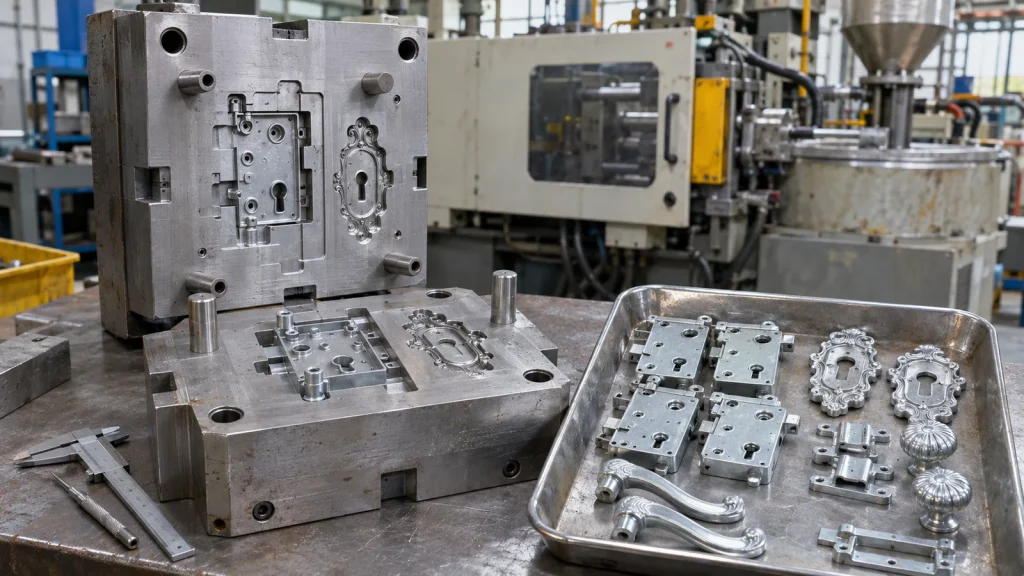
A zinc alloy die casting mold is the central tooling element in one of the most efficient routes for producing small and medium-sized metal parts. It is a precision-machined, reusable steel tool into which molten zinc alloy is forced under pressure. The metal fills a shaped cavity, cools and solidifies in seconds, and is then ejected as a casting that is close to its final geometry. The mold is usually called a die, and the complete process is called die casting. The term zinc alloy die casting mold therefore refers to the tool itself, not to the zinc alloy, the machine, or the finished part.
The basic working principle is cyclic pressure casting into a closed steel die. Two mold halves are clamped tightly together, molten zinc alloy is injected into the cavity through a controlled passage system, the metal solidifies against the cooled steel walls, the mold opens, and ejector pins push the part out. The cycle then repeats. Because the mold opens and closes many thousands or even millions of times, it must combine accurate geometry with robust mechanical support, effective cooling, reliable ejection, and careful venting. The mold is not simply a negative shape. It is a complete mechanical system that controls filling, heat transfer, dimensional accuracy, surface quality, and production rate.
What a zinc alloy die casting mold is
A zinc alloy die casting mold is a hardened steel tool designed for repeated use. This distinguishes it from expendable molds such as sand molds, which are destroyed after a single casting, and from many permanent molds that rely mainly on gravity. In die casting, the mold is a closed tool, and the metal is driven into it at high speed and pressure. The mold must withstand thermal cycling, mechanical clamping force, injection pressure, erosion from flowing metal, and the repeated action of slides, cores, and ejector pins.
Most zinc die casting molds are used on hot-chamber die casting machines. In a hot-chamber machine, the injection mechanism is immersed in a bath of molten zinc alloy. A plunger forces the metal upward through a gooseneck and nozzle into the mold. This arrangement is practical because zinc alloys melt at relatively low temperatures, typically around 380 to 420 degrees Celsius. The low melting temperature reduces thermal shock to the tool and allows the injection system to sit directly in the melt. Aluminum and magnesium generally require cold-chamber machines because their higher melting temperatures would damage a submerged injection system.
The mold usually consists of two main halves. The cover die, or fixed half, is mounted on the stationary platen of the machine. The ejector die, or moving half, is mounted on the moving platen. When the machine closes, the two halves meet along a parting line and form a sealed cavity or set of cavities. The cavity is the negative shape of the part. Additional features such as cores, slides, inserts, runners, gates, overflows, vents, and cooling channels turn that basic cavity into a production tool.
A zinc die casting mold may be a single-cavity tool for a large or complex part, or a multi-cavity tool for high-volume small parts. It may also use a family layout, in which several different but related parts are produced in one shot. The choice depends on annual volume, part size, tolerance requirements, machine capacity, and the economics of tooling. In all cases, the mold is part of a larger production system that includes the die casting machine, melting and holding furnace, metal transfer or hot-chamber injection system, temperature control units, release agent spraying, trim press, and inspection equipment.
Why zinc alloys are well suited to die casting molds
Zinc alloys are among the easiest metals to die cast. Their melting range is low compared with aluminum, magnesium, or brass, and their fluidity is excellent. Good fluidity allows molten zinc to fill thin walls, fine ribs, small holes, sharp lettering, and decorative textures before solidification blocks the flow. Zinc also has good thermal conductivity, so heat leaves the casting quickly and cycle times can be short. This combination supports high production rates and parts with smooth surfaces and tight dimensional tolerances.
The most familiar zinc die casting alloys are the Zamak family. Zamak 3 is widely used because it offers a good balance of castability, dimensional stability, mechanical properties, and surface finish. Zamak 5 contains copper and provides higher strength and hardness, with some trade-off in dimensional stability and ductility. Other zinc-aluminum alloys, sometimes called ZA alloys, may be used in specific applications, but hot-chamber zinc die casting is dominated by alloys formulated for reliable casting and finishing. Alloy selection affects fluidity, shrinkage, strength, plating response, creep resistance, and corrosion behavior, so it should be decided together with part design and end-use requirements.
Zinc die castings are often chosen for small structural parts, housings, connectors, locks, handles, gears, and decorative components. The alloy can be plated, painted, powder coated, or otherwise finished. Because the casting process can reproduce fine detail, a zinc die casting may require only limited secondary machining. In many cases, the mold produces a near-net-shape part with integrated bosses, ribs, holes, and mounting features. This is one reason zinc die casting remains competitive for high-volume precision components.
Zinc alloys are not universal solutions. They have lower melting points than steel or aluminum, and their mechanical properties change with temperature. Creep resistance, impact strength, and corrosion performance must be evaluated for the service environment. Thin, highly detailed parts may be ideal for zinc, while large load-bearing structures may be better suited to other materials. The mold design must therefore begin with a clear understanding of alloy behavior, part function, and production volume.
Anatomy of a zinc alloy die casting mold
The fixed half, or cover die, is attached to the stationary platen. It usually contains the sprue bush or entry passage through which molten metal enters the mold. The exact arrangement depends on the machine and injection system, but the fixed half provides a stable reference for the cavity and the metal delivery path. It must resist clamping force and support the cavity inserts without deflection that could cause flash or dimensional variation.
The moving half, or ejector die, is mounted on the moving platen. It carries the ejector system that pushes the solidified casting out after the mold opens. The moving half also supports cores, slides, and other features that must withdraw before ejection. Alignment between the two halves is maintained by guide pins and guide bushings. Wear plates and interlocks may be used to protect the parting line and maintain register in demanding tools.
The cavity and core assembly defines the part geometry. The cavity forms the external shape, while cores form internal features such as holes, recesses, undercuts, or threads. Fixed cores are simple and robust. Movable cores and slides are used when a feature cannot be released in the direction of mold opening. Slides, lifters, and hydraulic or mechanical core pulls add cost and maintenance requirements, but they can eliminate secondary operations. Inserts may be used for wear resistance, local cooling, or easy replacement of high-wear areas.
The feed system includes the sprue, runners, gates, overflows, and vents. The sprue is the initial passage from the injection nozzle into the mold. Runners distribute metal to the gates. Gates are the controlled entries into the cavity; their size, shape, and location strongly influence fill speed, turbulence, and solidification. Overflows provide a place for the first metal to travel, which can carry oxides and cold metal away from critical surfaces, and they help establish a favorable temperature distribution. Vents allow air and gas to escape as the cavity fills. Poor venting can cause incomplete filling, gas porosity, surface defects, and excessive injection pressure.
Cooling channels are internal passages that carry water, oil, or another heat-transfer fluid. They regulate mold temperature, remove heat from the casting, and help balance solidification. Cooling is not simply about making the mold cold. The die must be kept within a suitable temperature range so that metal fills properly, thermal gradients are controlled, and the part solidifies in a favorable sequence. Hot spots can cause shrinkage porosity, warpage, or local sticking. Excessive cooling can cause cold shuts or poor surface finish. Modern molds may use baffles, bubblers, thermal pins, conformal cooling, or separate temperature-control circuits for different regions.
The ejection system usually includes an ejector plate, ejector pins, return pins, and sometimes sleeves or blades. After the mold opens, the ejector plate advances and pushes the casting away from the core or cavity. Ejection must be balanced so that the part does not distort, crack, or stick. Draft angles on the part are essential for clean release. In some molds, a take-out robot removes the part from the open die, while in others the part falls freely or is caught by a chute.
The mold base provides the structural frame. It includes plates, guides, clamps, mounting patterns, and space for the ejector system and cooling manifolds. The mold base must be rigid enough to resist injection pressure without excessive deflection. Deflection can open the parting line, create flash, accelerate wear, and make dimensional control difficult. For high-volume production, the mold base and cavity inserts are designed as an integrated mechanical system rather than as separate components.
Mold materials are usually hardened tool steels. H13 is a common hot-work die steel because it combines toughness, heat resistance, and hardenability. Other grades may be selected for cavity inserts, cores, slides, or wear components. Heat treatment, surface treatment, and coatings can improve wear resistance and reduce soldering or erosion. However, no steel choice can compensate for poor cooling, poor gating, or abusive operation. Mold life depends on design, maintenance, alloy chemistry, die temperature, and the number of shots.
The basic working principle: the hot-chamber die casting cycle
The working principle of a zinc alloy die casting mold can be understood as a repeating sequence of clamp, inject, solidify, eject, and reset. Although the details vary by machine and part, the fundamental cycle is consistent.
1. Close and clamp the mold
The moving half advances until it meets the fixed half. The machine then applies clamping force. This force must be high enough to keep the mold closed while molten metal is injected. If clamping force is insufficient, the pressure inside the cavity can force the halves apart slightly, producing flash along the parting line. Excessive clamping force can damage the mold, crush vents, or cause unnecessary wear. The correct clamp force depends on cavity projected area, injection pressure, and the stiffness of the mold and machine.
2. Inject molten zinc alloy
In a hot-chamber machine, the injection mechanism sits in the molten zinc bath. A plunger and shot sleeve, often working with a gooseneck, force a measured quantity of metal through the nozzle and into the sprue. The metal travels through runners and gates into the closed cavity. Injection speed and pressure are controlled. The first stage fills the cavity quickly enough to prevent premature freezing, while the second stage intensifies pressure to pack the metal and compensate for shrinkage.
Typical injection pressures vary with part geometry, alloy, and machine design, but zinc hot-chamber casting commonly uses pressures in the range of roughly 1,000 to 5,000 psi, with many applications in the lower-to-middle part of that range. The exact value is less important than the principle: the mold must be filled completely before the metal freezes, and the metal must remain under pressure while it solidifies. For thin walls and fine detail, high fill speed may be needed, but excessive speed can create turbulence, air entrapment, and die erosion.
3. Fill the cavity and intensify pressure
The cavity fills through gates that are designed to distribute metal smoothly. Air and gas in the cavity must escape through vents, along the parting line, or through overflow passages. In some tools, vacuum assistance may be used to reduce trapped gas. Once the cavity is filled, the hydraulic system maintains or increases pressure. This intensification packs the metal into fine features and helps reduce shrinkage porosity. The gate must freeze at the right time so that the pressure remains effective in the cavity rather than bleeding back into the runner.
4. Cool and solidify
Heat transfers from the molten zinc into the steel mold and then into the cooling fluid. Because zinc alloys have relatively low melting temperatures and good thermal conductivity, solidification can be rapid. Many small zinc die castings solidify in a few seconds, although thicker sections, large parts, and multi-cavity tools may require longer cooling. The mold temperature is usually controlled within a range that supports good fill and surface finish while avoiding sticking, soldering, or excessive cycle time. The cooling layout should be designed around the part’s wall thickness and geometry, not simply placed uniformly around the cavity.
5. Open the mold and eject the casting
When the casting is strong enough to be handled, the clamp releases and the moving half retracts. The part may remain on the moving half, the fixed half, or a combination of cores and slides, depending on the design. Ejector pins then advance to push the casting out. Slides and cores withdraw before ejection if they form undercuts. The ejection system must be timed correctly to avoid damaging the part or the mold.
6. Trim, recycle, and reset
The ejected part usually remains attached to a sprue, runner, overflow, and flash. These are removed in a trim press or secondary operation. The reclaimed zinc is remelted and reused, which is an important economic and environmental advantage of die casting. The mold is inspected, cleaned if necessary, and sprayed with a release agent or lubricant. The next cycle then begins. In a well-designed cell, the entire sequence may take only seconds to tens of seconds, depending on part size and cooling requirements.
Flow, pressure, and thermal balance
A zinc die casting mold works only when filling, pressure, and cooling are balanced. Gating affects how metal enters the cavity. A gate that is too small may cause excessive velocity, atomization, and erosion. A gate that is too large may freeze slowly and reduce the effectiveness of intensification. Multiple gates may be needed for large or complex parts, but they must be arranged so that flow fronts meet in controlled locations and air can escape. Overflow placement can help direct the first, colder metal away from critical surfaces and provide a place for trapped gas to collect.
Venting is equally important. Air trapped in the cavity can become porosity, incomplete fill, or surface defects. Vents must be deep enough to allow gas to escape but shallow enough to prevent molten zinc from flowing out excessively. They must be kept clean. Over time, flash, lubricant residue, and metal build-up can block vents and change the filling behavior of the mold.
Thermal balance is the third pillar. If one area of the mold runs too cold, metal may freeze before the cavity is full. If an area runs too hot, the casting may stick, soldering may occur, or shrinkage porosity may form. The die temperature should be controlled by a combination of cooling channels, heating, spray lubrication, and cycle timing. The goal is not a uniform temperature everywhere, but a controlled temperature distribution that supports directional solidification and stable production.
Design and process parameters that matter
Part design has a major effect on mold performance. Wall thickness should be as uniform as possible. Sudden changes in section thickness can create hot spots, shrinkage porosity, and warpage. Generous radii reduce stress concentration and improve metal flow. Draft angles are required on surfaces parallel to the direction of mold opening so that the part can be ejected without scuffing or cracking. Undercuts should be avoided unless they can be formed by slides or removable cores.
Shrinkage must be allowed for in the mold cavity. Zinc alloys shrink as they solidify and cool, so the cavity is made slightly larger than the finished part dimensions. The exact shrinkage allowance depends on alloy, wall thickness, molding conditions, and feature constraints. A mold designer does not simply apply one blanket factor to every dimension; critical dimensions may require correction based on experience and trial shots.
Tolerances should be realistic. Die casting can achieve good dimensional control, but very tight tolerances can increase tool cost and inspection burden. Functional features should be toleranced separately from cosmetic surfaces. Machining allowances may be added where fits, threads, or sealing surfaces require additional precision. The mold should be designed for the manufacturing process, not merely drawn as a copy of the final part.
Cavity count and machine size are economic and technical decisions. A multi-cavity mold can raise output per shot, but it also increases mold size, clamping force requirements, metal consumption in the feed system, and the difficulty of balancing flow and cooling. A single-cavity mold may be better for a large part or a low-volume program. The selection should consider annual demand, part price, changeover cost, and the risk of tooling obsolescence.
What distinguishes zinc alloy die casting molds
Zinc alloy die casting molds are distinctive because they operate in a lower-temperature, high-fluidity regime. Compared with aluminum die casting, zinc tooling experiences less thermal shock and less severe erosion. This can contribute to long mold life and stable production. Zinc’s fluidity allows very thin walls, fine textures, sharp corners, and small internal features. The resulting castings often have smooth surfaces that can be plated or painted with minimal preparation.
Hot-chamber processing also contributes to productivity. The injection mechanism is integrated with the molten metal bath, so a shot can be made quickly and consistently. Cycle times are short for small parts. The lower melting temperature reduces energy consumption compared with higher-melting metals and can extend the life of cores, nozzles, and other components. These advantages explain why zinc die casting is widely used for small precision parts that would be expensive to machine individually.
These advantages do not remove the need for good tooling practice. Zinc can still erode gates, wear cores, and form flash if the mold is poorly maintained. Zinc alloys can also interact with certain tool surfaces if lubrication and temperature control are poor. A zinc mold must be designed with adequate cooling, venting, ejection, and guidance just like any other die casting tool.
Applications of zinc alloy die castings
Zinc die castings appear in many everyday and industrial products. Hardware components include door handles, locks, hinges, brackets, and decorative trim. Automotive applications include small brackets, connectors, housings, and trim parts. Electrical and electronic products use zinc castings for shields, connector bodies, heat sinks, and mounting frames. Consumer products include zipper pulls, toy components, cosmetic cases, and appliance parts. Industrial equipment may use zinc castings for gears, levers, valve components, and instrument housings.
The common thread is a need for small, complex, repeatable metal parts with good surface finish and moderate strength. Zinc die casting is particularly attractive when the part can be produced near net shape and finished with plating or coating. The mold can incorporate logos, textures, ribs, bosses, and mounting features that would otherwise require multiple machining operations. For high-volume production, the tooling investment can be recovered through low per-part cost and short cycle times.
Quality control, common defects, and maintenance
Quality in zinc die casting depends on stable process control. Important variables include metal temperature, die temperature, injection speed, injection pressure, intensification pressure, shot size, cooling time, spray lubrication, and cycle time. These variables should be documented and monitored. A mold that produced good parts last month may produce defects if a cooling line is partially blocked, a vent is plugged, or the metal chemistry has drifted.
Common defects include porosity, incomplete filling, cold shuts, flash, surface blisters, soldering, and dimensional drift. Porosity may be gas-related or shrinkage-related. Gas porosity often comes from trapped air or lubricant breakdown; shrinkage porosity is associated with feeding and thermal gradients. Cold shuts occur when flow fronts meet after the metal has cooled too much. Flash indicates insufficient clamping, excessive pressure, or worn parting surfaces. Soldering is the sticking of zinc to the die, often related to high die temperature, poor lubrication, or surface condition. Each defect has a cause, and effective troubleshooting starts with the filling and thermal history of the mold.
Maintenance is essential for long mold life. The parting line should be cleaned and inspected. Vents should be cleared. Cooling channels should be checked for scale and flow restriction. Ejector pins and slides should be lubricated according to the maintenance plan. Cores and inserts should be inspected for wear, cracking, and heat checking. If a mold is allowed to run with flash or damaged vents, the problem can accelerate wear and alter filling behavior. A structured maintenance schedule based on shot count and condition monitoring is more effective than reacting only after a failure.
Cost, mold life, and production economics
A zinc alloy die casting mold is a capital investment. Its cost depends on part complexity, cavity count, steel selection, slides and cores, cooling design, surface finish requirements, and expected life. A simple single-cavity tool may cost far less than a multi-cavity tool with hydraulic slides and tight tolerances. The purchase price, however, is only one part of the total cost. The mold’s productivity, maintenance burden, scrap rate, and life determine the true cost per part.
Mold life is usually measured in shots. With good design and maintenance, a zinc die casting mold can produce many thousands or even millions of parts. The actual life depends on alloy, part geometry, gate design, die temperature, cooling, lubrication, and how carefully the tool is operated. High-wear areas may use inserts that can be replaced without rebuilding the entire mold. Polishing, retexturing, vent cleaning, and replacement of ejector pins are normal maintenance activities. A well-maintained mold can remain productive for years, while a poorly maintained mold may fail early through cracking, erosion, or dimensional loss.
Practical checklist for specifying a zinc die casting mold
When specifying a zinc alloy die casting mold, start with the part’s function and production volume. Confirm the alloy and the required mechanical properties. Review wall thickness, draft, radii, undercuts, holes, threads, and cosmetic surfaces. Decide which features should be cast and which should be machined. Establish realistic tolerances and inspection methods. Consider the feed system, venting, cooling, and ejection early in the design, because these are not details that can be added later without cost.
Select a mold maker with experience in zinc hot-chamber die casting. Ask for a design review that covers filling, solidification, die temperature, and maintenance access. Confirm the machine tonnage, shot capacity, and platen size. Plan for trial shots and sampling. A first article inspection should verify critical dimensions, appearance, porosity, and fit. Production should begin only after the process window is established and documented. This disciplined approach reduces the risk of costly tool modifications and improves the long-term reliability of the mold.
Frequently asked questions
What is the difference between a zinc die casting mold and a plastic injection mold?
Both are reusable steel tools that form parts in a closed cavity, but they operate under different conditions. A zinc die casting mold handles molten metal at roughly 380 to 420 degrees Celsius, so it needs heat-resistant tool steel, thermal management, and wear resistance suited to metal flow. Injection pressures and clamping forces are also high, and the tool must withstand erosion and thermal cycling. A plastic injection mold processes polymer melt at lower temperatures and pressures, although it may still require precision cooling and ejection. The design principles are related, but the material behavior and tooling requirements are different.
Why is zinc usually die cast in a hot-chamber machine?
Zinc alloys melt at relatively low temperatures, so the injection mechanism can be immersed in the molten metal bath without rapid degradation. This allows fast, consistent shot delivery and short cycle times. Aluminum and magnesium require higher temperatures, which would damage a submerged injection system, so they are normally processed in cold-chamber machines where the metal is transferred into a separate shot sleeve. Hot-chamber processing is one reason zinc die casting is efficient for small and medium parts.
How long does a zinc alloy die casting mold last?
Mold life varies widely. A well-designed and well-maintained zinc die casting mold can last for a very high number of shots, often hundreds of thousands or more, and some tools can exceed a million shots depending on the part and operating conditions. Factors include alloy, part geometry, gate design, die temperature, cooling, lubrication, maintenance, and the quality of the steel and heat treatment. High-wear areas may be designed as replaceable inserts to extend the life of the mold base.
What are the most common defects in zinc die casting?
Common defects include porosity, incomplete filling, cold shuts, flash, soldering, surface blisters, and dimensional variation. Porosity may come from trapped gas or from shrinkage. Incomplete filling and cold shuts are often related to low die temperature, slow fill, or poor venting. Flash is usually caused by insufficient clamping force, excessive injection pressure, or worn parting surfaces. Soldering is associated with high die temperature, inadequate lubrication, or poor surface condition. Effective correction requires reviewing the whole process, not just one variable.
Can zinc die castings be plated or painted?
Yes. Zinc die castings are commonly plated with chrome, nickel, or other finishes, and they can also be painted or powder coated. Good surface finish from the mold helps reduce preparation costs. Plating requires careful process control because surface porosity, contamination, or incomplete filling can affect adhesion and appearance. The alloy, casting quality, and finishing process should be considered together during product development.
What information is needed to quote a zinc die casting mold?
A mold maker typically needs a 3D part model, 2D drawings with critical dimensions and tolerances, alloy specification, annual volume, expected product life, surface finish requirements, and any secondary operations. Information about undercuts, inserts, threads, and cosmetic surfaces is important. The buyer should also provide machine constraints, if any, and clarify whether the mold will be used for sampling only or for full production. A complete quotation should define cavity count, tool steel, cooling design, ejection, slides, maintenance access, and the acceptance process for trial shots.
Conclusion
A zinc alloy die casting mold is a reusable precision steel tool that turns molten zinc alloy into accurate, repeatable metal parts. Its basic working principle is a closed-die pressure casting cycle: the two mold halves clamp together, molten zinc is injected through the sprue, runners, and gates, the cavity fills and is packed under pressure, the metal solidifies against cooled steel, the mold opens, and ejector pins release the casting. The sprue, runners, overflows, and flash are trimmed and recycled, and the cycle repeats.
The mold itself is much more than a cavity. It is a system of fixed and moving halves, cavity inserts, cores, slides, vents, cooling channels, ejector pins, guides, and structural plates. Its performance depends on good gating, venting, thermal balance, clamping, and maintenance. Zinc alloys are well suited to this process because they melt at relatively low temperatures, flow easily into fine details, solidify quickly, and produce smooth surfaces. These characteristics make zinc die casting molds valuable for hardware, automotive, electrical, consumer, and industrial components.
For anyone specifying or operating a zinc alloy die casting mold, the practical message is clear: start with part design and alloy selection, design the feed and cooling systems together, control the process window, and maintain the tool systematically. When these elements are aligned, a zinc die casting mold can deliver high output, good dimensional control, excellent surface quality, and long service life.