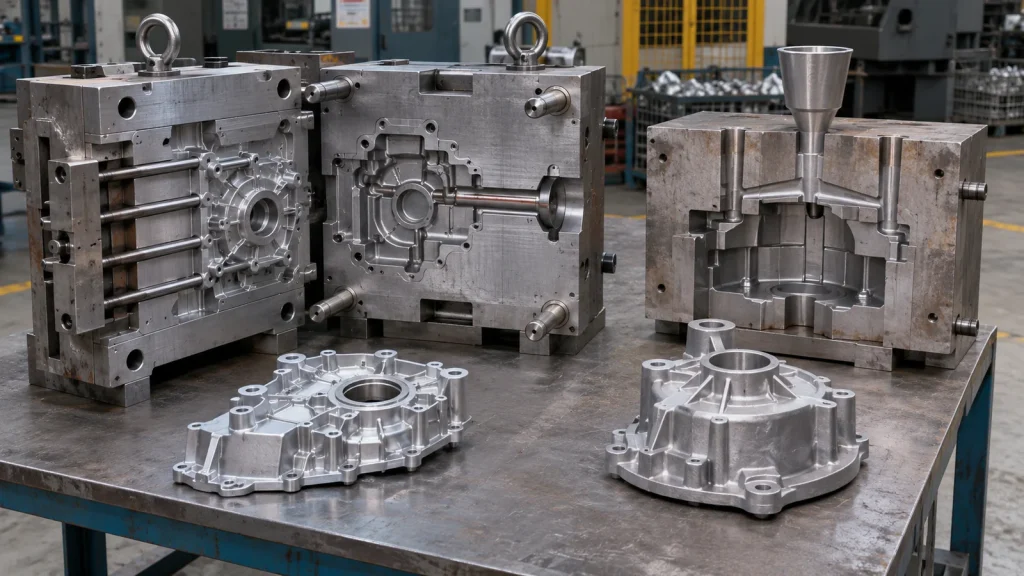
At first glance, a die casting mold and a gravity casting mold can look like variations of the same idea: two halves of tooling, a shaped cavity, and a method for filling that cavity with liquid metal. The real distinction is conceptual, and it sits upstream of every detail in the tool. A die casting mold is designed around force. A gravity casting mold is designed around flow and feeding. That single difference explains why one tool needs a massive clamping machine, precise vents, and hardened hot-work steel, while the other may rely on a simple pouring basin, a well-placed riser, and a carefully managed thermal gradient. It also explains why the two molds are rarely interchangeable even when the finished parts look similar on a drawing.
The question of concept matters because it prevents a common mistake: comparing molds only by cavity shape or by the fact that both can be made of metal. Two molds can both be permanent tools and still belong to different process families. The mold is not just a negative shape. It is the physical interface between a filling strategy and a solidification strategy. In die casting, the filling strategy is high-pressure injection. In gravity casting, the filling strategy is gravity, assisted by good gating and feeding. The mold must be designed around whichever strategy dominates.
The Core Conceptual Difference: How the Metal Is Driven Into the Cavity
The cleanest way to state the difference is this: a die casting mold contains and survives a forced injection; a gravity casting mold guides a pour and feeds the resulting shrinkage. In die casting, molten metal is typically forced into a reusable steel cavity by a plunger or piston at high speed and high pressure. The pressure may range from roughly 1,000 psi to more than 20,000 psi depending on the process, alloy, and part. The cavity fills in milliseconds. The mold is clamped shut by a large machine so that the two halves do not separate under the internal pressure. The metal is not simply poured; it is accelerated, compressed, and shaped before it has time to freeze.
In gravity casting, molten metal is poured into the mold and flows under its own weight. The driving force is the metallostatic head created by the pouring basin, sprue, and runner system. There is no injection plunger and no high-pressure shot. The mold may be a permanent metal mold, or it may be a consumable sand mold. In either case, the filling concept is gravity. The mold must guide the metal smoothly, avoid turbulence where possible, allow air and gases to escape, and provide a way to feed the casting as it shrinks. Filling takes seconds rather than milliseconds. The mold is not a pressure vessel in the same sense; it is a flow path and a thermal system.
This difference is often summarized as pressure versus gravity, but the practical meaning is deeper. Pressure changes the entire economics and physics of the tool. It allows very thin walls and fine detail, but it also introduces gas entrapment, high clamping loads, expensive tooling, and severe thermal shock. Gravity reduces those mechanical demands, but it requires thicker walls, careful riser design, and a solidification plan. The mold designer is solving a different problem in each case.
Die Casting Mold as a Pressure Vessel and Heat Exchanger
A die casting mold must do several jobs at once. It must define the part shape with high precision. It must resist the separation force created by injected metal. It must vent air and gas from the cavity before those gases become porosity. It must remove heat quickly enough to freeze the thin sections before the shot cycle ends. It must eject the part without distortion. And it must survive repeated cycles of heating and cooling without cracking, eroding, or losing dimensional accuracy.
That is why die casting molds are usually made from premium hot-work tool steels, such as H13 and related grades, and why they receive careful heat treatment, surface treatment, and cooling design. The mold includes a sprue, runner, and gate system that delivers metal from the shot chamber into the cavity. It often includes overflows and vents to capture cold metal and expel air. It may include vacuum channels, thermal control circuits, slides for undercuts, inserts for wear resistance, and ejector systems. The parting line must be tight because the mold is closed against pressure. The clamping tonnage of the machine is not a convenience; it is a process requirement.
The die casting mold is also a rapid heat exchanger. Because the cavity fills in milliseconds and the part may solidify in seconds, the thermal balance of the mold directly affects fill, porosity, surface quality, and cycle time. Hot spots can cause shrinkage porosity or soldering. Cold spots can cause incomplete filling or cold shuts. Cooling lines, baffles, bubblers, and sometimes conformal cooling channels are used to manage the temperature field. The mold is therefore a dynamic system, not a static block of steel.
Gravity Casting Mold as a Flow Guide and Feeding System
A gravity casting mold has a different center of gravity, literally and figuratively. It must accept metal from a ladle or pouring basin and deliver it to the cavity without introducing excessive turbulence, slag, or oxide films. The gating system is designed to control velocity and direction. In a permanent metal mold, the mold may be coated to control heat transfer and protect the die surface. In a sand mold, the sand itself provides permeability for gas escape and can be shaped with complex cores. In both cases, the mold must allow the casting to solidify in a controlled direction.
Feeding is the defining design problem. As metal solidifies, it shrinks. A gravity casting mold must provide risers or feeders that remain liquid longer than the casting and supply liquid metal to compensate for shrinkage. It may use chills to accelerate cooling in selected regions, exothermic sleeves to keep risers hot, and insulating coatings to control thermal gradients. The goal is directional solidification: the distant or thin sections freeze first, and the riser freezes last, feeding the shrinkage that occurs in between. This is a very different design logic from die casting, where the injection pressure and the machine intensification system may help compact the metal, and where overflows and vacuum assist are used to manage gas and shrinkage.
A gravity casting mold is therefore not simply a cavity with a hole on top. It is a thermal and fluid-flow system. The runner must not dump metal into the cavity in a way that creates turbulence. The riser must be large enough and located correctly. The mold coating must be selected for the alloy and the desired cooling rate. The draft angles must allow part removal. The mold material must withstand the thermal cycling of repeated pours if it is a permanent mold, or it must be inexpensive enough to be replaced if it is a sand mold.
The Common Ground
Despite these differences, both mold types share basic foundry principles. Both need shrinkage allowances. Both need draft angles or taper so the part can be removed. Both need a parting line or a way to open the mold. Both must manage heat. Both must avoid defects such as cold shuts, misruns, inclusions, and distortion. Both must be designed around the alloy, the part geometry, and the quality specification.
The difference is not that one mold is scientific and the other is simple. The difference is where the design effort is concentrated. In die casting, the effort is concentrated in pressure containment, high-speed filling, venting, cooling, and tooling durability. In gravity casting, the effort is concentrated in gating, riser design, thermal gradients, mold coating, and controlled solidification.
How the Filling Force Reshapes Mold Design
The filling force is not an isolated parameter. It changes the mechanical loads, the venting strategy, the solidification pattern, the allowable wall thickness, the tooling material, and the production economics. Understanding these cascading effects is the key to understanding the conceptual difference.
Clamping, Parting Lines, and Mechanical Loads
In die casting, the injected metal tries to push the mold halves apart. The clamping unit must generate enough tonnage to keep the mold closed. If the clamping force is insufficient, flash can form, dimensions can drift, and the shot can become unsafe. The mold therefore needs strong backing plates, robust support pillars, a well-supported cavity insert, and a parting line that can withstand repeated pressure cycles. Ejector pins and slides must be designed so that they do not become weak points under pressure.
In gravity casting, the metal does not create the same separation force. The mold halves may be held together by clamps, weights, or a simple closing mechanism. The parting line still matters for dimensional accuracy and flash control, but it is not fighting a high-pressure injection. This reduces the structural demands on the mold and the machine. It also means that gravity casting molds can be simpler, larger, and less expensive to build, especially when the mold is made of sand or a lower-cost permanent mold material.
Venting and Gas Entrapment
Venting is one of the clearest conceptual dividers. In die casting, the cavity fills so fast that air has little time to escape through natural gaps. The mold must provide dedicated vents, overflows, and sometimes vacuum assistance. If air or vapor is trapped, it becomes gas porosity. That porosity may be invisible from the outside but can cause blisters during heat treatment, leaks in pressure-tight parts, or weak sections in critical areas. The venting system is therefore part of the mold design, not an afterthought.
In gravity casting, filling is slower and the metal front is gentler. In sand casting, the sand is permeable and gases can escape through the mold wall. In permanent mold gravity casting, vents and coatings help, but the lower filling velocity reduces the tendency to whip air into the metal. This does not mean gravity casting is free of gas defects. It can still entrap gas if the gating is poor, if the mold is too cold, or if the coating generates gas. But the defect profile is different. Gravity casting is often more tolerant of heat treatment and welding because it has less trapped gas porosity, provided the gating and feeding are well designed.
Solidification and Feeding
Die casting relies on rapid solidification and, in many cases, on intensification pressure applied at the end of the shot. The thin walls cool quickly, which is good for productivity and fine grain, but it also means that feeding distances are short. Shrinkage porosity can still occur in thick sections, hot spots, or areas far from the gate. Overflows can help by providing a hot reservoir and by capturing cold metal. Vacuum and squeeze casting variants can reduce porosity further, but conventional high-pressure die casting often has limited ability to feed shrinkage in isolated thick sections.
Gravity casting relies on risers and directional solidification. The mold designer must ensure that the riser stays liquid long enough to feed the casting. This may require a riser with a larger modulus than the casting section it feeds, insulation, exothermic material, or a chill in the casting to promote directional cooling. The feeding system is the heart of the gravity mold design. If the riser freezes too early, shrinkage porosity appears. If the thermal gradient is wrong, the casting may have internal voids or tears.
Wall Thickness, Detail, and Surface Finish
High-pressure injection can force metal into very thin sections and fine details. Die casting can produce walls as thin as about 0.5 mm in small parts, although practical limits depend on alloy, part size, and geometry. It can reproduce sharp corners, fine textures, and near-net-shape features. Surface finish is usually good, and secondary machining may be limited.
Gravity casting generally requires thicker walls. A common minimum is around 3 mm or more for many permanent mold and sand cast parts, and thicker sections may be needed for feeding and structural integrity. Detail is softer, surface finish is rougher, and machining allowances are more common. Sand casting has the roughest surface because the sand mold leaves a textured skin. Permanent mold gravity casting can produce a better finish than sand casting, but it still does not match high-pressure die casting for fine detail and thin walls.
Thermal Fatigue and Mold Materials
Die casting molds endure severe thermal fatigue. The surface heats rapidly when the metal enters and cools rapidly when the mold opens and spray is applied. This cyclic thermal load can cause heat checking, cracking, erosion, and soldering. The mold material must have high hot strength, good thermal conductivity, and resistance to tempering. H13 is common, but other hot-work steels and surface treatments are used depending on the alloy and production volume. Cooling design and spray practice are critical to mold life.
Gravity casting molds have different wear mechanisms. Permanent metal molds experience thermal cycling and metal contact, but the mechanical loads are lower. They may be made from cast iron, steel, or other heat-resistant materials. Coatings are often used to protect the mold and control heat transfer. Sand molds are used once and destroyed, so the mold material cost is part of every part rather than a capital tooling investment. The trade-off is different: permanent gravity molds have higher tooling cost than sand but lower cost per part at moderate volume, while sand molds have low tooling cost but higher per-part labor and material cost.
A Side-by-Side Conceptual Comparison
The table below summarizes the conceptual differences. It is not a specification sheet for a particular part, but a map of how the two mold concepts differ.
| Dimension | Die Casting Mold | Gravity Casting Mold |
|---|---|---|
| Primary function | Contain high-pressure injection and form the part | Guide a gravity pour and feed shrinkage |
| Filling drive | Plunger or piston, high pressure and high speed | Gravity head from pouring basin and runner |
| Typical fill time | Milliseconds | Seconds |
| Clamping | Heavy clamping tonnage required | Simple clamping or holding |
| Typical mold material | Hardened hot-work tool steel | Cast iron, steel, graphite, or bonded sand |
| Wall thickness | Very thin possible, often 0.5 to 2 mm | Thicker, often 3 mm or more |
| Detail and finish | Excellent, near net shape | Good but generally rougher |
| Gating | Sprue, runner, gate, overflow, vent, vacuum | Pouring basin, sprue, runner, riser, chill |
| Feeding | Intensification pressure, overflows, thermal control | Risers, chills, insulation, directional solidification |
| Gas porosity risk | High without good venting or vacuum | Lower in well-gated gravity casting, but still possible |
| Heat treatment and welding | Often limited by trapped gas | Generally better if sound and properly gated |
| Tooling cost | High | Moderate to low, depending on mold type |
| Cycle time | Very fast | Slower |
| Typical volume | High volume, thousands to millions | Low to medium volume, hundreds to tens of thousands |
| Best fit | Small to medium complex parts, thin walls, high volume | Larger, thicker, simpler parts, prototypes, heat-treated parts |
The table makes the conceptual difference visible. The die casting mold is built to withstand and contain pressure. The gravity casting mold is built to guide a pour and manage feeding. Everything else follows from that.
From Mold Concept to Production System
The mold is only one part of the production system. Die casting requires a die casting machine with a shot system, a clamping unit, a ladle or automatic metal delivery system, a mold spray system, and often a trim press. The machine must be sized for the projected area of the part and the injection pressure. The mold must be compatible with the machine’s tie-bar spacing, platen size, shot position, and ejection system. Production is fast and highly automated, but the capital investment is high.
Gravity casting can be manual, semi-automated, or automated. A permanent mold gravity casting cell may use a tilt-pour machine, a robot ladle, and controlled mold cooling. A sand casting line may use automated molding, pouring, and shakeout. The cycle time is longer, and the process may require more labor or more floor space per part. But the capital equipment is generally less expensive than a high-pressure die casting machine of comparable part size. The production system reflects the mold concept: pressure processes favor high-speed automation and high capital intensity; gravity processes favor flexibility and lower capital intensity.
It is important not to confuse gravity casting with low-pressure die casting. Low-pressure die casting uses a pressurized furnace to push metal up into a mold. It is a different process with its own mold design logic. Gravity casting relies on gravity alone, even if the mold is made of metal and the process is automated. The distinction matters because low-pressure die casting can produce parts with less turbulence and better feeding than gravity casting, but it is not the same as a gravity pour.
Materials and Geometry: Where Each Concept Fits Best
Die casting is commonly used with aluminum, zinc, and magnesium alloys, and sometimes with copper alloys. The alloys must have good fluidity and be suitable for high-speed injection. Zinc alloys are easy to cast and can produce very thin walls. Aluminum die casting is widely used for automotive, electronics, and industrial parts. Magnesium die casting is used where weight reduction matters. The process is well suited to complex shapes with bosses, ribs, and thin walls, as long as the part can be ejected from the mold and the tooling can accommodate slides for undercuts.
Gravity casting covers a broader range of materials. Permanent mold gravity casting is common for aluminum, magnesium, and copper alloys. Sand casting can handle cast iron, steel, and many other alloys that would be difficult or uneconomical in a high-pressure die casting mold. Gravity casting is often chosen for larger parts, thicker sections, and parts that require internal cavities formed by sand cores. It is also common for prototypes and low-volume production because the tooling cost is lower and the lead time can be shorter.
Geometry plays a major role. Die casting can produce thin, complex shapes with fine detail, but it needs draft angles and a feasible parting line. Undercuts require slides, which add cost and maintenance. Internal cavities are possible with soluble cores or specially designed slides, but they are not as easy as sand cores. Gravity casting, especially sand casting, can form complex internal passages with sand cores that are destroyed after the pour. Permanent mold gravity casting is more limited because the metal cores must be removed, but it can still produce parts that would be difficult in die casting.
Quality, Defects, and Performance
The quality profile of the two processes is different. Die casting produces fine grain and good surface finish because the metal cools quickly in a steel mold. It can achieve tight dimensional tolerances and excellent repeatability. However, the high-speed filling can trap air and gas, leading to gas porosity. This porosity can limit heat treatment and welding. If a die-cast part is heated to solution treatment temperatures, trapped gas can expand and cause blisters. Welding can also create porosity and weak joints. Vacuum-assisted die casting and squeeze casting can reduce gas porosity, but they add cost and complexity.
Gravity casting is generally slower to cool, which can produce a coarser grain structure. It may have lower tensile properties than die casting in the as-cast condition, especially in thick sections. But gravity casting can be designed with risers and chills to produce sound, feedable castings. It is often more suitable for heat treatment and welding because it has less trapped gas porosity. Structural parts that must be welded or heat treated frequently favor gravity casting or low-pressure casting over conventional high-pressure die casting.
Both processes can produce shrinkage porosity if the thermal design is wrong. In die casting, shrinkage porosity tends to appear in hot spots and thick sections that cannot be fed. In gravity casting, shrinkage porosity appears when the riser freezes before the casting or when the thermal gradient is not directional. Both processes can produce cold shuts, misruns, inclusions, and distortion. The difference is in the dominant defect mechanisms and the design tools available to control them.
Cost, Volume, and the Break-Even Logic
The economic logic of the two mold concepts is very different. Die casting tooling is expensive because the mold must be made from premium steel, machined to tight tolerances, heat treated, and equipped with cooling, venting, slides, and ejection. The machine is also expensive, and the process requires careful setup and maintenance. However, the cycle time is short, the process is highly automated, and the cost per part at high volume can be very low. The high tooling cost is spread over a large number of parts.
Gravity casting tooling is generally less expensive, especially for sand casting. A permanent gravity mold costs more than a sand pattern but less than a high-pressure die casting mold. The machine cost is lower, and the process can be more flexible. The cycle time is longer, and the labor content may be higher. At low to medium volume, gravity casting can be more economical because the tooling investment is lower and the break-even volume is lower. At high volume, die casting often wins because the per-part cost falls and the process is faster.
The break-even point depends on many factors: part size, complexity, alloy, tolerance, surface finish, machining allowance, scrap rate, and finishing requirements. A large part with thick walls may favor gravity casting even at relatively high volume because the die casting machine and mold would be very large and expensive. A small, thin-walled, complex part may favor die casting even at moderate volume because gravity casting cannot achieve the required geometry or finish. The decision should be based on total cost, not on a simple volume threshold.
Common Misconceptions and Practical Clarifications
Several misconceptions persist about these two mold types. The first is that a die casting mold is simply a gravity mold that has been strengthened. In reality, the entire design logic is different. A die casting mold is a pressure vessel with a shot system, venting, cooling, and ejection integrated into a high-speed cycle. A gravity mold is a flow guide and feeding system. Strengthening a gravity mold does not turn it into a die casting mold.
The second misconception is that gravity casting is always low technology. Permanent mold gravity casting can be highly engineered, with tilt pouring, controlled cooling, thermal analysis, and precise coatings. Sand casting can use sophisticated patterns, cores, and simulation. The process may be older, but it is not unsophisticated.
The third misconception is that gravity casting always means sand casting. Gravity casting is a filling method. It can use permanent metal molds, sand molds, graphite molds, or other mold types. The mold material affects cost, finish, and cooling rate, but the filling concept remains gravity.
The fourth misconception is that thinner walls are always better. Thin walls save weight and material, but they can increase filling difficulty, reduce stiffness, and create hot spots or stress concentrations. Die casting can make thin walls, but the design must still respect filling, ejection, and structural requirements. Gravity casting requires thicker walls, but those walls may provide better feeding and structural integrity.
The fifth misconception is that the two processes are interchangeable for the same part. A part designed for die casting may have walls, draft angles, and features that cannot be produced in a gravity mold. A part designed for gravity casting may have thick sections, risers, and machining allowances that are unnecessary or uneconomical in die casting. Converting a part from one process to the other usually requires redesign, not just a new mold.
How to Choose: A Practical Decision Framework
When choosing between a die casting mold and a gravity casting mold, start with the part requirements rather than the process name. The first question is alloy and heat treatment. If the part must be solution treated and aged to high strength, conventional high-pressure die casting may not be suitable because of gas porosity. Gravity casting or a vacuum-assisted die casting variant may be better.
The second question is geometry and wall thickness. If the part has thin walls, fine detail, and complex features, die casting has an advantage. If the part is large, thick-walled, or has internal passages that require sand cores, gravity casting may be the better fit.
The third question is volume and tooling budget. If the annual volume is high and the part is small to medium, die casting can justify the tooling investment. If the volume is low or the part is large, gravity casting may have a lower total cost.
The fourth question is quality and performance. If the part must be pressure tight, heat treated, welded, or used in a structural application, the porosity profile matters. Gravity casting may offer better soundness if properly designed. Die casting may offer better dimensional repeatability and surface finish.
The fifth question is finishing and assembly. Die casting often produces near-net-shape parts with minimal machining. Gravity casting may require more machining, but it can also produce larger parts with less tooling risk. The total cost should include machining, finishing, inspection, and scrap.
A practical approach is to involve both the product designer and the process engineer early. Use casting simulation to evaluate fill and solidification. Compare tooling cost, piece price, lead time, and quality risk. The best process is the one that meets the functional requirements at the lowest total cost, not the one with the most advanced mold.
FAQ
Is a gravity casting mold always a permanent metal mold?
No. Gravity casting describes how the metal enters the mold, not what the mold is made of. A gravity casting mold can be a permanent metal mold, a sand mold, a graphite mold, or another consumable or reusable mold type. Permanent metal molds are common for aluminum and magnesium gravity casting, while sand molds are common for iron, steel, and large or complex parts. The shared concept is that the metal flows under gravity rather than being injected under pressure.
Can die-cast parts be heat treated or welded?
Conventional high-pressure die castings can be heat treated or welded only with caution. The high-speed filling can trap gas in the metal, and that gas can expand during heat treatment, causing blisters or surface defects. Welding can also be difficult because trapped gas can create porosity. Vacuum-assisted die casting, squeeze casting, and other specialized variants can reduce gas porosity and improve heat treatability, but they are not the same as conventional die casting. If heat treatment or welding is a core requirement, gravity casting is often the safer choice.
Why does die casting require such expensive tooling?
Die casting tooling is expensive because it must survive high pressure, high speed, and severe thermal cycling. The mold is made from premium hot-work steel, machined to tight tolerances, heat treated, and equipped with cooling channels, vents, overflows, slides, and ejector systems. The clamping machine is also large and expensive. The tooling cost is high, but it is spread over a large production volume, which is why die casting can be economical for high-volume parts.
Is gravity casting only for low volume?
No. Gravity casting is often used for low to medium volume because the tooling cost is lower, but it can also be used for high-volume production, especially for parts that are too large or too thick for die casting. Permanent mold gravity casting can be automated and run at production rates. Sand casting can also be highly automated. The choice depends on part size, geometry, alloy, and quality requirements, not only on volume.
Which process gives a better surface finish?
Die casting generally gives a better as-cast surface finish and finer detail because the metal is forced against a polished steel cavity at high pressure. Gravity casting, especially sand casting, leaves a rougher surface. Permanent mold gravity casting can produce a good finish, but it is usually not as fine as die casting. The required finish and machining allowance should be considered when choosing the process.
Can the same alloy be used in both processes?
Some alloys can be used in both, but not all. Die casting requires alloys with good fluidity and suitable casting characteristics for high-speed injection. Gravity casting can use a broader range of alloys, including many that are not suitable for die casting. Even when the same base alloy is used, the process may require different composition, temper, or casting conditions. The alloy should be selected together with the process, not independently.
Conclusion
The conceptual difference between a die casting mold and a gravity casting mold is simple to state and far-reaching in practice. A die casting mold is built to contain and survive a high-pressure injection. It is a pressure vessel, a rapid heat exchanger, and a precision forming tool. A gravity casting mold is built to guide a pour and feed shrinkage. It is a flow system and a thermal system that relies on gravity, gating, risers, and controlled solidification.
That difference explains the thin walls and fine finish of die casting, as well as its high tooling cost and gas porosity risk. It explains the thicker walls and lower tooling cost of gravity casting, as well as its need for risers, chills, and careful thermal design. It also explains why the two processes are suited to different materials, geometries, volumes, and quality requirements.
The practical lesson is to choose the mold concept that matches the part and the production system. Do not ask only whether a mold is metal or reusable. Ask how the metal will be driven into the cavity, how the part will solidify, how gas will escape, how shrinkage will be fed, and how the total cost will behave at the expected volume. When those questions are answered, the choice between a die casting mold and a gravity casting mold becomes much clearer.