Zinc alloy die casting is often treated as a lower-temperature cousin of aluminum die casting, but that view is misleading. Zinc alloys such as Zamak 3, Zamak 5, and the ZA family cast at roughly 380 to 430 °C. The lower temperature can extend die life and help reproduce thin walls, fine lettering, small ribs, and sharp cosmetic details. It also allows minimal draft in some areas and encourages very short cycle times on hot-chamber machines. Those advantages are real, but they place unusual demands on the mold. Because zinc is fluid and fills quickly, every parting-line mismatch, venting error, sliding-fit clearance, and polishing defect can show up as flash, flow marks, soldering, or a rejected plated surface.
The commercial context matters too. A zinc die can run for hundreds of thousands of shots, and in some applications more than a million. The tool is expected to hold dimensional tolerance, survive thermal cycling, tolerate repeated assembly and disassembly, and maintain a cosmetic surface that may go directly to chrome plating, powder coating, or visible consumer assembly. A shop that can cut a cavity block is not automatically a shop that can build a production zinc die. The difference lies in an integrated set of machining, finishing, fitting, inspection, and process-engineering capabilities.
Why Zinc Tooling Demands a Specific Capability Set
Zinc’s fluidity is the central technical fact. In a hot-chamber process, molten zinc is injected rapidly through small gates and thin runners. It reaches fine details that aluminum may not fill, but it also seeks out any gap. A parting surface that is flat within a few thousandths of a millimeter on one bench may still flash if the die halves do not seat uniformly under clamp load. A slide fit that feels acceptable by hand may allow zinc seepage if the clearance is not controlled. A vent that is too deep can fill; a vent that is too shallow can trap gas and cause porosity or incomplete fill.
At the same time, zinc tooling usually lives a long life. That means the shop must think beyond first article. Cavity surfaces need to resist soldering and thermal fatigue. Cooling lines must be placed close enough to control cycle time without breaking into ejector holes or cavity details. EDM recast layers must be removed because they can crack and initiate soldering. Heat treatment and nitriding must be controlled so that the cavity does not distort after final machining. A zinc die is therefore a system of tightly linked tolerances, not a collection of separately machined plates.
The most capable mold shops combine five families of capability: design and simulation, precision machining, EDM and grinding, surface and thermal treatment, and verification and tryout. A weakness in any one family shows up later in the other four.
Design, Simulation, and Press-Specific Engineering
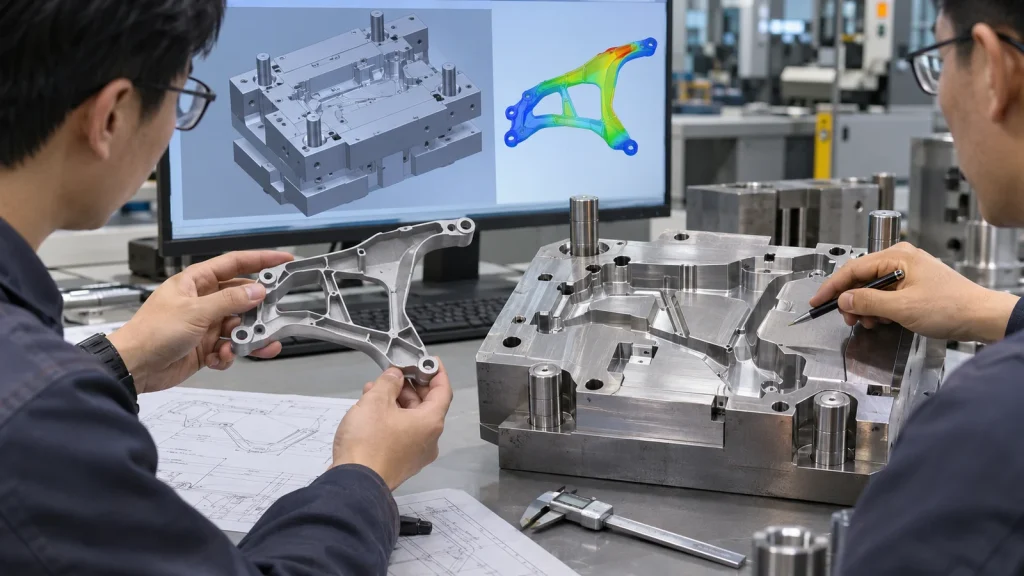
Zinc die design starts with part geometry review. The shop should be able to assess draft, wall transitions, ribs, bosses, ejector placement, gate location, overflow layout, venting, and cooling before steel is cut. A good design team does not simply accept a 3D model and begin programming. It checks whether the part can be cast, whether it can be ejected without distortion, whether thick-to-thin transitions will create shrinkage or gas traps, and whether the proposed gate and runner system will fill the cavity without overpacking thin sections.
Simulation is valuable because zinc fills and freezes quickly. Gate size, runner taper, overflow volume, vent depth, and cooling layout interact. A shop that relies only on experience may still build successful tools, but a shop that uses mold-flow analysis and DFM feedback can identify high-risk areas before heat treatment and final finishing. This is especially important for parts with cosmetic surfaces, thin walls, or multiple slides.
The design capability must also be machine-specific. A die that is geometrically sound but incompatible with the customer’s press is not production-ready. The shop should account for clamp force, shot weight, die height, platen size, ejector pattern, tie-bar spacing, hot-chamber gooseneck and nozzle interface, and the expected thermal profile. The output should include a complete die layout: cavity and core, parting line, slides and lifters, inserts, ejector system, gates, runners, overflows, vents, cooling and heating lines, and a tolerance stack for critical shutoffs.
A strong shop also provides manufacturability feedback on the part itself. It may recommend a small draft change, a thicker rib, a different ejector location, or a revised gate position that saves weeks of trial-and-error. That feedback is part of the machining capability because it determines what the CNC, EDM, grinding, and polishing departments will be asked to achieve.
CNC Milling: The Backbone of Zinc Die Construction
Zinc dies are commonly built from H13 or 1.2344 hot-work tool steel, hardened to roughly 44 to 48 HRC, with gas nitriding on the cavity surfaces. Some shops also use P20, 420 stainless, or other grades depending on the part, but H13-class steel is the reference point for long-life zinc tooling. The shop must therefore be able to machine both soft and hardened steel efficiently and accurately.
Three-axis and five-axis milling
Three-axis CNC milling is the workhorse for die bases, bolster pockets, cooling channels, insert pockets, ejector plates, and many cavity roughing operations. Five-axis capability becomes important for contoured cosmetic surfaces, angled slide pockets, undercut details, deep pockets, and parts that would otherwise require multiple re-fixturing operations. Every refixturing step introduces stack-up error, and zinc tooling has little tolerance for error at the parting line or on a visible surface.
Five-axis machining also allows shorter, stiffer tools to reach deep areas. That reduces deflection and chatter, which matters when finishing a cavity that must later be polished to a mirror finish. A shop with only a general-purpose three-axis mill may be able to cut the geometry, but it may struggle to hold the surface quality and positional accuracy needed for a production zinc die.
High-speed and hard milling
High-speed machining is not simply a faster spindle. It is a system of rigid machine structure, high-rpm spindle, balanced tool holders, advanced CAM strategies, and stable workholding. For zinc dies, high-speed milling supports fine finishing of cavities, small ribs, and thin wall sections. It also enables hard milling of H13 after heat treatment, reducing or eliminating the need to rely entirely on EDM and grinding for final geometry.
Hard milling at 48 HRC or above is a genuine differentiator. A capable shop can mill hardened H13 to near-net shape and hold roughly plus or minus 0.010 to 0.025 mm on critical features, depending on geometry and access. This capability shortens lead time, reduces EDM burn time, and can produce a better surface for final polishing. It also demands disciplined tool management, coolant control, and in-process inspection. A shop that claims hard milling without the right spindle, tooling, and measuring equipment may produce acceptable samples but inconsistent production tools.
Turning and boring
CNC turning and boring may seem secondary, but zinc dies contain many round components: cores, bushings, ejector pins, leader pins, nozzle bushings, and insert sleeves. These parts must fit smoothly and hold alignment. A shop that outsources all turning or treats it as a low-precision operation can create binding ejection, cooling leaks, or misalignment between core and cavity. Precision turning should be integrated with grinding and inspection so that round features meet the same tolerance regime as the cavity.
EDM: Sinker, Wire, and Electrode Control
Milling cannot reach every feature. Sharp internal corners, deep narrow ribs, thin slots, small ejector-pin pockets, lettering, logos, and textured details often require electrical discharge machining. For zinc dies, EDM is not a fallback; it is a core capability.
Sinker EDM, also called ram EDM, is used for deep cavities, sharp corners, ribs, small details, and areas where a rotary cutter would leave an unacceptable radius. The shop should be able to manufacture its own graphite or copper electrodes, control electrode wear, and use orbiting to achieve fine surface finishes. Outsourcing electrode production can work, but it adds coordination risk and makes it harder to tune the EDM process to the final polish requirement.
Wire EDM is critical for precise through-features, slide pockets, ejector holes, core-pin holes, insert pockets, venting lands, and tight-tolerance shutoffs. A capable wire EDM department should be able to hold around plus or minus 0.005 mm on critical work, depending on thickness and setup. Wire EDM is also valuable for cutting hardened steel after heat treatment, which avoids distortion from machining soft steel and then hardening it.
The integration of milling and EDM matters. The best shops use milling wherever it is efficient and reserve EDM for geometry that truly needs it. They also remove the EDM recast layer. On a zinc die, a recast layer left on a cavity surface can crack under thermal cycling and promote soldering. Polishing or gentle finishing must therefore be planned into the process, not treated as a cosmetic afterthought.
Grinding and Precision Fit-Up
Surface grinding establishes flat, parallel parting surfaces, die shoes, and shutoffs. In zinc tooling, parting-line flatness directly controls flash because the molten metal is so fluid. A parting surface that is not flat or that does not seat uniformly under clamp load will produce flash even if the cavity geometry is perfect. Grinding also supports insert pockets, wear plates, and slide components that must move smoothly without excessive clearance.
Cylindrical grinding finishes core pins, ejector pins, guide bushings, leader pins, and other round components. These parts may look simple, but their fit affects ejection force, alignment, cooling, and die maintenance. A sticky ejector pin can cause drag marks or part distortion. A poorly fitted core pin can allow zinc seepage or create a stress concentration. Precision grinding should be linked to inspection so that diameters, straightness, and surface finish are verified before assembly.
Hand fitting and benching remain important. Slides, lifters, inserts, and shutoffs often need blue-checking and manual spotting to achieve smooth movement with controlled clearance. This is skilled work that separates a die shop from a general CNC job shop. A shop that cannot fit and spot its own slides will struggle to deliver a zinc die that runs without flash and excessive maintenance.
Deep-Hole Drilling and Thermal Control
Cooling lines in a zinc die must be straight, accurately positioned, and close enough to the cavity to control temperature without breaking into cavity details, ejector holes, or other water lines. Gun drilling or deep-hole drilling is therefore a necessary capability. A shop that relies on conventional drilling for long cooling channels may accept drill wander, poor surface finish, or intersecting holes that cannot be repaired cleanly.
Thermal control is not only about cycle time. Poor cooling creates hot spots, which can lead to soldering, local erosion, heat checking, and dimensional variation. In zinc, the combination of fast cycles and thin walls makes thermal uniformity especially important. The shop should be able to prove flow and leak integrity after drilling, and it should understand baffle placement, circuit layout, and the difference between cooling for cycle time and cooling for surface quality. Hot-oil or heating circuits may also be required for certain geometries or start-up conditions.
Heat Treatment, Nitriding, and Dimensional Stability
H13 tool steel must be hardened, tempered, and stress-relieved under controlled conditions. Consistency matters more than speed. A shop may have in-house heat treatment or use a tightly controlled vendor, but it must be able to document the process and verify hardness. It must also plan machining allowances so that heat-treatment distortion can be corrected without losing critical geometry.
Gas nitriding of cavity surfaces is common practice for zinc tool life. Nitriding improves wear resistance and can reduce soldering tendency, but it must be applied to a properly prepared surface. If the cavity has a heavy EDM recast layer, poor polishing, or residual stress, nitriding will not solve the underlying problem. The shop should control nitriding depth, hardness, and dimensional effect, and it should know which surfaces should be masked or left un-nitrided.
Stress relief between rough machining and finish machining is another sign of maturity. Large die blocks and complex inserts can move after material removal. A shop that rough machines, stress-relieves, and then finishes has a better chance of holding shutoff tolerances and slide alignment after heat treatment.
Polishing, Texturing, and Cosmetic Surface Control
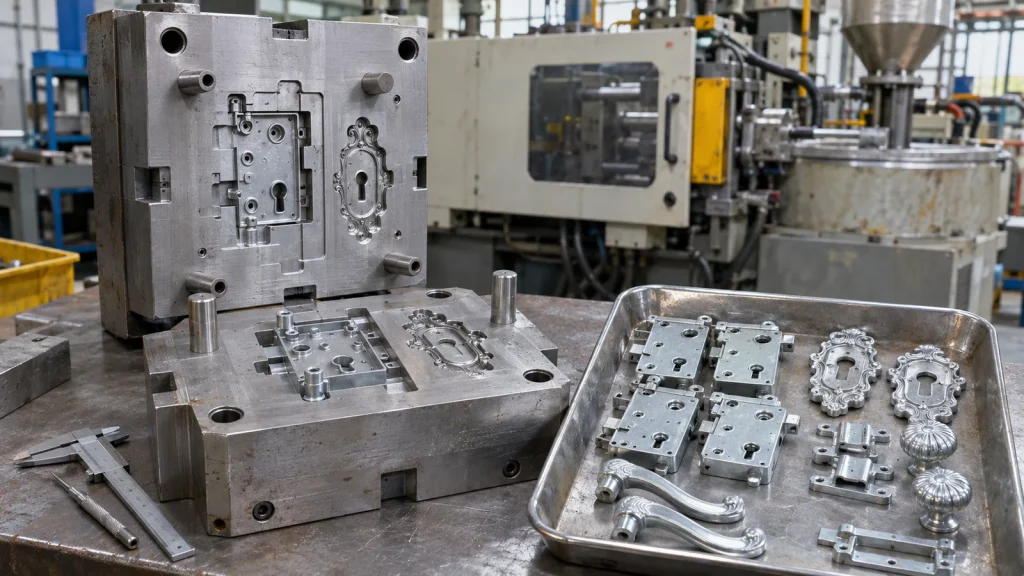
Many zinc castings are plated, painted, or used as visible components. The cavity surface therefore translates directly into part cosmetics. A shop needs skilled bench polishers who can achieve mirror or SPI A-2 to A-1 finishes on cavities, cores, runners, and visible details. Polishing must be controlled so that it does not round over sharp edges, wash out lettering, or change critical dimensions.
Texturing is equally important. Some parts require an MT or VDI grain, a laser texture, or a chemical etch. The shop should be able to apply texture consistently and protect critical shutoffs during the process. It should also understand how texture affects draft, ejection, and plating. A texture that is too deep or poorly applied can cause drag marks or incomplete filling in zinc.
Removing EDM recast and polishing out tool marks are not optional for cosmetic zinc dies. A mirror cavity with a hidden recast layer may look good at first but fail after thousands of shots. The best shops integrate polishing into the manufacturing flow, inspect the surface before nitriding, and protect finished surfaces during assembly and tryout.
Assembly, Spotting, Tryout, and Maintenance
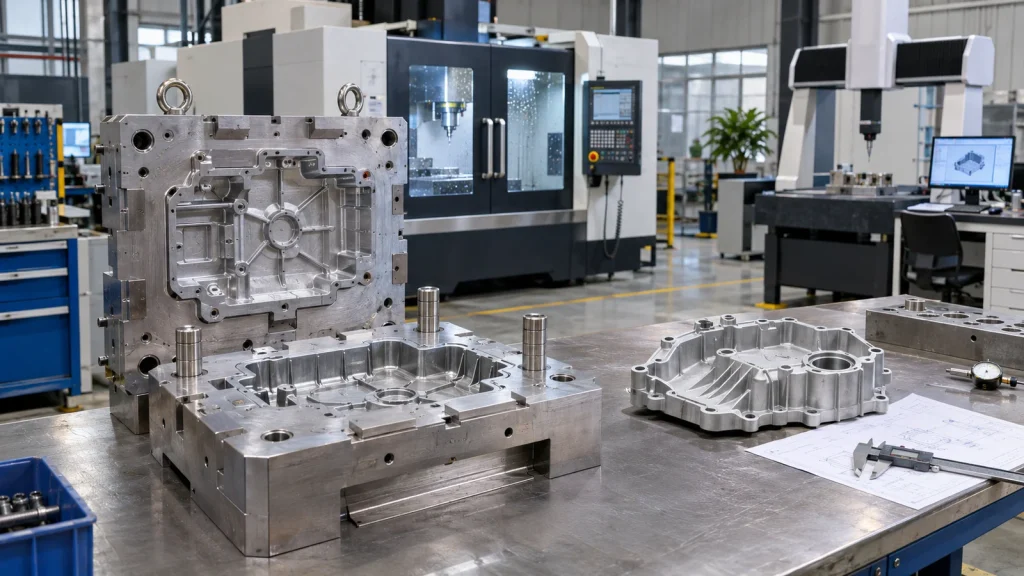
A die is not finished when the last cavity is polished. Assembly and spotting verify that the parting lines seat, slides move in the correct sequence, ejectors travel without binding, cooling circuits do not leak, and all inserts and cores align. Blue-checking of parting surfaces is still a practical and valuable step. Slide timing and ejector return must be checked under realistic conditions, not only on the bench.
In-house tryout or access to a partner press is a major advantage. The customer should receive T1 samples and a tryout report, not simply a completed die shipped blind. The tryout should confirm fill, flash, porosity, ejection, dimensional capability, and cosmetic appearance. A simple zinc tool may take around 30 days and a complex multi-slide tool around 45 days, but those timelines should include design review, machining, EDM, polishing, assembly, and tryout. If tryout is excluded, the schedule is incomplete.
Maintenance capability also matters because zinc dies live a long time. The shop should be able to weld, re-machine, re-EDM, re-polish, and re-fit worn or damaged areas. Engineering changes are common in consumer and hardware products, and a shop that can modify its own tooling without starting from scratch is more valuable than one that only builds new dies.
Inspection, Documentation, and Quality Systems
Coordinate measuring machine inspection is essential for cavities, cores, slides, insert pockets, and finished parts. The shop should be able to verify cavity dimensions, slide travel, core-to-cavity alignment, and parting-line flatness before tryout. Optical inspection, surface roughness measurement, and hardness testing round out the quality system. For automotive, hardware, or consumer products, first-article inspection and PPAP-style documentation may be required.
ISO 9001 is a baseline expectation for a serious mold shop. IATF 16949 becomes relevant for automotive work. Certification alone does not guarantee capability, but it indicates that the shop has documented processes for inspection, calibration, nonconforming material, and corrective action. The more important question is whether inspection data is used to drive machining decisions or simply collected after the fact.
A strong shop will provide a dimensional report, hardness records, surface-finish data, and tryout samples. It will also be able to explain how it controls critical shutoffs, how it verifies cooling flow, and how it handles engineering changes after tryout.
Secondary Machining: An Overlooked but Valuable Capability
Many zinc castings require post-cast CNC work on datums, bores, threads, sealing faces, or mounting surfaces to reach tolerances around plus or minus 0.010 mm. A mold shop that also has CNC finishing, drilling, tapping, and trimming in-house can prove that the die produces a machinable part, not just a castable one. This capability is not mandatory for every project, but it is a strong indicator of practical manufacturing knowledge. It also helps the shop give better DFM advice because it understands how the casting will be held and machined after ejection.
Capability Map by Die Feature
| Die feature | Primary processes | Key quality target |
|---|---|---|
| Cavities and cores | Three-axis and five-axis CNC milling, sinker EDM, polishing, nitriding | Tight profile accuracy, low surface roughness, zero flash at parting, solder resistance |
| Slides, lifters, and inserts | CNC milling, wire EDM, surface grinding, hand fitting | Smooth sliding fit with controlled clearance to prevent zinc seepage |
| Gates, runners, and vents | CNC milling, wire EDM, precision grinding | Smooth flow transitions and shallow vent depths matched to zinc fluidity |
| Thermal and ejection systems | Gun drilling, turning, grinding, assembly fitting | Uniform heat control, leak-free circuits, bind-free pin and sleeve ejection |
| Cosmetic surfaces | High-speed milling, EDM, polishing, texturing | SPI finish, consistent grain, no recast, no tool marks |
| Die base and structure | CNC milling, boring, surface grinding | Flat, parallel seating, stable clamp load, accurate pocket alignment |
This table shows why a single machine cannot define a zinc die shop. The cavity may be milled, EDM-cut, polished, nitrided, and measured on different machines, but the tolerances interact. A shop must manage the whole chain.
Shop Infrastructure and People
A capable zinc die shop usually has a climate-controlled environment, multiple CNC machining centers including dedicated high-speed or hard-milling machines, sinker and wire EDM, surface and cylindrical grinding, gun drilling, turning, inspection equipment, and a clean assembly area. Toolroom support is important because fixtures, electrodes, and special cutters are part of the process. CAM programming should be integrated with machining and inspection so that changes can be made quickly.
People matter as much as machines. Hard milling, EDM, polishing, and fitting are skill-intensive. A shop with excellent equipment but weak bench skills may still struggle with flash, surface defects, and slide fit. Project management is also a capability. Zinc tooling projects involve design review, steel procurement, rough machining, stress relief, heat treatment, finish machining, EDM, polishing, nitriding, assembly, tryout, and correction. A shop that cannot control this sequence will lose time even if each individual operation is technically strong.
Vendor Evaluation Checklist
When evaluating a mold shop for zinc alloy die casting tooling, ask specific questions and listen for specific evidence.
- Do you design, machine, EDM, polish, assemble, and try out in-house, or do you outsource critical steps? In-house EDM, heat treatment control, polishing, and tryout are strong indicators of capability.
- What is your hard-milling capability? Ask for the machine, spindle speed, tooling system, and tolerance achieved on hardened H13 at 48 HRC or above.
- How many sinker and wire EDMs do you have, and do you machine your own electrodes? Ask about wire tolerance and recast removal.
- Can you gun-drill cooling lines and prove flow and leak integrity? Ask for the maximum length-to-diameter ratio and typical circuit layout.
- What cavity finish can you hold, and what is your polishing and texturing process? Ask for SPI examples and evidence that recast is removed before nitriding.
- Do you nitride in-house or through a controlled vendor? Ask for hardness, depth, and dimensional-control records.
- Do you perform die spotting, slide timing checks, ejector travel checks, and tryout? Ask what press tonnage and hot-chamber interface you trial on.
- What is your CMM capability and reporting package? Ask for first-article, dimensional, hardness, and surface-finish reports.
- How do you handle engineering changes and die maintenance after launch? Ask about welding, re-machining, re-EDM, and re-polishing.
- Can you provide DFM feedback and mold-flow analysis before steel is cut? Ask for examples where simulation changed a gate, vent, or cooling layout.
A shop that can answer these questions with data, samples, and a clear process is much more likely to deliver a production-ready zinc die than a shop that speaks only in general machining terms.
Common Gaps and What They Cost
One common gap is the absence of true hard milling. The shop may cut a beautiful soft cavity, then rely on EDM and hand work after heat treatment. This can still produce a good tool, but it may struggle with dimensional consistency, lead time, and surface quality on complex geometry.
Another gap is weak EDM integration. If sinker and wire EDM are outsourced, the shop loses control of recast layers, electrode strategy, and tolerance stack-up. A third gap is insufficient polishing and fitting skill. Zinc parts often show cosmetic defects that aluminum parts might hide. A fourth gap is no tryout. Shipping a die without T1 samples transfers risk to the customer and often turns a manageable correction into a crisis.
A fifth gap is inspection that is too late in the process. If the shop measures only the finished die, it may discover a shutoff or slide-fit problem after nitriding and polishing, when correction is expensive. In-process inspection during machining, EDM, grinding, and assembly is a sign of a mature zinc tooling operation.
FAQ
What is the minimum machining capability for a shop that wants to build zinc die casting molds?
The minimum practical set is three-axis CNC milling, sinker EDM, wire EDM, surface grinding, turning or boring for round components, gun drilling for cooling lines, polishing, assembly and spotting, and CMM inspection. For competitive lead times and better quality, add five-axis milling, high-speed hard milling, in-house electrode machining, controlled nitriding, and tryout access. A shop with only a general CNC mill and no EDM or polishing capability can cut die components but is unlikely to deliver a production-ready zinc die without heavy outsourcing.
Why is hard milling so important for zinc tooling?
Zinc dies are commonly made from H13-class steel hardened to about 44 to 48 HRC. Hard milling allows the shop to finish cavities and pockets after heat treatment with less reliance on EDM and grinding. That improves dimensional consistency, reduces EDM recast, and shortens lead time. It also helps hold thin ribs, sharp details, and complex surfaces that are difficult to produce by EDM alone. A shop that cannot hard mill may still build a die, but it needs excellent EDM and polishing to compensate.
How tight should parting lines, vents, and slide clearances be?
Parting lines and shutoffs must be flat and seat uniformly under clamp load. Critical shutoffs may need to be controlled within sub-0.005 mm in local areas, while general cavity tolerances may fall in the plus or minus 0.010 to 0.025 mm range depending on part requirements. Vent depths are usually shallow and must be matched to zinc’s fluidity. Slide clearances must be tight enough to prevent zinc seepage but loose enough to avoid binding. The exact values depend on part geometry, press, and thermal conditions, so the shop should justify them with experience and tryout data.
Does a zinc die shop need in-house heat treatment and nitriding?
In-house heat treatment and nitriding are convenient but not mandatory. What is mandatory is tight process control and documentation. H13 hardening, tempering, stress relief, and gas nitriding all affect dimensional stability and die life. If these are outsourced, the mold shop must still control machining allowances, inspection, and the sequence of stress relief and finish machining. A cheap heat-treat vendor with poor consistency can ruin an otherwise well-machined die.
Why is polishing more important for zinc than for many other die casting tools?
Many zinc castings are plated, painted, or used as visible parts, so the cavity surface directly affects the final appearance. Zinc also tends to reveal polishing defects, EDM recast, and tool marks. A mirror or SPI A-2 to A-1 finish may be required, and texture must be applied consistently. Polishing also removes recast layers that could crack or promote soldering. For cosmetic zinc work, polishing is a functional capability, not a cosmetic extra.
Can a shop without tryout still be considered capable?
It can be capable of machining die components, but it is not fully capable of delivering a production zinc die. Tryout confirms fill, flash, ejection, cooling, dimensional capability, and cosmetic quality. Without tryout, the customer absorbs the risk of first-run problems. A shop may use a partner press, but it should still provide T1 samples and a corrective-action plan. Tryout access is especially important for multi-slide tools, thin-wall parts, and cosmetic surfaces.
Conclusion
A mold shop that builds zinc alloy die casting tooling needs an integrated capability chain, not a single strong machine. The chain begins with design and simulation, moves through three-axis and five-axis CNC milling, hard milling, turning, gun drilling, sinker and wire EDM, surface and cylindrical grinding, heat treatment and nitriding, polishing and texturing, assembly and spotting, and ends with CMM inspection and tryout. Secondary machining is a useful bonus because it proves the shop understands how the casting will be finished after ejection.
The reason is zinc itself. Its fluidity, fast fill, thin-wall capability, cosmetic requirements, and long production life expose every weakness at the parting line, slide fit, vent, cooling circuit, and cavity surface. A shop that lacks hard milling, EDM, polishing, fitting, or tryout may still cut steel, but it is unlikely to deliver a die that holds tolerance and surface quality over hundreds of thousands of shots. The right supplier is the one that can explain how each capability connects to flash control, thermal stability, ejection reliability, and cosmetic yield, and can prove it with inspection data and tryout samples.
参考资料
- Multi-Slider Die Casting | DieCastor
- https://www.gettyimages.com/detail/photo/high-precision-mold-and-die-manufacture-for-royalty-free-image/1054891300
- Zinc Die Casting Services
- Die Casting Molds
- ENGINEER / BUILD / MAINTAIN
- Zinc Die Casting Parts
- Custom Die Casting Parts | Aluminum, Zinc & Mg
- Die Casting Services
- Precision Die Casting | PROFIT MACHINING
- Zamak Zinc Die Casting Molds: Design & Manufacture | HFG3D