Understanding the Process and the Product Fit
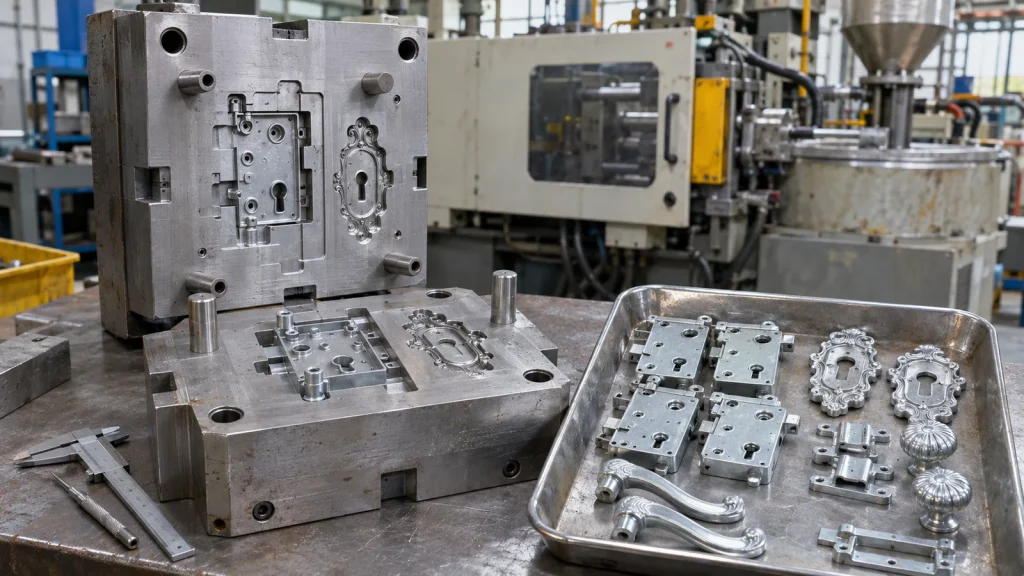
Hot chamber zinc alloy die casting is a specific production method, not just a generic casting category. In a hot chamber machine, the injection mechanism, often called the gooseneck, remains immersed in the molten zinc alloy. A plunger pushes metal through a nozzle and into a steel mold cavity under high pressure. Because zinc alloys melt at a relatively low temperature, usually around 380 to 420 C, the injection system can stay in the melt without excessive wear or thermal damage. This arrangement supports short cycle times, consistent shot weights and long mold life, often exceeding one million shots when the mold is properly maintained.
The process is most economical for small to medium components produced in large quantities. It excels when a part needs fine detail, thin walls, sharp lettering, textured surfaces, precise holes, internal threads or a surface that will later be polished and plated. Zinc alloys such as Zamak 3, Zamak 5 and ZA-8 are common. Zamak 3 offers excellent castability and dimensional stability. Zamak 5 adds copper for higher strength and hardness. ZA-8 provides higher strength and better creep resistance than the standard Zamak grades, while still being suitable for hot chamber processing in many applications.
The product profile can be summarized simply. If a part is small, metal, highly detailed, needed in large volumes and intended for a visible or precision application, hot chamber zinc die casting is a strong candidate. The process is less suitable for very large parts, thick heavy sections, continuous high-temperature service or applications where extreme structural loads dominate. It is also not the first choice for parts that must resist aggressive chemicals without a coating, or for products where zinc could create a regulatory or food-contact issue. Those constraints do not reduce the importance of zinc die casting. They simply define where it creates the most value.
Builders Hardware, Locks, Plumbing and Consumer Fittings
One of the largest product families for hot chamber zinc alloy die casting is builders hardware and visible fittings. Door and cabinet hardware includes handles, knobs, hinges, latches, escutcheons, rosettes, key cylinders, deadbolt components, padlock bodies and decorative trim. These parts often need a combination of shape, strength, wear resistance and a high-quality finish. Zinc die castings accept chrome, nickel, brass, bronze and other electroplated finishes very well, and they can also be powder coated, painted or brushed. That makes zinc a practical choice for hardware that must look good and survive repeated handling.
Locks and security products are another important category. Deadbolt cylinders, padlock bodies, key blanks, smart-lock escutcheons, latch mechanisms and internal lock components can be produced as zinc die castings. The alloy can hold fine details and tight tolerances, which helps with keyway features, threaded inserts and mating surfaces. However, security-critical load paths and attack-resistant components must be validated carefully. A zinc casting may be appropriate for a housing, trim plate or mechanism component, while the highest-stress shackle or bolt may use steel. The best design often combines materials rather than forcing one material to do every job.
Plumbing and sanitary fittings represent a third major group. Faucet handles, spouts, valve bodies, showerhead bodies, valve stems, decorative trim, bathroom accessories and components for sanitary hardware are commonly die cast in zinc alloys. The visible surfaces can be polished and plated to match brass or stainless steel. Internal waterways, however, require careful attention. Zinc die castings are not automatically suitable for every potable water path, and compliance depends on the alloy, coating, local regulations and contact duration. For this reason, many plumbing products use zinc for handles, trim and external housings while keeping the wetted path in brass, copper, stainless steel or approved plastic.
Consumer fittings and fasteners also fit the process. Brackets, clamps, buckles, hooks, zipper pulls, cable fittings, eyelets, connectors and small decorative fasteners can be cast in zinc when the volume is high and the geometry is detailed. The process can produce complex outlines with minimal machining, which is attractive for fashion hardware, luggage fittings and electrical accessory components. The limitation is that zinc is not a substitute for steel in highly loaded fasteners. A zinc casting can be strong for its size, but it has lower ductility and different fatigue behavior than steel, so safety-critical load-bearing fasteners require engineering review.
Automotive and Transport Components
Automotive and transport applications use hot chamber zinc die casting for interior trim, exterior trim and small mechanical assemblies. Interior parts include door handles, seat adjustment levers, mirror housings and brackets, gear-shift components, dashboard knobs, control buttons, bezels and decorative trim. Exterior parts include door handles, emblems, badges, grille trim, wiper components and small ornamental fittings. These parts benefit from zinc because it can reproduce fine lettering, sharp edges and textured surfaces, and it can be plated or painted to match vehicle styling.
Under-hood and mechanical applications include fuel system components, carburetor parts in older or specialty vehicles, pump housings, gear housings, sensor brackets, actuator housings and small powertrain components. Zinc provides good dimensional stability and can hold fine threads, which reduces secondary machining. It also has useful impact resistance and bearing wear characteristics compared with some alternative materials. That said, automotive specifications are demanding. Temperature exposure, vibration, road salt, fuels, oils and cleaning chemicals must all be evaluated. Zinc die castings are often chosen for brackets, housings and trim rather than for highly stressed engine internals.
Safety-related automotive parts deserve special caution. Seatbelt retractor gears, airbag-related housings, sensor mounts and steering system brackets may be produced from zinc alloys in certain designs, but they are subject to rigorous validation. The material choice must be supported by crash, fatigue, corrosion and temperature testing. A zinc casting should never be substituted for a validated safety-critical component without a full engineering review. The process is capable, but the application determines whether it is appropriate.
Transport applications outside passenger cars also use zinc die castings. Motorcycle and bicycle components, commercial vehicle hardware, rail interior fittings, marine accessories and aftermarket parts can use zinc for small housings, brackets, levers and decorative pieces. Marine use requires particular attention to corrosion and coating quality because salt exposure is aggressive. In many cases, zinc castings perform well when they are properly plated, painted or protected, but the total coating system matters as much as the alloy.
Electronics, Telecommunications and EMI Shielding
Consumer electronics and telecommunications are natural markets for hot chamber zinc die casting because many products need small, rigid, detailed metal housings in high volumes. Zinc alloys can form thin walls and complex internal features, and they provide electromagnetic interference and radio frequency interference shielding when the housing is properly designed and grounded. Common products include electrical connectors, coaxial cable connectors, fiber optic transceiver housings, RF shielding cans, USB and HDMI shells, antenna parts and ruggedized connector bodies.
Device chassis and internal frames also use zinc die castings. Smartphones, laptops, cameras, high-end audio equipment and wearable devices may use small zinc components for structural frames, hinge parts, brackets, buttons, dials and shielding covers. Zinc can deliver a premium metal feel, sharp cosmetic edges and good dimensional consistency. It also accepts fine finishes, including painting, physical vapor deposition, electroplating and laser marking. These features matter in consumer products where appearance and touch are part of the value proposition.
Audio and communication equipment provides clear examples. XLR microphone bodies, headphone hinges, cable connectors, speaker terminals and control knobs can be zinc die cast. The metal body provides shielding, weight and durability, while the casting process allows complex shapes that would be expensive to machine from solid stock. In high-end products, the surface finish and assembly precision may be as important as the mechanical properties.
There are limits in electronics as well. Zinc is a useful EMI shielding material, but it is not automatically the best choice for primary heat dissipation. Aluminum often has an advantage in thermal conductivity and weight for large heat sinks. Zinc can be used for shielding covers, frames and small heat-spreading parts, but thermal analysis should guide the decision. Plating and coating also affect conductivity, grounding and corrosion. A well-designed zinc housing must consider gasket interfaces, screw grounding points, coating masks and galvanic compatibility with mating parts.
Appliances, Controls and Home Equipment
Home appliances and controls form another broad product family. Washing machine control dials, refrigerator door hinges, blender bases, coffee machine portafilters, thermostat parts, switch housings, buttons, knobs and decorative panels can be produced in zinc alloys. These parts often need a combination of appearance, tactile feel, wear resistance and dimensional accuracy. Zinc die casting can deliver molded-in detail, such as indicator marks, ribs, snap features and threaded inserts, with less secondary machining than a fabricated metal assembly.
Appliance makers also value the finishing flexibility of zinc. Chrome, nickel, brushed metal, painted and powder-coated finishes are all possible. A zinc knob can look like polished metal, while a painted zinc housing can match a appliance color scheme. The alloy can also hold magnetic inserts, threaded bushings and overmolded features. This makes it useful for control assemblies that combine metal structure with plastic or elastomer components.
However, appliance applications must consider heat, moisture and cleaning agents. A zinc part near a heater, motor or steam path may need a protective coating or a different material. Similarly, parts exposed to strong detergents or acidic foods should be evaluated for corrosion and coating durability. Coffee machine portafilters are a good example of a part that benefits from zinc for weight and appearance, but the wetted path and food-contact requirements must be addressed through design, coating and material selection.
Industrial Machinery, Power Tools, Office Equipment and Medical Devices
Industrial machinery and power tools use zinc die castings for parts that need wear resistance, rigidity and complex geometry without the cost of machining steel. Power tool components include gear housings, gearboxes, trigger assemblies, drill chucks, blade guards, clamps and motor mounts. These parts may experience vibration, impact and abrasive dust, so the alloy grade, wall thickness, rib design and bearing surfaces must be selected carefully. ZA-8 may be preferred where higher strength and creep resistance are needed, while Zamak 3 may be adequate for housings and covers.
Fluid and pneumatic controls also use zinc castings. Valve bodies, regulator housings, pump impellers, cam locks, small pulleys and threaded inserts can be produced in zinc when the duty cycle and chemical exposure are compatible. Pump impellers and valve bodies require particular attention to pressure, cavitation, corrosion and fatigue. Zinc is not universally suitable for every fluid, but it can perform well in low-to-moderate duty applications with appropriate design and coating.
Office equipment is a long-established market. Printer gears, copier components, stapler mechanisms, lock parts, paper guides and small drive components can be die cast in zinc. The process can produce fine gear teeth and bearing bores with minimal machining, which is attractive for high-volume office machines. Dimensional stability helps maintain alignment and smooth operation over the product life.
Medical and dental instruments use zinc die casting for selected small housings, handles, precision fittings and device components. The process can create ergonomic shapes, fine textures and cleanable surfaces. However, medical applications demand caution. Zinc alloys are generally not used for implants or long-term internal contact. For external device housings and handles, the alloy, coating, cleaning protocol and biocompatibility requirements must be reviewed. Sterilization methods, disinfectants and repeated cleaning can affect plating and corrosion resistance, so validation is essential.
Toys, Gifts, Fashion Accessories and Sporting Goods
Toys and collectibles are a well-known zinc die casting market. Die-cast model cars, miniature figurines, toy gun components, building-set connectors, game pieces and mechanical toy parts can be produced in zinc. The process captures fine surface detail, sharp panel lines and realistic textures. It also provides a metal feel and weight that plastic cannot match. Zamak 3 is common for model castings because it casts well and takes paint or plating nicely. Safety compliance is critical for toys, including small-parts rules, paint and coating limits, sharp-edge requirements and heavy-metal restrictions.
Fashion accessories and giftware form another category. Belt buckles, brooches, pendants, watch cases, cufflinks, medal blanks, trophy bases, picture frames and ornamental fittings are often zinc die cast. The material can be polished, plated, antiqued, painted or enameled. The ability to cast detailed logos, textures and complex outlines makes zinc attractive for branded accessories. Nickel release and skin-contact regulations must be considered for jewelry and watch components, especially in markets with strict requirements.
Sporting goods and outdoor gear use zinc for selected components such as fishing reel bodies, firearm triggers and guards, bicycle derailleur parts, camping hardware and game call components. These applications vary widely in load and environment. A fishing reel body may need corrosion resistance and precise bearing seats. A firearm component may need impact resistance and strict dimensional control. A bicycle part may need fatigue strength and weather resistance. Zinc die casting can meet these needs in the right design, but each application requires a specific engineering review.
Why Zinc Alloys Are Chosen for These Products
Zinc alloys are chosen for several practical reasons. First, they have high fluidity. That allows molten metal to fill intricate cavities, thin walls and fine surface textures without cold shuts. In good designs, walls can be as thin as roughly 0.5 mm in local areas, although structural and manufacturing requirements usually call for thicker sections. Second, zinc die casting offers net-shape precision. Complex geometries, cored holes, internal threads, gear teeth and mating features can often be cast directly, reducing CNC machining and assembly cost.
Third, zinc accepts surface finishing exceptionally well. Electroplating, powder coating, painting, chromate conversion and laser marking are common. A smooth as-cast surface can be polished to a high cosmetic standard before chrome or nickel plating. Fourth, zinc provides useful strength and hardness at small sizes. It is generally stronger and stiffer than many plastics and can outperform aluminum and magnesium in dent resistance and bearing wear for certain small parts. Fifth, zinc has good dimensional stability, which helps maintain tolerances in precision assemblies.
The limitations are equally important. Zinc alloys have lower melting points than aluminum, but their service temperature is limited. Continuous exposure to elevated temperatures can cause creep, dimensional change or loss of strength, depending on alloy and load. Zinc is also susceptible to certain corrosion mechanisms if unprotected, especially in humid, salty or chemically aggressive environments. Plating and coating are often necessary. Zinc is not a universal replacement for steel in high-stress structural parts, and it is not the best choice for very large castings or parts with extremely thick sections. Designers should select zinc when its strengths match the product and avoid forcing it into applications where another material is clearly better.
Alloy Selection and Mold Design Considerations
Alloy selection begins with the application. Zamak 3 is the general-purpose grade. It offers excellent castability, good surface finish and stable dimensions. It is widely used for hardware, decorative parts, electronics housings and general components. Zamak 5 contains more copper and provides higher strength and hardness, making it suitable for parts that need better wear resistance or load capacity. ZA-8 offers higher strength and creep resistance than Zamak 3 and is used for more demanding mechanical parts. Other zinc alloys exist for special purposes, but the designer should confirm hot chamber compatibility, casting behavior and regulatory status.
Mold design is central to success. A hot chamber zinc die casting mold must manage metal flow, solidification, cooling, ejection and venting. The runner and gate system should fill the cavity smoothly and avoid turbulence that can trap air or create cold shuts. Overflows help collect cold metal and oxides. Vents allow air to escape. Cooling channels should balance the thermal profile so that the part solidifies uniformly and avoids shrinkage porosity. Ejector pins must be placed on features that can tolerate marks. Inserts and cores may be used for undercuts, holes and threads, but they add cost and maintenance.
Part design also matters. Uniform wall thickness reduces shrinkage variation. Generous radii reduce stress concentration and improve metal flow. Draft angles help ejection. Ribs and bosses should be designed to avoid thick masses that can create porosity. Threads can be cast, but the designer must specify tolerance, draft and permissible incomplete threads. Cosmetic surfaces need careful gate placement because gate marks and flow lines may affect plating appearance. As-cast flatness and dimensional tolerance should be realistic for the process rather than borrowed from machining standards.
The mold itself is usually made from hot-work die steel and may include advanced cooling, surface treatment and wear protection. Hot chamber dies experience thermal fatigue, erosion and soldering. Proper maintenance, polishing, vent cleaning and cooling control extend mold life. A well-maintained zinc die casting mold can produce very high volumes, but the economics depend on part geometry, alloy, machine size, quality level and finishing requirements.
Production Economics, Finishing and Quality Control
Hot chamber zinc die casting is economically strongest at high volume. Tooling costs are significant, so the process usually makes sense when annual quantities are large enough to amortize the mold. Cycle times are short compared with many other casting processes, and the ability to cast near-net shape reduces machining, assembly and scrap. However, secondary operations such as trimming, deburring, tumbling, polishing, plating, painting and assembly can add substantial cost. Designers should consider the total cost, not just the casting price.
Finishing is often a major part of the value proposition. Zinc castings can be barrel finished, vibratory finished, polished, brushed, plated, powder coated, painted, printed or laser marked. Plating requires good surface preparation because pits, porosity or inclusions can cause blisters and adhesion failures. Die casters and finishers should agree on surface acceptance criteria before production. For cosmetic parts, sample approval under the final finish is essential.
Quality control should match the application. Dimensional inspection may use calipers, micrometers, gauges, optical comparators or coordinate measuring machines. Threads are checked with gauges. Porosity can be evaluated by visual inspection, sectioning, X-ray or pressure testing, depending on the part. Plating adhesion, coating thickness, salt spray resistance and color match may be required for finished products. Mechanical properties can be verified through lot testing and process control. Melt chemistry, metal temperature, die temperature, injection pressure and cycle time should be monitored and documented.
Common defects include porosity, cold shuts, flow lines, flash, shrinkage, cracks, soldering, blisters after plating and dimensional drift. Most defects are prevented through good part design, stable process parameters and disciplined mold maintenance. Porosity is often linked to air entrapment, shrinkage or gas from lubricants. Cold shuts occur when metal fronts meet after cooling too much. Flash results from insufficient clamping or worn parting lines. Plating blisters can come from subsurface porosity or poor cleaning. A capable die caster will use process control and inspection to manage these risks rather than relying on final inspection alone.
Regulatory, Safety and Sustainability Factors
Zinc alloys are widely recyclable and have a relatively low melting point, which supports energy-efficient melting and long product life. Die casting molds can produce very high volumes, reducing material waste compared with some subtractive processes. However, regulatory compliance depends on the alloy, coating and application. RoHS, REACH, ELV and similar frameworks may restrict certain substances. Toy safety rules, food-contact regulations, nickel release requirements and California Proposition 65 are relevant for specific products. Designers should obtain material declarations and test reports from the die caster and finisher.
Food contact and potable water applications require particular care. Zinc is not automatically acceptable for direct contact with food or drinking water. The wetted surface, coating integrity, alloy composition and local regulations must all be considered. In many products, zinc is used for external hardware while the wetted path uses another material. Medical and dental applications also require cleaning, sterilization and biocompatibility review. Skin-contact products such as jewelry and watch cases may need nickel-release testing. These requirements should be identified at the design stage, not after tooling is built.
A Practical Selection Checklist
Use the following checklist when deciding whether a product fits hot chamber zinc alloy die casting:
| Question | Favorable Answer |
|---|---|
| Is the part small to medium in size? | Yes, especially handheld or component-scale parts |
| Is the production volume high? | Yes, enough to amortize tooling and finishing setup |
| Does the part need fine detail or thin walls? | Yes, within realistic casting limits |
| Does it need tight tolerances or net-shape features? | Yes, with machining only where necessary |
| Will it be plated, painted or used as a visible part? | Yes, zinc takes finishes well |
| Does it need EMI or RF shielding? | Yes, zinc can provide shielding when grounded |
| Is the service temperature moderate? | Yes, avoid continuous high-temperature exposure |
| Is the load moderate and well understood? | Yes, validate safety-critical or fatigue-loaded parts |
| Is corrosion protection required? | Yes, specify plating, coating or paint |
| Are food, water, skin or toy regulations involved? | Review alloy, coating and test requirements |
If most answers are favorable, zinc die casting is likely to be competitive. If the part is very large, highly stressed, exposed to high temperature or required to have a special corrosion or food-contact approval, another material or process may be better.
Frequently Asked Questions
Can hot chamber zinc die casting produce large parts?
Hot chamber zinc die casting is best suited to small and medium parts. It can produce components that are substantial in size, but the economics and machine capability favor parts that are easy to handle, fill and eject. Very large parts are usually better suited to cold chamber aluminum or other processes. The practical size limit depends on the machine, mold, wall thickness and required quality, so the die caster should be consulted early.
Which zinc alloys are most common for these products?
Zamak 3 is the most common general-purpose alloy because it casts easily, holds dimensions well and takes finishes nicely. Zamak 5 is used when higher strength and hardness are needed. ZA-8 is chosen for higher strength and creep resistance in more demanding mechanical parts. The final choice should consider casting behavior, mechanical requirements, finishing, regulatory status and cost.
Is zinc die casting strong enough for load-bearing parts?
Yes, for many small and moderate-load applications. Zinc alloys can provide good strength and hardness at small sizes, and they can hold threads and bearing surfaces. However, zinc is not a universal substitute for steel. High-stress, fatigue-critical, impact-critical or safety-critical parts require engineering validation, and the design should avoid thin load paths, sharp corners and unsupported sections.
Why choose zinc instead of aluminum or plastic?
Zinc offers a combination of fine detail, thin walls, dimensional stability, metal feel, EMI shielding and excellent finishing response. Compared with plastic, it provides greater stiffness, strength and durability. Compared with aluminum, it can cast thinner and more detailed parts in hot chamber machines and often requires less machining. Aluminum has advantages in lightweighting, large castings and thermal conductivity, so the choice depends on the product.
Can zinc die cast parts be plated?
Yes. Zinc die castings are commonly electroplated with chrome, nickel, brass, bronze and other finishes. Good plating depends on sound casting quality, smooth surfaces, effective cleaning and controlled process chemistry. Porosity, pits and inclusions can cause blisters or adhesion failures, so the die caster and plater should agree on inspection standards and sample approval.
What are the most important design rules for zinc die casting molds?
Use uniform walls, generous radii, adequate draft, balanced gating, proper venting and effective cooling. Avoid isolated thick sections that can create shrinkage porosity. Place ejector pins on non-cosmetic surfaces. Design threads and cored holes with the die caster. Plan finishing requirements early because gate location and surface flow can affect the final appearance. Above all, involve the die caster in design review before the mold is cut.
Conclusion
Hot chamber zinc alloy die casting molds are typically used to produce small to medium, high-volume metal parts that need fine detail, thin walls, tight tolerances and a high-quality surface finish. The most common product families include builders hardware, locks, plumbing trim, automotive interior and exterior parts, small mechanical components, electrical connectors and shielding, appliance controls, power tools, office equipment, toys, model cars, fashion accessories, trophy bases and selected medical or dental device housings. Zinc alloys such as Zamak 3, Zamak 5 and ZA-8 are selected because they cast easily, hold dimensions, accept plating and provide useful strength at small sizes.
The process is not unlimited. It is less suitable for very large parts, continuous high-temperature service, aggressive chemical exposure without protection and highly stressed structural applications that require steel-like ductility. Successful projects combine the right alloy, a robust mold design, realistic tolerances, appropriate finishing and a quality plan that matches the product risk. When those conditions are met, hot chamber zinc die casting remains one of the most efficient ways to make detailed, durable and attractive metal products in large quantities.